Matt Blitz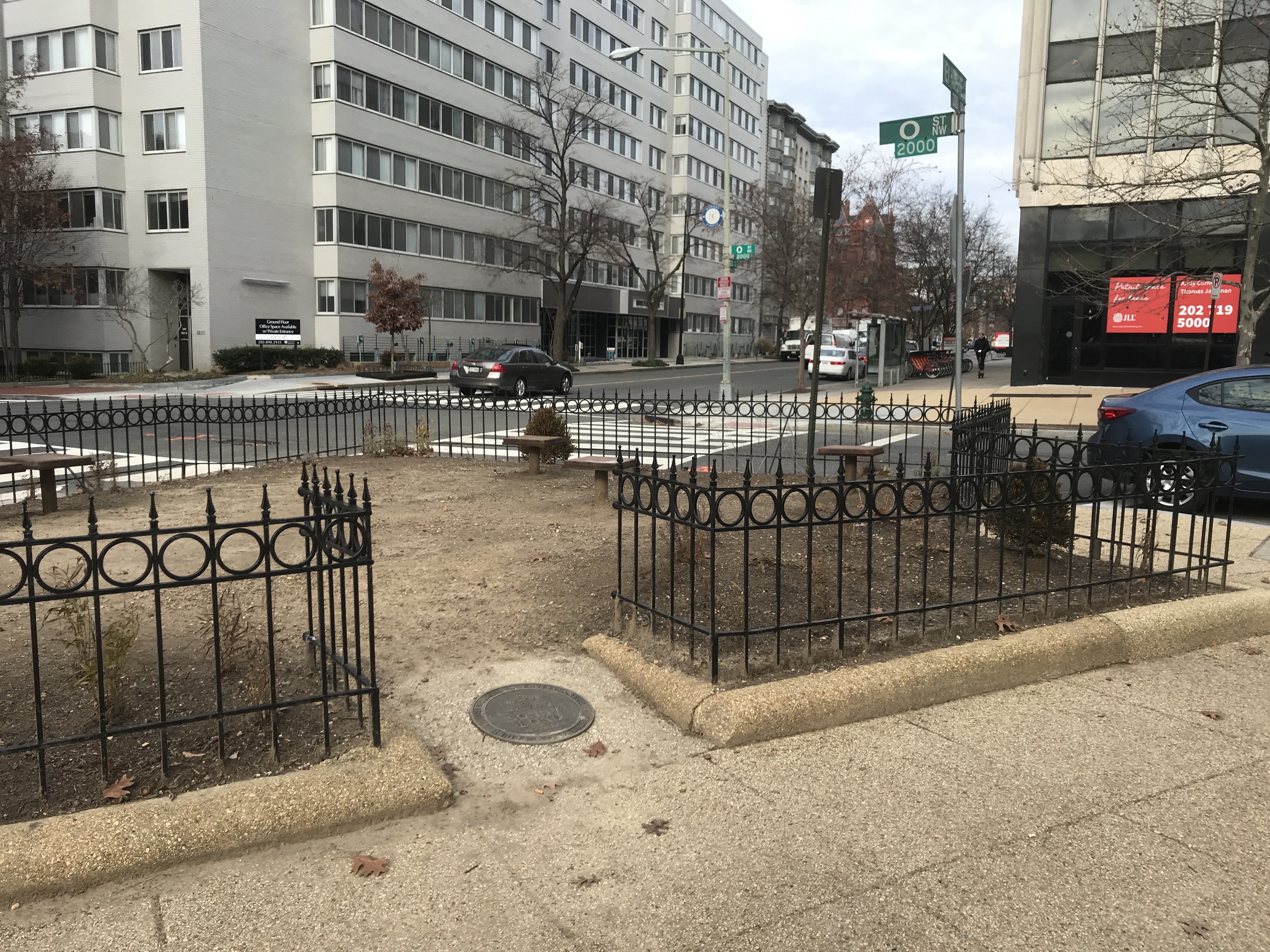

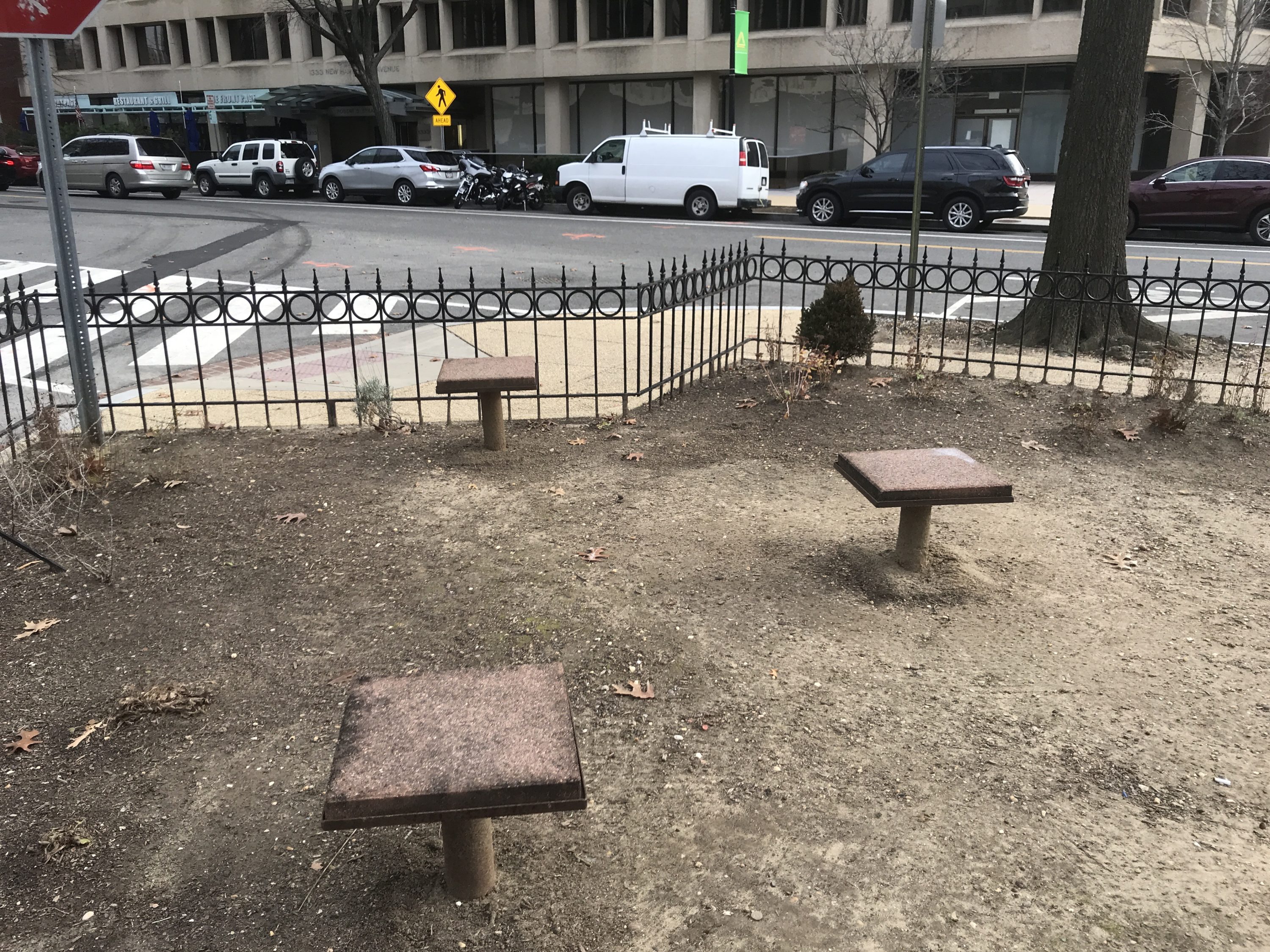

A wrought iron fence sections off Sonny Bono Park from pedestrian and vehicle traffic at the triple intersection of New Hampshire Avenue, 20th Street, and O Street in Northwest. On a day in mid-December, the small park is empty save for fallen leaves, a few tufts of vegetation, and a squirrel that scampers through. Several single-seat concrete benches dot the space. Despite being steps from heavily trafficked Dupont Circle, this tiny pocket park dedicated to the late legendary entertainer and California congressman feels lonely. Perhaps that’s what its creator intended.
“It was never built to draw attention to Sonny,” says long-time D.C. resident Geary Simon and Bono’s friend. “The park is for me to remember him.”
On January 5th, 1998, the two-term Republican Congressmen from California’s 44th district was killed in a skiing accident on the slopes of Lake Tahoe. However, it wasn’t Sonny Bono’s political career that made him a household name. During the 1960s and 70s, Americans knew him as one half of the singing, dancing, variety-show hosting husband-wife team Sonny & Cher. After their divorce in 1975, Cher went on to become a one-name superstar; recording more hits, going platinum, winning an Academy Award, and being selected as a 2018 Kennedy Center Honoree. Meanwhile, Bono moved into politics. He was the mayor of Palm Springs, California from 1988 to 1992. He lost the Republican nomination for a Senate seat in 1992 (which Democrat Barbara Boxer eventually won), before being elected to Congress in 1994 and re-elected in 1996. It was during his second term when he died suddenly. Despite being divorced for more than two decades, it was Cher who delivered his eulogy.
Simon met Bono at a tae kwon do academy (Simon’s girlfriend owned it and Bono’s kids were attending) during his time as a congressman in the mid-1990s. They became fast friends and bonded over family, Italian food, and boats.
“He was the kind of person that could put anybody at ease five minutes into a conversation,” says Simon.
A 1998 Washington City Paper article also notes that they connected over their own individual failures and attempted comebacks. Bono’s entertainment career had taken a dive after breaking up with Cher, before re-emerging in the political sphere. Simon, according to the Washington Post, had spent time in prison due to larceny, mail, and insurance fraud. He was also involved in the mess that was Dupont Down Under.
Simon was at Bono’s funeral and he remembers coming back to D.C. to this “void” without his friend. Feeling lost and wanting a place to grieve, he reached out to D.C.’s Department of Parks and Recreation about adopting a small park on New Hampshire Avenue a few blocks from his house, a plot known in DPR records as simply Reservation 143.
“It was all overgrown and rodent infested,” says Simon. “[DPR was] pleased to have somebody take control and care of the park.”
Simon says he signed a 99-year lease in 1998 with DPR to take care of the park and be the park partner. DPR was unable to confirm or deny if such an agreement exists, and Simon doesn’t have a copy.
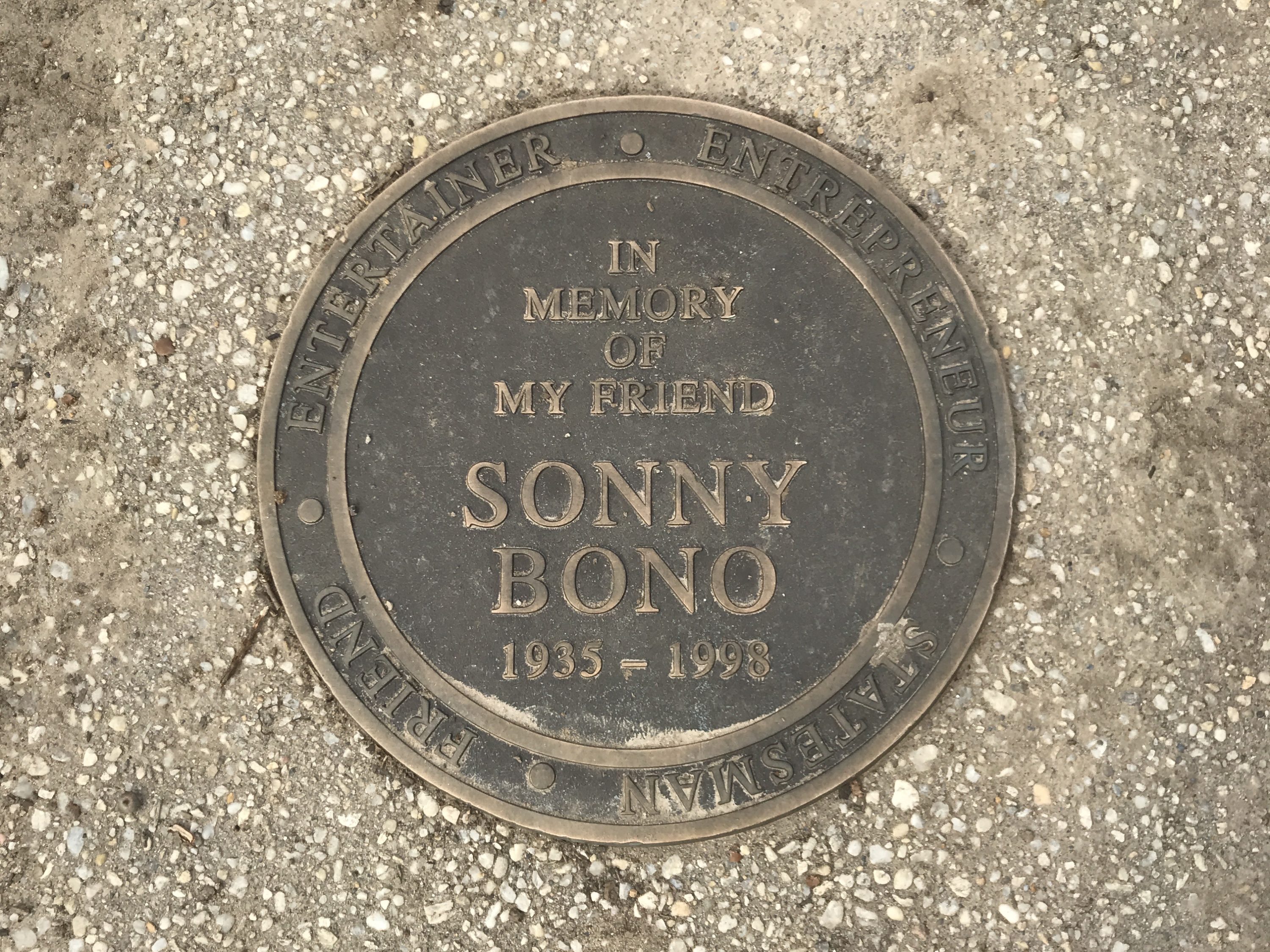
Whatever happened, Simon got to work designing an urban shrine to his friend. He says he laid down Kentucky bluegrass, planted begonias and plumes, and put in a Japanese maple from Bono’s 44th district. He installed underground sprinklers and single seat concrete benches (“[DPR] told me not to build anything big enough for someone to sleep on,” says Simon). Then, he buried a time capsule-like container holding a few Sonny-inspired items: a menu and mug from Bono’s restaurant, Congressional cufflinks that the congressman gave Simon as a Christmas present, and a copy of sheet music of “The Beat Goes On.” On top of this container, he installed a bronze, manhole-shaped plaque that still reads, “In Memory of My Friend Sonny Bono 1935-1998.” Simon estimates that he poured tens of thousands of dollars of his own money into the project.
“I took something that was an eyesore and I made it a place for people to go. People would meditate there, do yoga, eat their lunches in the spring and summertime,” Simon tells DCist. “But it’s just all beat up now.”
Flash forward two decades later, and the park looks much different. The manhole cover is still there, but the Kentucky bluegrass and the Japanese maple are not. While it’s winter, the perennials seemingly are gone, too. The single slab benches look uncomfortable and uninviting.
The Heurich House Museum sits across the street. Kim Bender, executive director of the museum since 2012, could see from the window how unwelcoming the park was. “It was often full of trash,” she says.
Upon learning about the park’s history, Bender says she reached out to Simon herself to see what the museum could do to help. Bender says she—along with others in the neighborhood who were concerned—were consistently unable to reach him. Then, they turned to the Department of Parks and Recreation who, according to Bender, told her that Simon no longer had any authority nor agreement to manage the park. In August 2014, the Heurich House Museum signed an agreement with the Department of Parks and Recreation to become the park’s “Adopt-a-Park Partner,” a one-year agreement the museum has renewed ever since.
Bender says that by the time the museum took over, the underground sprinklers Simon had installed no longer had water because the city had cut them off at some point. In the summer of 2015, the museum put together a plan to beautify the park by installing a perennial garden. Later that year, they hosted a Beautification Day. “We had volunteers clear out space, bring it down to the soil, and start all the plantings from scratch again,” Bender says.
Since then, she says that the museum donates their gardener’s time to go across the street and spends about five to ten hours a month tending to the park, mostly throwing away trash and replanting flowers. They have to submit a quarterly report to DPR about any donated time or spent money on the park. They also get help sweeping trash and planting flowers from Dupont Circle Main Streets. She says the museum is very open to getting more help from the community, be it in time or financial resources, to maintain Sonny Bono Park. She acknowledges that the museum needs additional financial and volunteer resources, but plans on being the park partner for the foreseeable future.
“We have the will, but we don’t have the funds to dedicate to this particular thing,” says Bender. “At least somebody is paying attention to it.”
Meanwhile, Simon is convinced that the city broke the agreement with him. He says he reached out to DPR himself in 2014 upon hearing about the Heurich House’s agreement. Simon says DPR claimed they didn’t know anything about his 1998 agreement.
“Then how do they think it got the plaque, the iron-wrought fences, and the other stuff?” Simon asks.
He cites a 2013 construction project in the area that tore the park up as the reason for its demise. “Everything was destroyed,” Simon says. He doesn’t blame the Heurich House Museum, though he says they “haven’t done much with it.” He hopes that someday the park gets back to what it was in 1998—but only under his direction.
“I’m not really interested in donating money to [Heurich House Museum] to work on Sonny’s park,” Simon says. “If they came to me and said, ‘Hey, we took this on and we don’t really have the finances or the resources. Would you mind restoring it?’ I would absolutely spend my money to do that.”
Bender welcomes help from neighbors, including Simon, but again reiterates that the park was in a decrepit state when it was adopted by the museum.
“The park was in terrible condition when we adopted in, filled with piles of garbage and zero plantings. The watering infrastructure was broken and the fence was falling apart,” Bender says. “We are happy to continue as the stewards of the park, and look forward to the support of our neighbors to continue to improve it.”
The Department of Parks and Recreation did not make anyone available on the record for this story, but the Interim Director of the DC Department of Parks and Recreation Delano Hunter said in a statement: “Each park partnership is unique. While DPR and DGS are responsible for the care and up-keep of all parks in our inventory, DPR’s Adopt-a-Park partners are essential in assisting with the general clean-up, beautification and maintenance of adopted parks. Adopt-a-Park partners are individuals, corporate entities, and community-based organizations, who are committed to improving our city’s green spaces for the benefit of fellow residents, their communities, and the city.”
Meanwhile, Simon says he still goes to the Sonny Bono Park time to time to polish the plaque and remember his friend in the small space that was dedicated to him in the nation’s capital. Would Sonny have liked having a park named after him in D.C.? “He’s from Hollywood. He had a huge ego,” laughs Simon, “Of course he would’ve.”
How would have felt to see his park nearly empty and lifeless? “It’s unfortunate what has happened to the park,” Simon says. “It really is.”