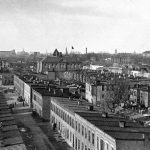
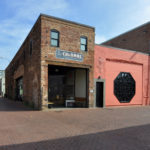
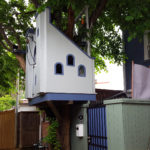
The stereotypes associated with alleys are plentiful, but for years now, D.C.’s alleys have served as areas for urban growth and creativity. In this three-part series, DCist will look at the evolution of these places, point out some particularly noteworthy alleys to explore, and delve into the inevitable drama and conflict that ensue over shared community space. Today, we’ll begin with the history of the District’s alley system.
In most of D.C., the alleyways tucked behind rows of houses serve only as trash collection points or access to parking spots. But a few are home to hidden surprises—enclaves of artists’ workshops or community parks. So how exactly did these alleys come to be?
Laid out by Pierre L’Enfant in 1791, Washington’s city grid divides land into rectangular blocks, interrupted by diagonal avenues that intersect at small parks. Long and short blocks were overlaid on the grid, resulting in an almost Tartan pattern with oversized lots ripe for subdivision.
These alleys, unlike so much of D.C., were not meticulously planned. During the 1850s, and again following the Civil War, D.C. struggled to house its surging population and alley lots presented a free-for-all for developers. Historian James Borchert described in his 1980 book, Alley Life in Washington: Family, Community, Religion, and Folklife in the City, 1850-1970, how developers built settlements for poor residents in alleys at the same time that they constructed grand townhouses for wealthier residents along the city’s thoroughfares.
“Their implicit assumption seemed to be that the middle classes would live on the streets, while working-class people would reside in the alleys,” Borchert wrote.
For a time, this system did meet the housing demand, though unequally. Alley dwellings ranged from ramshackle to robust. And while these areas of high density produced tightly knit communities of working-class people from similar backgrounds, alleys could also be home to disease, drunken debauchery, and violent crime. Most alleyways, however, were centers of domestic life and shared community, where children could play without fear of traffic, and neighbors in close proximity to each other frequently interacted.
But the explosion of these alley communities was a gadfly for the city’s power brokers. In 1892, Congress enacted legislation that prohibited building dwellings in alleyways less than 30 feet wide that were not connected to city utilities, and that law is still reflected in current District zoning and planning.
In the years following the law’s passage, however, alley populations were still strong. By 1897, alley developments housed 17,244 people, according to a police department census; 16,046 of these residents were black and 1,198 were white. (Borchert concedes that the actual number of alley residents was likely higher, considering that census-takers reportedly feared entering some alleys.)
The city did make some efforts to improve safety and housing quality in its alleys, although these efforts often displaced residents. During the 1870s, for example, the Board of Health demolished some 300 shanties. Between 1906 and 1911, it repaired more than 300 alley dwellings.
These early housing reform efforts did succeed in reducing alley dwellings.
In 1912, a group called the Monday Evening Club counted 240 blocks with 3,201 alley dwellings within the Federal City, according to Borchert. By 1927, the number of alley dwellings had decreased to 1,346 occupied houses in Northwest and Southwest; overall, there was a 40 percent reduction in alley dwellings as automobiles enabled those with means to move to less congested near-suburbs, relieving some housing pressure of the central city.
By 1934, alley dwellings were dwindling and deteriorating. The city seldom sent trash collection to the alleyways, so rodents flocked to the piled-up refuse, and related health issues spread. Alley dwelling owners allowed their properties to fall into disrepair, or, when they did make improvements, swiftly rolled associated costs into higher rents for their tenants. The District deemed these communities slums and formed an Alley Dwelling Authority to clear them out.
These efforts to end alley dwelling had a strong ally in First Lady Ellen Wilson, wife of the 28th president, who was inspired by progressive urban reform movements in cities like New York and Chicago. She led a crusade against D.C.’s alley dwellings until her death in 1914. Ultimately, the second World War curbed the effects of the Alley Dwelling Authority, and its outright ban on alley dwelling failed to take hold.
Alley use also shifted during this timeframe, Borchert notes. Instead of being dedicated almost exclusively to housing, many alley dwellings and stables in Northwest D.C. were converted into automobile service stations and garages. In Blagden Alley, for example, 42 of its 57 dwellings were converted to businesses or garages.
In Southwest, however, alleys continued to house communities.
Social worker Godfrey Frankel photographed these alleys in 1943, documenting cramped quarters in a neighborhood filled with some 10,000 residents. “About 58 percent of the houses there had outdoor toilets, 29 percent lacked electricity, 82 percent had no wash basins or laundry tubs, 94 percent lacked central heating,” according to The Washington Post. And although housing quality varied, there was a strong sense of community pride, Frankel reported to author Laura Goldstein.
But where Frankel saw a community, Congress saw only blight. And as was the case in many neighborhoods that were destroyed during the urban renewal movement of the mid-20th century, the Southwest neighborhood was 97.5 percent black. In 1945, Congress deemed most of Southwest too dilapidated to stand, and passed the District of Columbia Redevelopment Act. Because Congress governed the District at that time, the law allowed for the seizure and destruction of vast swaths of properties by eminent domain. Under a new policy promoting the welfare of inhabitants, Congress issued the following decree: “[I]t is in the judgment of Congress necessary … to eliminate the substandard housing conditions and the communities in the inhabited alleys and blighted areas.”
And eliminate they did. Though touted as urban renewal, the undercurrent of the Redevelopment Act of 1945, intentional or otherwise, was displacement of a major portion of the city’s majority black population, as Goldstein illustrates:
Between 1954, when the first alley enclave was demolished, and 1960, when the first high-rises began renting, an entirely different Southwest took shape. All told, 4,500 buildings were torn down, and 23,500 people—77 percent of them black, 64 percent with incomes below the poverty level—were relocated.
Southwest D.C. would then become home to a new set of modernist, mid-rise tower blocks, yet the residents who had been relocated—the majority of whom made new homes in Anacostia—were priced out of returning to the newly rebuilt area.
Amazingly, after more than a century of efforts aimed at clearing them, alleys have survived in the District. But many of today’s incarnations are a far cry from the rat-infested dwellings where tuberculosis spread like wildfire.
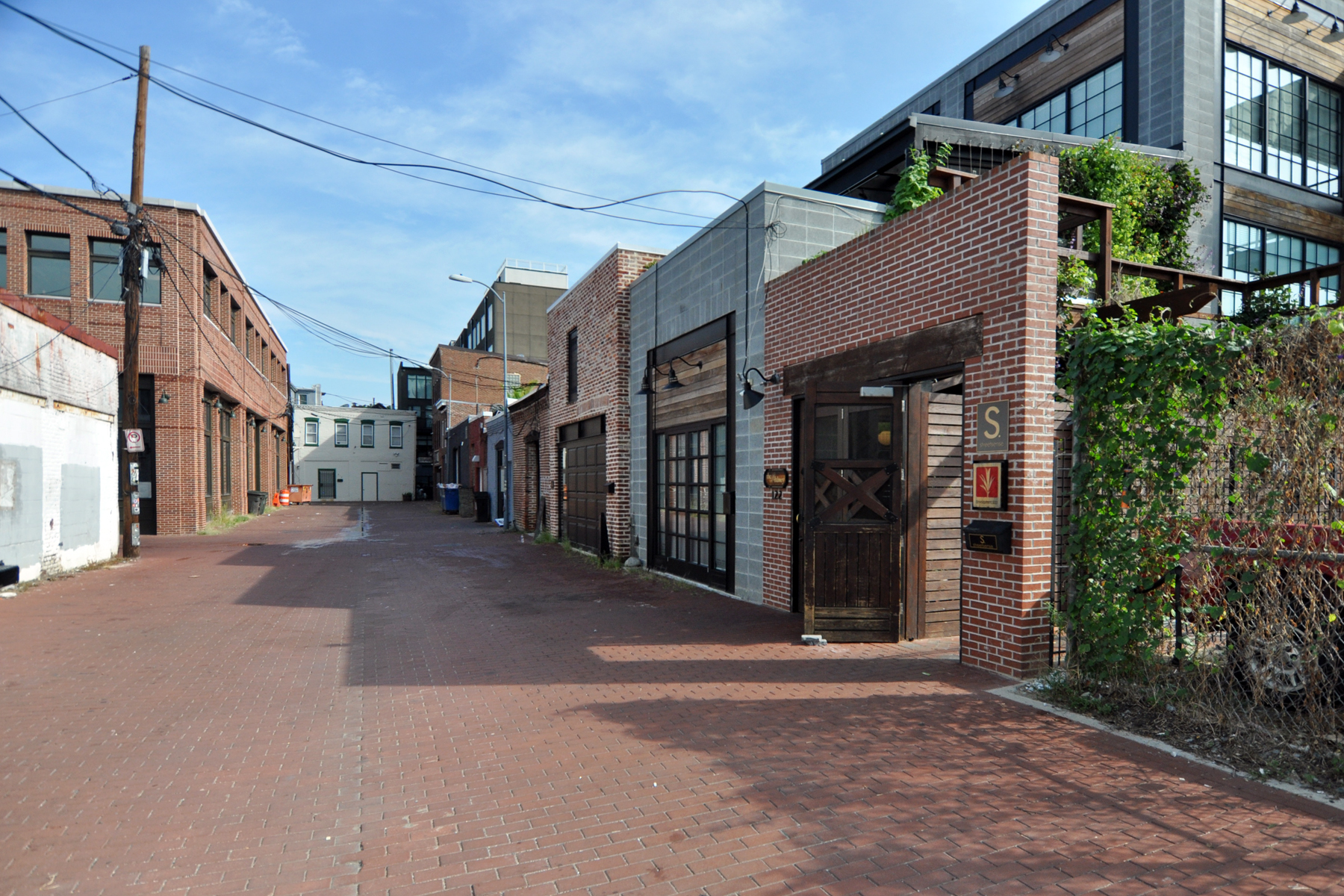
Often, these former dwellings-turned-stables-turned-garages have been reclaimed as art and architecture studios.
Alley structures could formerly only be used as garages or studios, but a 2016 update to zoning legislation affords new possibilities for accessory dwelling units to be added to properties. Now, ADUs can have their own kitchens, baths, and entrances separate from the main house on a property, subject to limitations on square footage based on size relative to the main house. ADUs are currently limited to a maximum of three occupants, but still provide potential for increased density. In addition to providing rental opportunities to offset costs of living for homeowners, these supplementary buildings can allow multigenerational living situations, such as a granny flat, where an older family member can live in her or his own space, yet still be close enough to offer or receive family assistance.
D.C., it seems, could see a resurgence of alley dwellings. As Washington grows once again, developers are seeking new opportunities to build. With an upper height limit in place, many are looking to the centers of oversized blocks as opportunities to add density. The District’s loosening of alley structure use restrictions will allow dwellings by right, where previously only studios or garages were permissible. Additionally, the updated alley guidelines will allow dwellings in 24-foot-wide alleys and some 15-foot-wide alleys, where earlier codes restricted alley dwellings to 30-foot-wide alleys only.
Meanwhile, businesses have taken advantage of industrial-scaled alleyway leftover spaces that translate well into dining rooms and cafés. Blagden Alley, for example, now boasts a coffee shop and a Michelin-starred restaurant. The thriving art community is also on view there, with murals that are themselves a tourist draw, according to Elizabeth Emerson, an architect with a studio on nearby Naylor Court who is currently studying Washington’s alleyways.
“This is a part of town where people even 15 years ago wouldn’t walk through,” Emerson says. “The fact that it’s now an Instagrammable space—out of the regulation or the structure of the L’Enfant Plan—that’s super appealing to people.”
More in D.C.’s alleys:
Map: 10 Notable D.C. Alleyways Worth Exploring
What Do Fights Over Treehouse Castles, Gardens, And Waffles Have In Common? Alleys