We’ve reached our finale in DCist’s three-part series on D.C. alleyways. First, we laid out the history of D.C. alleyways, and then we noted some that were particularly worthy of wandering through. Today is all about drama—what happens when neighbors disagree over how exactly to use these alleys?
You’re probably familiar with the phrase “Not in My Back Yard,” and the NIMBY-ist mindset that people take whenever change threatens whatever way of life with which they’ve grown comfortable. But what happens when it’s not the backyard in question, but the back alley? Alleyways are often the physical border between public and private land and even though they’re hidden from view, things can get pretty contentious when someone exerts a claim over a space that neighbors consider communal. The alley disputes covered below include fights over a treehouse castle, access to parking, a community garden, and a look at the Back Alley Waffles fiasco.
Capitol Hill Tree House Affair
A treehouse designed to look like a medieval castle seems like just the right venue for princess tea ceremonies, dragon(fly)-spotting, and epic foam sword battles. But one kid-centric playhouse became the point of contention between feuding adult neighbors in an alleyway in Capitol Hill.
Archibald Walk is a pedestrian-only alleyway that forms a U-turn off of the central alleyway between E and G Streets SE and 7th and 6th Streets SE. Entering beside the parking lot behind Christ Church Capitol Hill, visitors walk past a pair of attached houses at the center of the U, which are two of six alley dwellings that remain at the center of the block. Archibald Walk was named for longtime Capitol Hill resident Archibald Donohoe, who, a plaque proclaims, “walked these alleys with a twinkle in his eye.”
The owners of another of the surviving houses, at the eastern end of the U, aimed to put twinkles in the eyes of their two daughters with the addition of a castle-inspired aerie at the edge of their property. And thus began the Capitol Hill Tree House Affair.
When the two owners, Ellen Psychas and Bonding “Bing” Yee, constructed their tree-borne addition in 2015, they filed what they thought were the appropriate permits and began construction. The alley—which, at 10 feet wide, is impassable by automobiles—had long been populated with potted plants, benches, and other miscellaneous décor that various neighbors had installed to enliven the feel of this communal space. The tree in which Psychas and Yee built their children’s playhouse sat in a mulched tree box at the edge of the alley, and, crucially, at the edge of their property line. But some neighbors felt that the couple’s addition to Archibald Walk was more of an eyesore than an improvement, and that it encroached on public space.
The District Department of Transportation got involved, noting that the tree house hung 20 inches beyond its owners’ property line into the public right-of-way. In the process, the agency also cited the various plants and benches, and ordered those removed, further incurring rancor among the neighbors who had protested the tree house in the first place.
That’s where the Capitol Tree House Affair gets even murkier. In January of this year, UrbanTurf broke a story on a pending lawsuit alleging hacked accounts in the castle saga. In 2016, DDOT had fined Psychas and Yee, and ordered them to remove the tree house. But the couple appealed the decision, and issued a countersuit in January of 2018.
The suit alleges DDOT engaged in “permitting malfeasance and incompetence,” including hacking into the couple’s permitting account to request a renewal of a permit, which DDOT later rejected. It details exchanges between the couple and DDOT officials; notices DDOT sent to the couple, which they never received because they were sent to a non-existent “Mr. Lee”; and page after page of DDOT actions that the suit attests were “so outrageous and gravely unfair as to shock the conscience.”
A ruling on the couple’s suit has not yet been issued, but in the meantime, the tree house is open to children on several federal holidays, according to its dedicated website.
The Tunlaw Tussle
A dozen years ago, in October 2006, a minor skirmish broke out between Glover Park neighbors about an alleyway between their properties. The alleyway in question runs between Tunlaw Road NW and Hall Place NW, north of W Place NW, with the alley itself a narrow and leafy path passable to pedestrians only, at least according to a contemporaneous blog post via Ward3DC, which described it as “impassable sans machete.” The blog details the story of a Hall Place resident, Tim Robinson. He applied for a permit to park behind his house, which he obtained with little effort. At some point prior, Jersey barriers—those concrete signifiers of limits to vehicular access—had been installed across the entrances to the alley, and Robinson further applied to have those removed.
But emotions started boiling over when Tunlaw Road resident Ron Bitondo persuaded officials at DDOT to replace the barriers. Bitondo then applied with the city to have the alleyway permanently closed, citing concerns about the alley’s retaining walls. Topographically speaking, Hall Place is uphill of both the alley and Tunlaw Road, and the alley sat, according to the Ward3DC post, eight feet above Bitondo’s property.
Washington City Paper discovered that there was also speculation about impropriety between Bitondo and then-D.C. Council Chairman Linda Cropp over the alley closure. Bitondo had co-chaired Cropp’s mayoral campaign, and, when Robinson had questioned people at DDOT about the barrier return, he’d been told it was a political issue with his neighbor, Bitondo.
The alleyway issue was resolved quickly and without much more vitriol, although neighbors on both sides of the alley had taken firm stances on whether it should be re-opened or remain closed to traffic. At an ANC meeting a couple of days later, Ward3DC reported that commission chair Tamela Gordon read a letter from DDOT that said, effectively, that the alley would remain public but closed to through traffic:
“Because even the applicant does not want the alley to be privatized (he wants it to remain public property, but forever closed to car traffic) he should withdraw his application, and in its place DDOT would file documents indicating that the alley should stay city property but remain ‘unimproved and closed to vehicular traffic.’”
It seems that was enough to settle the dispute. These days, the alley entrance on W Place has a few planters blocking vehicular entry, but looking into the alley from Hall Place, at least one parked car is visible amongst the greenery.
Bloomingdale’s Hidden Park
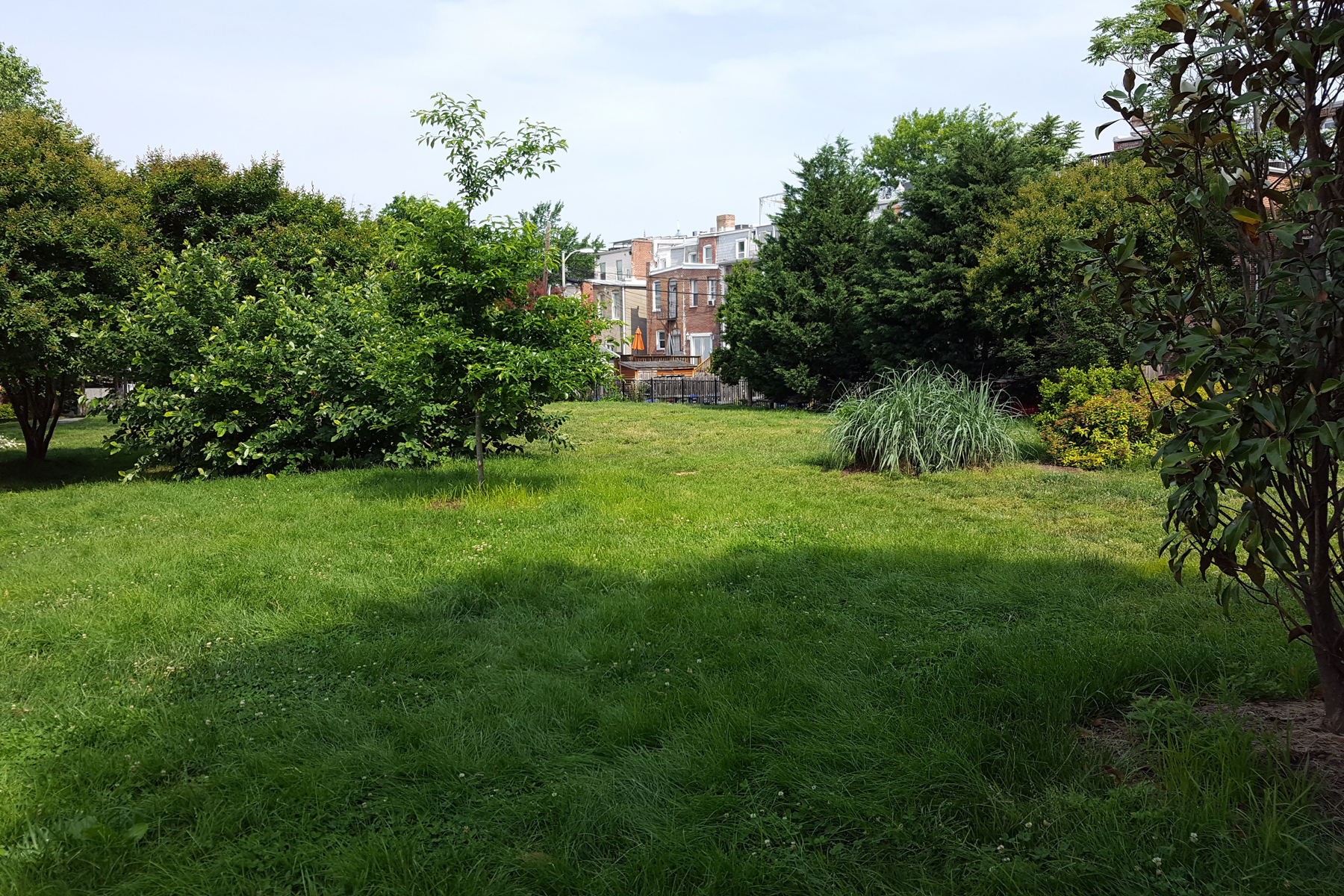
Crispus Attucks Park is an urban oasis, flanked on all sides by rowhouses in Washington, D.C.’s Bloomingdale neighborhood. Meandering dirt paths and gentle curves of flagstones connect benches secluded within groves of flowering bushes to an open, grassy lawn that rises gently toward its eastern end.
But the scene at this park hasn’t always been this bucolic: In 2012, neighbors engaged in turf warfare, staking individual claims onto communal property.
Before Crispus Attucks Park saw its struggle over ownership, the site at the center of the block bounded by U and V Streets at its south and north, and by North Capitol Street and 1st Street at east and west in the District’s Northwest quadrant had been home to a Chesapeake & Potomac Telephone Co. switching station.
According to the Crispus Attucks Development Corporation, that property, along with the 8,275-square-foot building left behind by C&P, was transferred to a non-profit in 1977 that reincorporated as CADC the following year. The former telephone building became the Crispus Attucks Museum and Park of the Arts. When the center lost its funding in 1987, the building fell into disuse. It burned in 1990 and again in 2000, prompting a 2001 demolition of the property. In the following decade, community efforts and multiple grant awards allowed for transformation of the site from a neglected concrete telephone yard into a cherished community park.
But with the passage of time, some older members of the community, who felt they had built the park, saw newer arrivals as interlopers reaping the benefit of the amenity they’d created. One in particular took umbrage, calling the newcomers “pirates,” among other things, according to a chronicling of the feud in the Washington Post in 2012. After filing a document with the Department of Consumer and Regulatory Affairs, the man in question, Marvin A. Rich, claimed ownership of the park, calling it his land.
While this may have seemed irksome, although harmless, when Rich later began soliciting donations using the Crispus Attucks Park name, the CADC decided it had to put a stop to it.
“When he started using the name of the park to raise money, our president at the time felt that it was necessary to get him to stop doing that,” says Molly Scott, who is vice president of the CADC. “We were able to get this document thrown out and have it confirmed that in fact the CADC was the board that was in charge of the park and maintained the park, and, as much as anyone is able to own it, the group—the board as an entity—owns it, not any one person.”
These days are far more serene, especially with construction on the nearby First Street Tunnel Project now complete. Scott’s love for the park is evident in the way she speaks of its great lawn and its landscaped gardens, which, she points out, are maintained by volunteers. Springtime Community Days serve as fundraisers to support the park’s upkeep, and the park has also hosted movie nights for the past two years.
“We’re trying to make it into a real neighborhood gathering space,” Scott says. And despite Crispus Attucks Park’s appearance in several best-kept secrets lists, it remains relatively unknown because of its invisibility from the street.
“I can’t tell you how many times I’ve been in the neighborhood and said something about Crispus Attucks Park, and even people who live in the neighborhood—newer residents—don’t know where it is,” Scott says. “I think what’s really special about it is that you really have to look for it. You have to go down an alley. And everybody taught you not to go down alleys.”
Waffle Kerfuffle
In previous alley coverage, we noted Blagden Alley’s artist studios, murals, and lively restaurant scene. And, for an all-too-brief moment in the summer of 2012, you could do one-stop shopping for sustenance both literal and cultural at Back Alley Waffles. Originally conceived as a means of driving traffic to a Blagden Alley gallery, Back Alley Waffles was the brainchild of Craig Nelsen.
As DCist wrote shortly after Back Alley Waffles’s griddles cooled for their last time in 2012, the waffle shop portion of the endeavor had no business being in business at all, as it lacked a certificate of occupancy or even a business license. Yet Nelsen was less concerned with going through the proper channels—although he expressed good-faith intentions to do so, had everything worked out—than he was with keeping his gallery afloat with this nascent second business.
Then came an ill-fated Groupon deal, to which Nelsen eagerly signed up without paying much attention to the fine print. He found himself inundated with customers, who were paying with vouchers instead of cash, while he was struggling to keep up with waffle orders and staff payments. Citing unfavorable terms with Groupon (which a spokesperson for Groupon denied), Nelsen closed Back Alley Waffles on short notice, and attempted an auction to recoup costs of the venture. Everything was for sale, including the waffle irons.
Previously: