A mural that hugs the field at 11th Street NW next to Tubman Elementary School features a poem about Columbia Heights that I’ve always felt captures the neighborhood. Written in both English and Spanish, it reads:
To my dear: Columbia Heights has so much history. The more you learn, you solve the mystery. There’s people of different culture, religions, and colors. Some holidays are new, some much older than others. Out here, there’s hope and dreams to achieve. Once you get here you won’t want to leave. Don’t worry about the kids, they’ll be just fine. There’s more in their futures, and hope in mine. As you look back at what we have been through, try to stand strong. This is where you belong. While sometimes the ocean is rough, and we feel like nothing gets done, we still shine like the sand when it’s hit by the sun. Let’s try and change the world, make it a better place. Have some respect for each other, and have some faith. – Love, XO
Painted by youth in the 2nd Nature Program of the neighborhood’s Latin American Youth Center, the mural features familiar scenes of the neighborhood: the Metro station, the fountain, the colorful row houses, the soccer field. Around the corner on Kenyon, another mural features portraits of Columbia Heights that finish the sentence “Columbia Heights is…”
The answers are simple but poignant: A mix of cultures that is fascinating, Diverse, Como mi segundo hogar, Really lively, musical, It’s changing, Yo vivo aquí. Here are some of the stories behind one of D.C.’s most diverse neighborhoods:

1. Target used to be the site of roof parties and dog shows
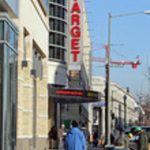
Before there was Target, Bed Bath & Beyond, and Washington Sports Club, the intersection of 14th Street and Park Road used to be the end of the line for the horse-drawn omnibus that shuttled people from downtown D.C. up the hill. When electric streetcars replaced the horses in 1892, the Washington and Georgetown Railroad Company built an elaborate garage for their streetcars, a Romanesque building with arched windows. By 1907, though, the streetcar line was extended, so the “car barn” was repurposed as the Arcade. It was dubbed “Washington’s Madison Square Garden.” There, people bowled, watched movies, played pool, danced on the roof, roller skated, and even held dog shows. The revelry lasted until the Great Depression. After that, the Arcade changed ownership a few times and was eventually torn down in 1947, to eventually be replaced by the boxy commercial real estate we know today. The DC USA shopping plaza opened in 2008, nine years after the Metro station was built.
2. Until 1871, Columbia Heights was considered ‘the county’
Can you imagine Columbia Heights as farmland and just a handful of houses? One hundred and fifty years ago, everything north of Florida Ave. (then “Boundary Street”) and everything across the Anacostia was considered Washington County. The military engineer Pierre Charles L’Enfant planned Washington City, and decided that it ended at the bottom of the hill. The Organic Act changed that in 1871, by repealing the individual charters of the cities of Washington and Georgetown and creating a new government for the District of Columbia, which included modern-day Columbia Heights. Now, Columbia Heights is #1. (Ward 1 that is.)
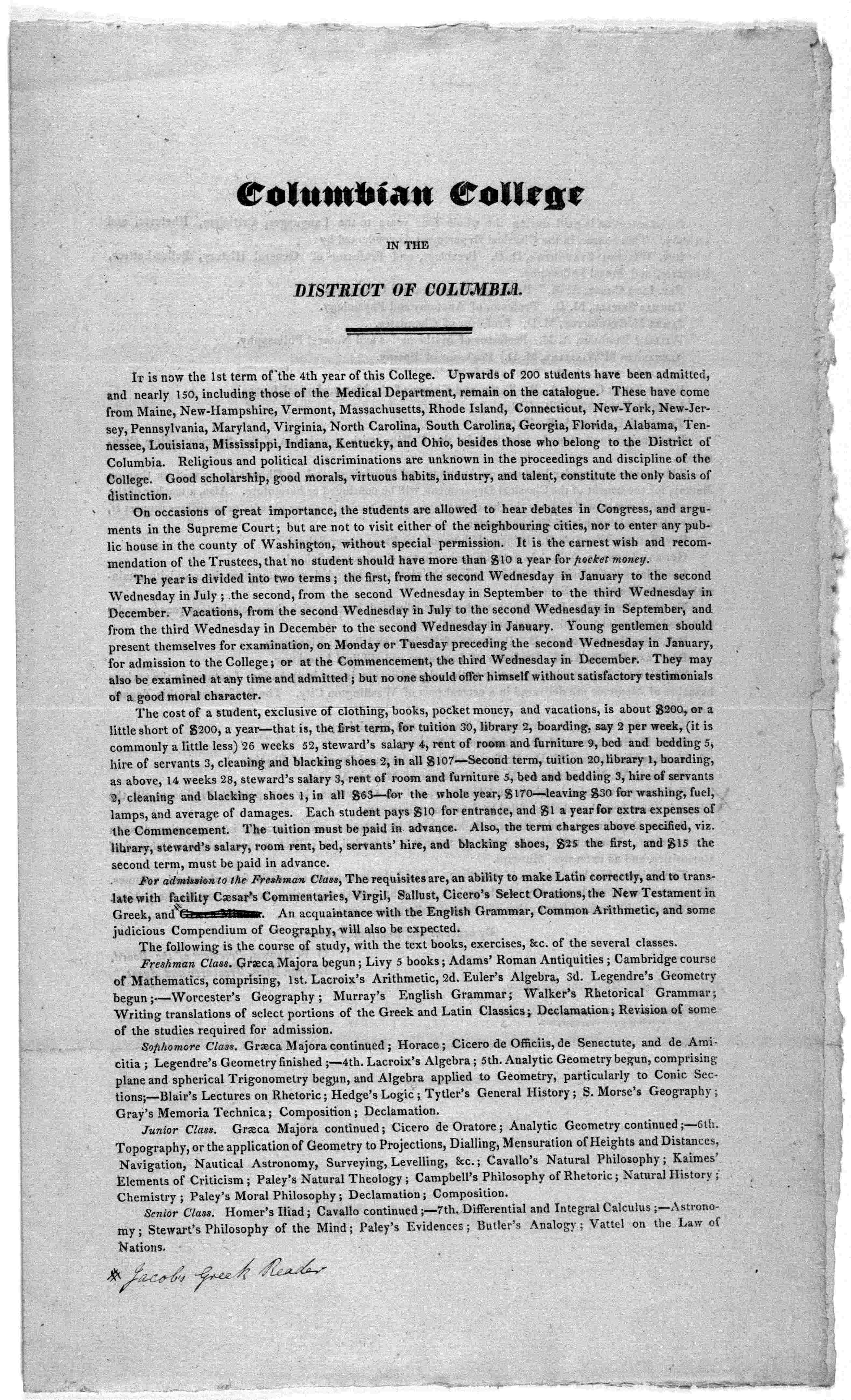
3. Columbia Heights was the original home of Columbian College, which eventually became George Washington University
In 1821, a group of trustees fulfilled George Washington’s long-time dream of founding a national university in D.C. Columbian College opened its doors on College Hill between 14th and 15th streets in modern-day Columbia Heights. The original admittance requirements included literacy in Latin, being able to translate Caesar’s Commentaries and the New Testament in Greek, and “a thorough knowledge of geography.” (Plus being male and white.) The first classes paid $60 annually in tuition. Classes rolled along until the Civil War, when the U.S. government commandeered the campus on the hill and Columbian medical graduates served on opposite sides (46 Union, 24 Confederate). In 1904, the college changed its name to The George Washington University and within a few years began its move to present-day location in Foggy Bottom.
4. In 1904, Congress annoyed the neighborhood by changing its street names
Congress wanted the streets of D.C. to be in an orderly grid: the north-to-south streets numbered, and the east-to-west streets lettered. Once the alphabet was exhausted to the north, they’d move to two-syllable names, then three. The residents of early-1900s Columbia Heights were not pleased.
The blog Ghosts of D.C. dug up a few gems of complaints published in the Washington Post:
“The scheme of naming these streets Yale, Harvard, and Princeton was a good one. They are significant of nice schools, names of colleges held in affection, and why should they not remain?” wrote someone named Judge McCalmont in 1904.
(Harvard St. is still a thing. Yale and Princeton were nixed.)
By 1929, people were still pissed. In an editorial written on Christmas Day, Tillman Joy lamented that some had been renamed to fit the alphabetical logic, but not others.
“Quite a number of years ago the authorities adopted a scheme for the systematic naming of streets added to those already regularly lettered, numbered and otherwise named,” Tillman wrote. “Naturally, it was thought that in its future growth the city would be free from the antiquated, unsystematic arrangement with which it was threatened. But it was not to be.”
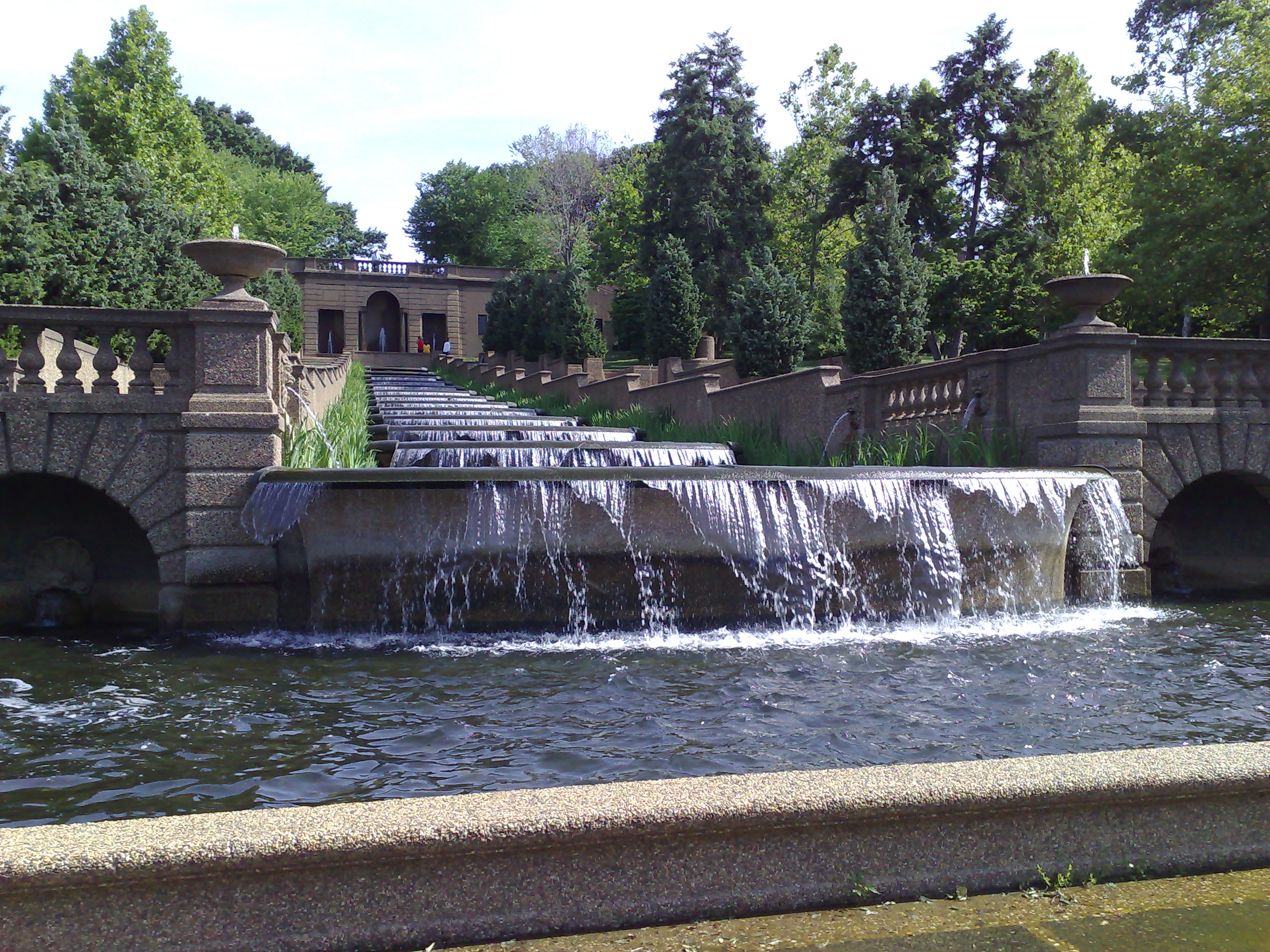
5. Malcolm X/Meridian Hill Park’s history is as eclectic as its statues
Today, the beautiful urban oasis bordered by 15th and 16th streets to the east and west and Euclid and W Streets to the north and south is the scene of grooving drum circles on Sundays, grueling stair workouts on Mondays, and picnics, dog-walking, and first dates nearly every other day.
The park has been busy since it was just a hill. A member of the Union Army who camped on the hill during the Civil War described it as “the most delightful locality in the city of Washington.” In 1911, Mary Henderson, who owned a mansion on the hill, petitioned Congress to site the Lincoln Memorial there. She lost that bid but succeeded in getting the area designated as a park. Her vision required the displacement of a number of African Americans in the neighborhood; their homes were razed. Italian landscape architect Ferruccio Vitale and his firm were commissioned to design the park, which features the longest cascading fountain in North America.
During the Civil Rights Movement, the park was often a site of activism. Dr. Martin Luther King Jr. often visited it when he came to D.C. The year after his death, Angela Davis called for the park to be renamed Malcolm X Park as a symbol of Black pride. Adam Clayton Powell, a Congressman from New York, introduced legislation to officially change the name, but it never passed, and the debate continues to this day.
There are four famously mismatched statues in the park: Serenity, an allegorical woman in a flowing robe; Dante, the Italian poet; James Buchanan, fifteenth president of the United States; and Joan of Arc, the 15th-century French heroine who was burned at the stake (people have been stealing, and NPS has been replacing, her sword for decades).

6. The neighborhood is part of the ward that has historically had the largest Latino population in the city—but it has been on the decline
Columbia Heights and neighboring Mount Pleasant have historically been the epicenter of the District’s Latino community, nearly 40 percent of whom hail from El Salvador (tens of thousands of people fled civil war in the 1980s and two devastating earthquakes in 2001). In 2000, Ward 1 counted 18,100 Latino immigrants as residents—almost double that of the next highest ward (9,200 in Ward 4). Ten years later, the city’s overall Latino population grew significantly, but Ward 1 was the only place to see a decrease in Latino residents. Rising housing prices pushed people out, particularly to neighborhoods north in Ward 4 and east in Ward 5. Still, Columbia Heights remains home to some of D.C.’s most important Latino cultural and social organizations (CARECEN, the Latin American Youth Center, and GALA Hispanic Theater among them) alongside a wealth of neighborhood pupuserias, Salvadoran restaurants, and small Latino markets
7. The neighborhood was once home to D.C.’s first black bookstore, Drum and Spear, an important nucleus of black power organizing
Shortly after Dr. King’s murder and the painful riots, Charlie Cobb, Judy Richardson, Courtland Cox, and Curtis Hayes, veteran organizers with the Student Nonviolent Coordinating Committee, opened Drum and Spear, a bookstore specializing in books by black authors, at 1371 Fairmont Street. Inspired by Cobb’s visit to Présence Africaine, the pan-African literary journal and bookstore in Paris, Drum and Spear was one of about 100 black bookstores in the United States around 1970 but was one of the largest in terms of inventory and influence.
“It wasn’t uncommon to see Toni Morrison and Amiri Baraka browsing the shelves alongside diplomats and regular folk,” according to writer and activist Daphne Muse.
“That was the whole point of the store,” Cobb said recently on The Kojo Nnamdi Show (a young Kojo himself once worked there). “To have a space where black people, whatever their political persuasions were, or maybe they didn’t have any political persuasions … could encounter ideas, could encounter serious thought, could think about the idea of black liberation.”
The FBI considered the bookstore so subversive that it sent agents there to surveil. Yet Drum and Spear was short-lived, closing its doors in 1974 after mainstream bookstores such as Brentano’s began to carry similar books. Today, its spirit lives on through D.C. bookstores such as Mahogany Books, Sankofa, and Busboys and Poets.
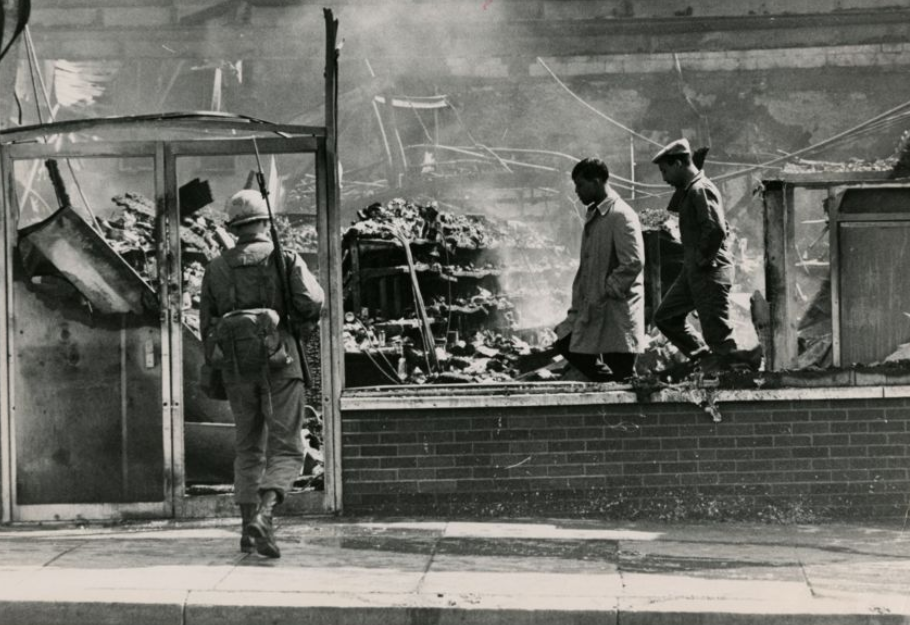
8. Riots following Dr. Martin Luther King Jr.’s assassination in 1968 didn’t just affect U Street. They also scarred Columbia Heights for decades.
When the news that Dr. King had been assassinated in Memphis reached D.C., the city erupted. Crowds gathered along 14th and U Streets. As night fell, some people began breaking storefront windows, clearing out shelves, and setting fires. Ultimately, 13 people died in the riots. Two black men – Thomas Stacey Williams and Ernest McIntyre – were shot by police; two white men – Fred Wulf and George Marvin Fletcher – were beaten and stabbed, respectively; Ronald James Ford slashed his neck on a broken storefront window; and eight other people died in fires.
“People were acting out of hate. They were acting out of anger,” said Dennis Hyater, a black police officer on the mainly white D.C. Police force at the time, as reported by WTOP. “And when the messenger [King] was killed, they saw no hope.”
Columbia Heights saw some of the worst of the property damage. The Giant supermarket on Park Road, which had just opened in 1966, survived the four days of chaos and later partnered with Sacred Heart Church and St. Stephen and the Incarnation Church to provide people in the neighborhood with provisions. But Columbia Heights was forever changed. Many businesses were burned, and many that weren’t closed anyway. Along the length of 14th Street from Logan Circle to Park Road, 270 of 320 businesses were destroyed – plus around 4,000 homes.
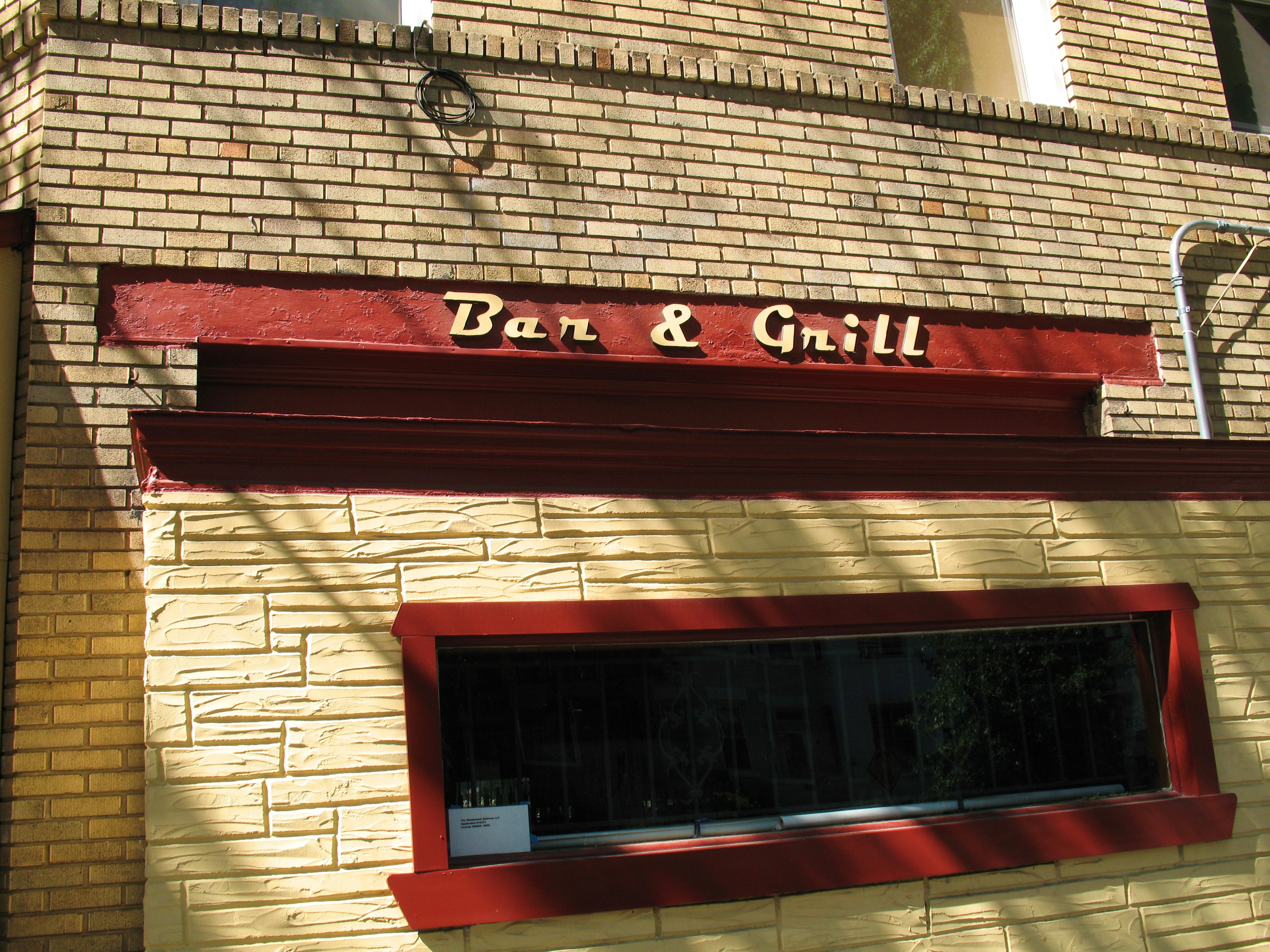
9. Wonderland Ballroom stands in place of one of the nation’s oldest black gay bars
Today, the one-lane-traffic staircase of Wonderland Ballroom leads you a sweaty dance floor. But until 2004, the space was Nob Hill, an African American-owned gay bar. It started as a private social club for black gay men in 1953, and it opened to the public in 1957–a particular hangout for gay students at nearby Howard University. Nob Hill hosted drag shows and a Sunday gospel night featuring local choirs. Many of the city’s black, queer spaces were destroyed in the 1968 riots, but Nob Hill survived.
When more gay bars and nightclubs began opening in the 1970s and 80s, Nob Hill earned a reputation of catering to older, middle-class men – and gained the nickname “The Wrinkle Room.” Still, up until its last decade of operations, many patrons cited it as a haven. When then-owner Robert Jones closed its doors in 2004, it was one of the longest standing gay bars in the country.
10. Tivoli’s Astounding Magic Supply Co. is really a writing center for kids
Tivoli Theatre on Park Road was once one of the grandest public spaces in the District. It closed as a movie theater in 1976, but the building remained as a neighborhood landmark.
The former movie theater is now home to the GALA Hispanic Theatre and Tivoli’s Astounding Magic Supply Co. This unassuming shop does sell magic supplies—from white gloves to Stage Fright Antidote—but the storefront is really a ploy to get you in the door. All purchases support 826DC, a nonprofit that helps kids with their writing skills. Writer Dave Eggers co-founded the organization in San Francisco, where the writing center is hidden behind a Pirate Supply Store. 826DC serves thousands of students every year through after- and in-school programs. They publish books of their own writing, such as Dear Brain, Having to Tell Your Mother Is the Hardest Part, and The Weight of the Day Surrounds My Body. 826DC’s space used to be the Museum of Unnatural History before it relocated to the former mezzanine of historic Tivoli Theatre and changed its storefront.
Previously:
Ten Facts You May Not Know About Navy Yard
10 Facts You May Not Know About Brookland
Ten Facts You May Not Know About Anacostia
Ten Facts You May Not Know About Dupont Circle
Nine Facts You May Not Know About The Southwest Waterfront