If you’re passionate about food and considering opening a restaurant of your own, Dan Simons of Founding Farmers has just one word of advice: “Don’t.”
Simons is one of many business owners in D.C. worried about what rising rent costs mean for the longevity of beloved local restaurants. Creme on 14th and Ventnor Sports Cafe in Adams Morgan both closed their doors last year, joining an ever-growing graveyard of District eateries.
Eater reported 80 food and beverage closures in 2018, but this number doesn’t include last week’s closings of Acadiana, 701, and multiple Mike Isabella restaurants. Washington Post critic Tom Sietsema even fielded a question about all the closures in his weekly chat on Wednesday (like some business owners on Upshur Street, his theory is that the main culprit is all the rain the D.C. area got last year).
A common cause of death? High rent increases.
“I was in an old row house paying top dollar,” says Ventnor’s Scott Auslander. “You reach a point where the rent is too high. The margins are tight.”
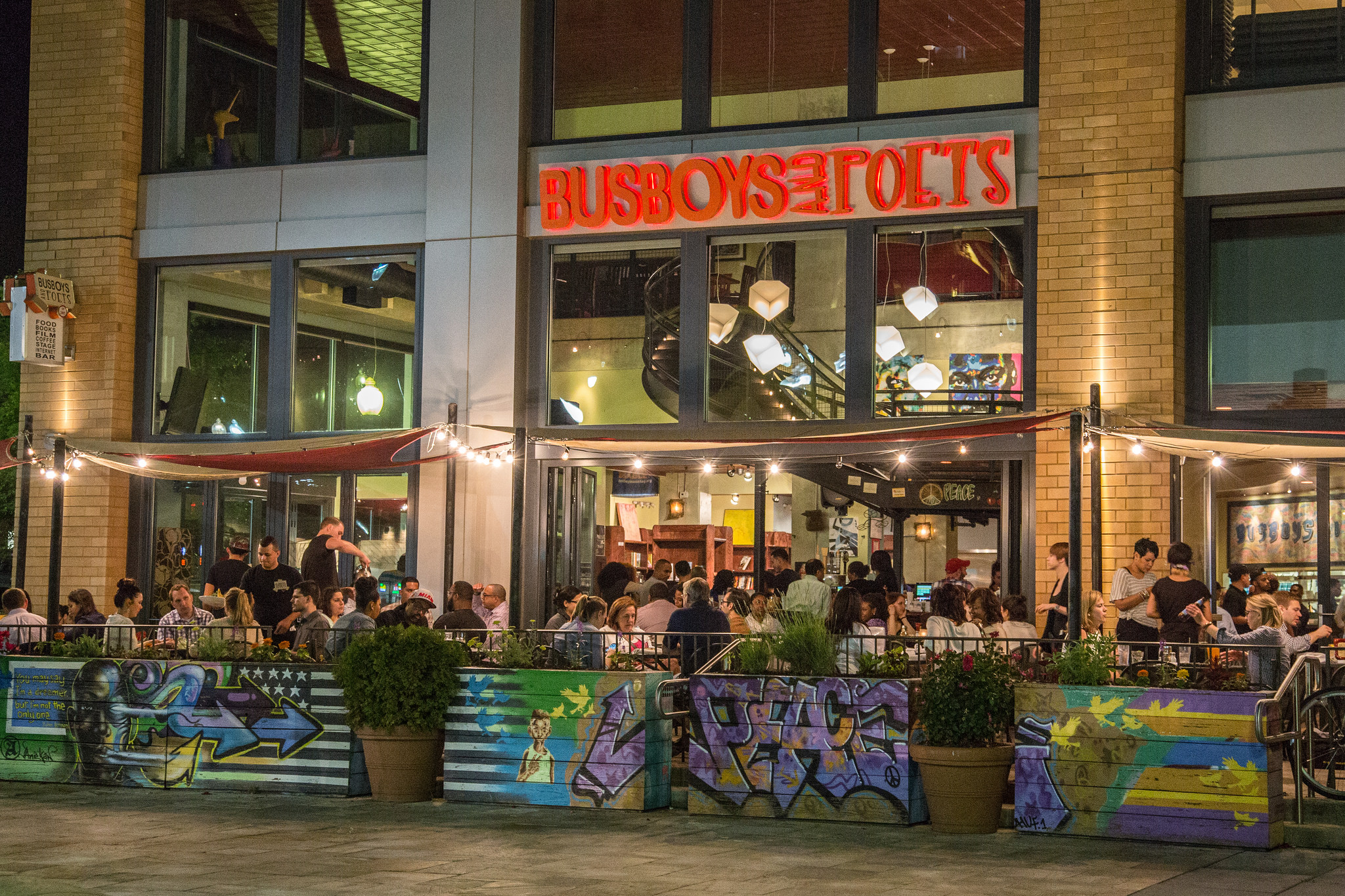
Andy Shallal, founder of the D.C. restaurant dining chain Busboys and Poets, faced a rent spike at his K Street location. In order to avoid shuttering the popular neighborhood gathering place, he moved to a new space just halfway up the block .
“My rent went up by 30 percent literally overnight,” says Shallal.
Already boasting a famously high failure rate compared to other types of commercial businesses, restaurants are also less poised to employ traditional methods for increasing their profit margins when feeling a rent squeeze.
“We can’t necessarily raise prices every year,” says Simons. “We don’t necessarily have more guests every year. Depending on what’s going on, it could be the opposite—we could have less guests, more competition, higher costs across the board.”
And even if the foot traffic stays high, those guests can’t keep pace with rising rent in some cases, including Ventnor’s.
“I was dealing with 1,800 or 1,900 square feet,” says Auslander. “I physically couldn’t get more people in the door.”
As if the trifecta of guests, competition, and costs isn’t enough for any business to juggle, restaurants have the added bonus of a clientele particularly sensitive to any sort of price increase.
“When we raise prices, consumer behavior changes,” Simons explains. “You take a roasted chicken dish from $19.50 to $20 and you will sell less. Now, instead of getting the $19.50 chicken dish, maybe they trade down to an $18 pasta. You can raise prices, but people will notice, think, ‘wow, it’s getting more expensive,’ and your sales don’t go up because the consumer behavior changes.”
In other words, when Apple raises the price of an iPhone by hundreds of dollars, many buyers don’t bat an eye. But an extra 50 cents for your burger? Next restaurant, please.
And there’s no shortage of alternatives in D.C. at the moment. The sheer scope of options when it comes to choosing a place to eat is one of the factors creating what Simons describes as “the perfect storm.”
“Between Columbia Heights and Logan Circle there’s 100 restaurants,” says Shallal. “And that’s probably a conservative estimate.”
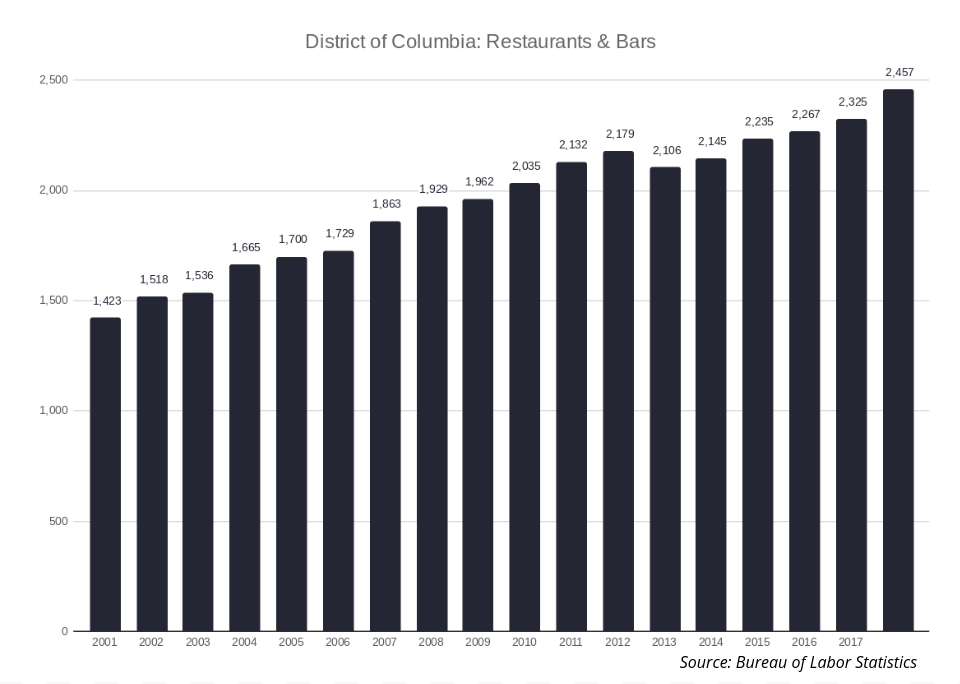
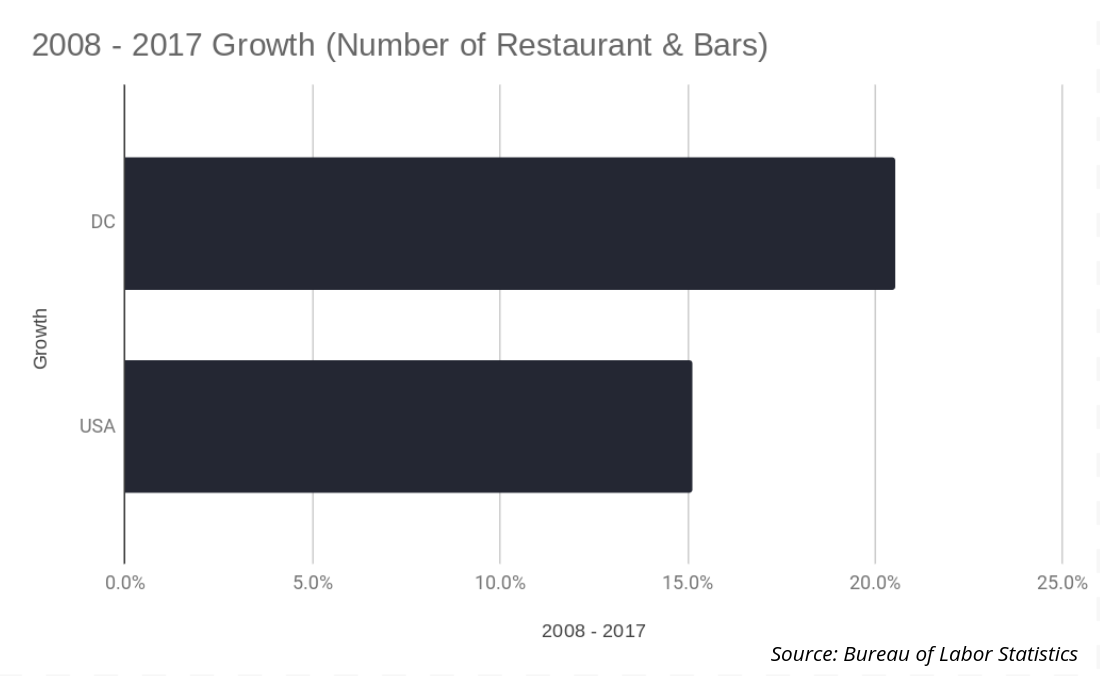
December’s release of Quarter 2 data from the Bureau of Labor and Statistics supports his assessment—the growth rate for restaurants and bars in the District from 2008 to 2017 sits at 20.5 percent, while the national average is 15.1 percent.
There were 2,267 bars and restaurants in D.C. in 2016. By the end of June 2018, there were 2,457—that’s a net increase of 190 restaurants.
A D.C. iteration of the Michelin Guide and attention from national publications like Bon Appetit may have had a hand in the restaurant boom, but Simons has another theory: Buildings going up in D.C. often only want restaurants, cafes, and bars on their first floors.
“Landlords are going to build more buildings, and they want to [offer amenities], but because Amazon killed retail, all they have to put on the first floor is food,” Simons says.
Shallal and Simons both reported murmurings of worry from others in their expanding industry.
“The two major costs in the restaurant business are product and labor,” Shallal says. “A lot of people are asking, ‘How do we mitigate the rising costs of labor, rent, food?’ We’re being more and more squeezed, having a harder and harder time. I didn’t hear this talk a year or two years ago. You can look around and see, ‘this place isn’t going to stay in business long,’ ‘that one isn’t going to be here.’ We’re seeing the writing on the wall.”
Rent increases each year aren’t uncommon in commercial properties, according to local business owners around the District. In fact, they’re often built into a 10-year lease from the get-go—and unlike residential properties, there’s no cap on raising commercial rents. Sometimes it’s two or three percent a year, other times it might be no increase for five years, then a 10 or 12 percent jump every five years after that.
Then there are the property taxes, repair and maintenance expenses, capital expenses, the common area maintenance (CAM) fees, the D.C. Ballpark Fee (Simons says he pays $30,000 a year in that one alone) and of course, labor—which both Shallal and Simons say they have prioritized at the expense of, well, their other expenses. Others, like local gelato company Dolcezza say that rising business business costs have forced them to cut wages.
The result is the big squeeze, that perfect storm.
“In so many ways our industry is thriving,” said Kathy E. Hollinger, President and CEO of Restaurant Association of Metropolitan Washington. “But with this incredible growth also comes challenges that threaten the viability of the restaurant community that is mostly comprised of small businesses.”
Hollinger reports that in D.C., 96 percent of full service restaurants are independently operated, and these restaurants are hit the hardest when everything is increasing: rent, competition, labor costs, food costs, and regulations.
“It’s important to understand that most restaurants in D.C. are small businesses that are trying to meet payroll and are paying yesterday’s bills with today’s money, so when there is an increase in operating costs it impacts every aspect of the restaurant,” Hollinger says.
If you’ve got the capital, you can get creative. Simons and his farmer-partners in North Dakota have been systematically eliminating the middlemen involved in the creation of your glazed bacon lolli’s and other dishes on the Founding Farmers menu, partnering directly with farms and even purchasing the truck that brings those ingredients from the Midwest to D.C.
Shallal, when hit with the 30 percent increase at his K Street location, moved across the street.
But for most other business owners and aspiring restaurateurs, capital and adaptability are in short supply.
“The truth is, the strip [on 14th Street] that everyone talks about, those are mostly restaurant groups and chains,” says Ventnor’s Auslander. “When the neighborhood restaurant has 15 locations now, that’s a company. People want mom-and-pops, but those can’t necessarily weather the storms.”
In other words, a Shackburger from the New York City based-chain doesn’t have the same D.C. flavor as Ventnor’s Lafayette burger, but Shake Shack can make the rent, even when it goes up overnight.
“That was one of the things that upset people when we closed,” says Auslander. “When you’re a mom and pop, places like this become sort of a community gathering place. People have gone there for years and years and years and as rent goes up and we lose those places, you end up with these chain places instead. Places that can pay that high rent and absorb losses.”

Looking at the long list of 2018 closures alongside the robust 2019 lineup of eager openers, locals in the industry are skeptical.
“Many aren’t going to make it,” Austrander says.
“People come into the businesses that might not know the economics,” echoes Shallal. “Business is cyclical. It goes up and it goes down, and if you cannot withstand the downturns, you’re not going to be in business for long. There will be a time when you have to face a recession or a downturn.”
With Amazon’s arrival looming over an already increasingly pricey region, the “day of reckoning,” Shallal warns, might not be very far off.
“I predict we’ll see more than a handful of empty and boarded up storefronts in the next year or two,” he says. “We’re seeing a piece of D.C. culture disappear and be replaced by deep-pocketed businesses coming from New York or Philadelphia or L.A.—high dollar, low-identity businesses.”
Both Shallal and Simons say that neither Busboys and Poets nor Founding Farmers will be disappearing.
“I know I speak for almost everyone who does it when I say we do it because we love it,” says Simons. “Sometimes things go great and can well exceed the average, and sometimes things go awfully. … But we love our staff, we love trying to please the guest, we love the teamwork, the challenge, the food and the drink.”
But as for opening your own restaurant? Simons has another idea.
“Open a yoga studio.”