Natalie Delgadillo
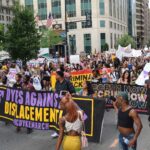
D.C. was home to the first-ever Dyke March in April 1993, when 20,000 self-described dykes from across the country joined together to march from Dupont Circle to the White House.
Since then, cities across the country have organized their own versions of the event, which traditionally takes place on the day before the Gay Pride Parade in June. “It was a way for queer women to show their visibility, because we’re easily erased when it comes to the LGBTQ community,” says Mary Wright, one of the women trying to bring the march back to Washington this year. “So it’s just a way for us to show we’re strong and unified and there are a lot of us and we shouldn’t be forgotten.”
Since that first march 26 years ago, marches in other cities (particularly New York, but also other places like Chicago, San Francisco, Seattle, and London) have flourished. But the one in D.C.—where everything began in the first place—has flagged for some reason. Wright says the last one she can find evidence for in D.C. happened in 2007, and she hasn’t been able to get in touch with anyone who’s previously organized a Dyke March in the city to find out why there hasn’t been another since then.
Wright says she’s been having conversations with friends for years about how they wished someone would take the mantle and bring the march back to the city. Late last year, she and her friend Maria Miller decided to take the first steps themselves: they created an Instagram page that has garnered more than 1,000 followers in less than a month. On Monday night, Wright says she created the Facebook event for the march, officially setting a time: June 7, the day before D.C.’s pride parade, at 4 p.m. There are 270 interested people so far.
Wright works in the city as an organizer, an artist, and a videographer. After she graduated from college in the city a few years ago, she helped create the District’s monthly Queer Girl Movie Night. Her co-organizer, Miller, is an organizer with Indivisible in D.C. Wright says neither of them have direct experience organizing a large march, and they’re hoping to rally others who have participated in dyke marches in the District or elsewhere to help out.
Following tradition, Wright says they plan for the march to be unpermitted. She says she hopes the march will add to the number of spaces in the city set aside for queer women and provide an outlet for anyone who identifies with “dyke” as a political signifier. While the word is sometimes used as a pejorative, some queer people have reappropriated it as an empowering political identity.
“D.C. is a very gay city. I feel like it’s also a very queer city, but that’s not really the dominant voice of the community here. Women are an afterthought to a lot of events and organizing,” she says. “I would like [a march] that isn’t corporate … We just want to be a noncommercial way to celebrate pride and keep the political side of it that our city is known for.”
Wright says that she and Miller have also spoken at length about how they want the march to feel inclusive for anyone who identifies as a dyke—not just lesbians. “Any queer woman, really any queer non-man that identifies with the history of the word ‘dyke’ can join. It’s in no way supposed to be like just for lesbians. I don’t want there to be queer erasure of any kind,” she says.
While Wright and Miller have started the process of garnering support and visibility in bringing the march back, Wright says she wants it to be clear that they’re not inventing anything—there’s a long history behind the Dyke March, and she says she expects that others will contribute significantly to the eventual march itself this year.
“I’m just a dyke that loves to read queer history,” she says. “I’m always the one of my friends being like, ‘did you know this happened?’ It’s good to know that this has been out there, and it’s not like a crazy thing to want to all meet and organize in this way.”