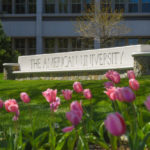
Nestled in the northwest corner of D.C.’s diamond, Spring Valley’s rolling landscapes are home to diplomats, prominent journalists, and even a young Kermit the Frog. American University consumes most of the Northwest neighborhood, with spacious colonial homes surrounding the campus. But dark secrets from the university’s past are also buried underneath this picturesque community on a hill.

1. George H.W. Bush got into some surprising scrapes on and around AU’s campus
D.C.’s movers and shakers pop by American University’s campus nearby for more than just paid speeches. During his time as vice president, George H.W. Bush was known to drive up Massachusetts Avenue from the Naval Observatory for a lap around AU’s track. In 1983, Bush violated AU’s new rules prohibiting dogs from the athletic fields when he unleashed his cocker spaniel on the track. According to The Eagle, AU’s Chief of Security Paul Leeper would make no exceptions about the policy. “The vice president of the United States will be treated like any other man,” Leeper said. “If he violates the law, he will face the consequences.” Bush also brushed up against the law during one of his regular visits to Wagshal’s deli just north of AU. In 1981, the D.C. Alcoholic Beverage Control Board launched an investigation into a report that the deli illegally sold liquor on credit to the vice president a week before his inauguration. Bush bought $77.72 in merchandise on credit, including Scotch whisky, rum and vodka, and asked to send the bill to the White House.
2. For much of its history, the neighborhood restricted homeownership to African Americans and Jews
In the 1930s and 40s, as white residents moved further from D.C.’s inner city and even past once pastoral neighborhoods like Mount Pleasant and Petworth, Spring Valley was not only marketed as a refuge for upper-middle class WASPs but created for this specific purpose. The neighborhood’s developers, W.C. and A.N. Miller Company, enshrined white control from the beginning with the restrictive covenants that prohibited home sales to African Americans and those of “the Semitic race… [including] Armenians, Jews, Hebrews, Persians, and Syrians.” In 1929, the company promoted the neighborhood as “safe from the invasion of the changing character of [Washington DC] neighborhoods.” The AFRO discovered that Richard Nixon signed such a covenant when he bought a $41,000 home on Tilden Street, as the Ghosts of DC blog recounts. Spring Valley was not alone in its racial covenants, the nearby Wesley Heights (which Miller also developed) and Crestwood to the east also had real estate laws barring black and Jewish people. In 1972, the U.S. Court of Appeals ruled that racially restrictive covenants are unlawful and could no longer be recorded
3. American University had some monumental plans that never got built
Although AU’s campus is a hodge-podge of neoclassical, brutalist, and modern architecture today, the school had grand plans for the campus around the turn-of-the-century. An 1892 letter outlined plans for a Lincoln Memorial Hall that would have incorporated 33 100-foot columns representing the states under Lincoln. Frederick Law Olmsted, the landscape architect who designed Central Park, made a preliminary visit to the grounds in May 1893 and detailed prospective designs for the campus in an October 1893 letter to Bishop John F. Hurst. A 1903 letter from famed Chicago architect Henry Ives Cobb even discussed the cost of a marble observatory building, which was estimated between $300,000 to $500,000 at the time. The library was supposed to be the “most monumental” of the campus buildings, with other buildings dedicated to literary, religious and artistic studies flanking the quad.
You won’t see any of those buildings or a rolling Olmsted landscape on AU’s quad today. “The University had to fundraise money for buildings plus an endowment to open, and money pledged hardly materialized,” says Leslie Nellis, associate archivist at AU. Fundraising issues, a rotating cast of campus planners and personnel changes thwarted construction, with Rev. George W. Gray’s departure signaling the end of the proposed Lincoln Hall.
“In a nutshell, the Olmsted plan fell through because of disagreements between the firm, AU, and Van Brunt & Howe firm,” Nellis says. “Olmsted believed the topography couldn’t accommodate the classical symmetrical design, AU favored a neoclassical design.”
Following the break with Olmstead, Van Brunt & Howe assumed responsibility for the campus planning but resigned after issues with the builder, Nellis adds. The school then hired Cobb as architect and campus planner.
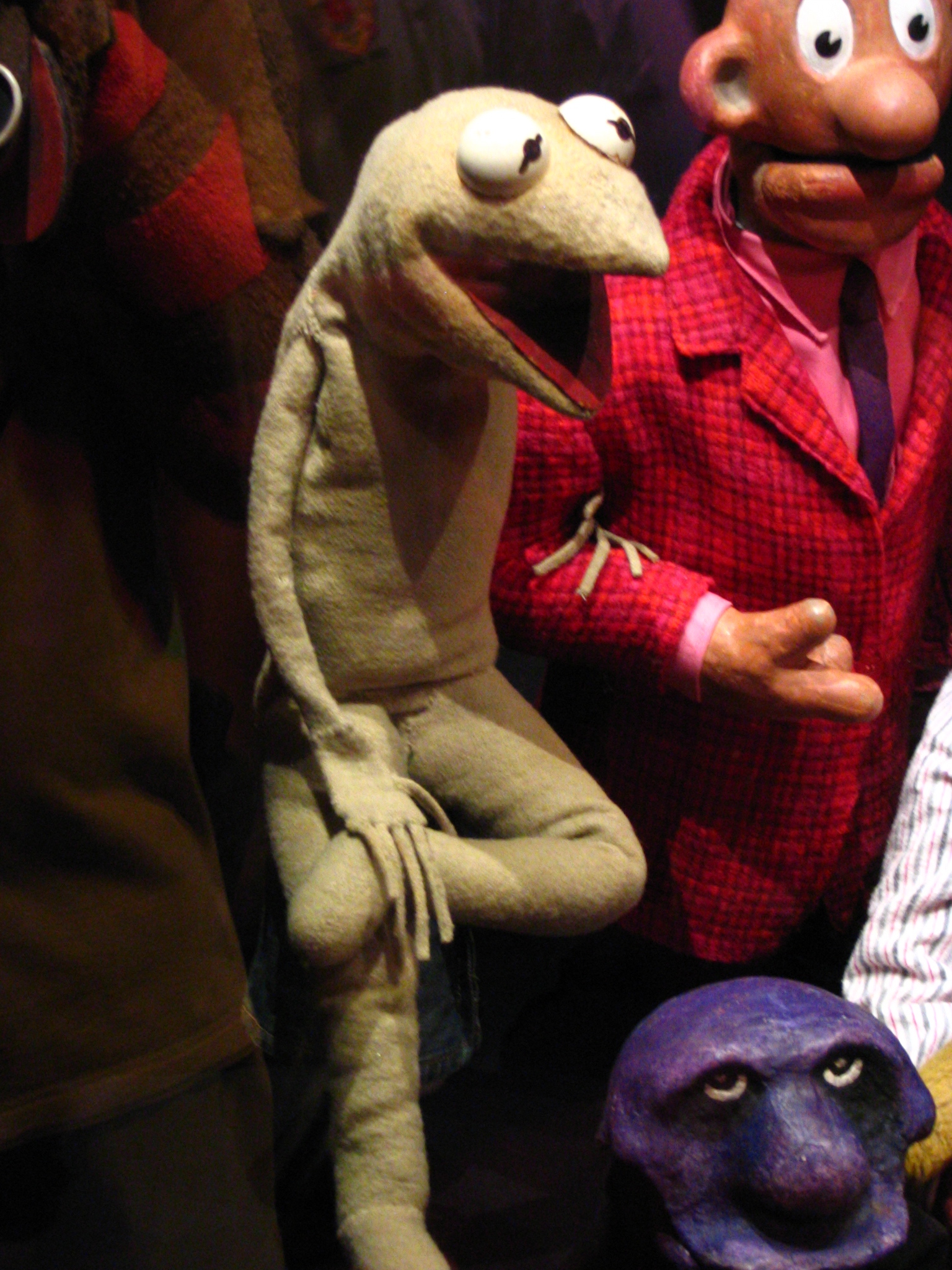
4. “Kermit the Frog” was born in D.C.
The Muppets’ green host is currently on display at the Smithsonian’s American History Museum, but Kermit’s D.C. roots stretch a few miles north to the local NBC affiliate on Nebraska Avenue. Between his graduation from Northwestern High School in Hyattsville, Maryland and his freshman year at the University of Maryland, a young Jim Henson answered an ad for WRC-TV in Washington seeking “youngsters…who can manipulate marionettes.” It was there that Henson got his big break and invented an early iteration of Kermit. Today’s Muppet fans likely wouldn’t recognize the Kermit who first appeared on Henson’s local puppet show, Sam and Friends, which aired on WRC (better known now as NBC4) in 1955. Instead of the gangly frog we know and love today, Kermit looked less amphibian and more reptilian. Henson constructed the first version of Kermit from his mother’s old, green felt coat and chopped a ping pong ball in half to create his signature, bulbous eyes, according to the Smithsonian. While Kermit’s staying power lasted longer than his cohorts Sam and Yorick, Sam and Friends earned Henson his first Emmy in 1958.
5. JFK delivered his “Strategy of Peace” speech at AU
Less than a year after the Cuban Missile Crisis, President John F. Kennedy delivered his seminal speech on nuclear nonproliferation at American University on June 10, 1963. Kennedy called for the development of a nuclear test ban treaty and announced preliminary discussions with Soviet Premier Nikita Khrushchev. More than an end to nuclear war, the president encouraged Americans not to demonize and dehumanize the Soviets. “No government or social system is so evil that its people must be considered as lacking in virtue,” he said. “As Americans, we find communism profoundly repugnant as a negation of personal freedom and dignity. But we can still hail the Russian people for their many achievements–in science and space, in economic and industrial growth, in culture and in acts of courage.”

6. Ward Circle is named for the Continental Army’s first commander-in-chief
There are many tri-cornered hat-wearing gentlemen gracing D.C.’s circles, but the roundabout plaguing drivers at Massachusetts Avenue and Nebraska Avenue NW is home to Revolutionary War General Artemas Ward. While this Leonard Crunelle sculpture might remind one of George Washington, Ward preceded that more famous Revolutionary fighter as the first commander-in-chief of the Continental Army. A native of Shrewsbury, Massachusetts, the Harvard graduate and attorney would go on to become a U.S. representative and delegate to the Massachusetts State Constitutional Convention in 1820. The military man and statesman is not to be confused with Artemus Ward, the Civil War-era satirist who also hailed from New England.
Despite his illustrious political career, Ward has no connection to American University other than his spot on the circle and his name on the School of Public Affairs building. In exchange for a $4 million donation to Harvard, Ward’s great-grandson requested a statue honoring the Revolutionary hero. Harvard commissioned the statue but never placed Ward on their campus. Instead, the college donated Ward to the U.S. and in 1938, the National Capital Park and Planning Commission deposited him on the circle just south of AU’s campus.
In 2017, Ward lost his namesake building at the nearby School of Public Affairs which AU’s board renamed “Kerwin Hall,” after the university’s former president, Neil Kerwin. But AU Eagles screeched on social media, vowing to call the SPA building by its original moniker.
7. Most of the residential neighborhood was built/developed by the Miller Development Company
The Miller Development Company set its on sites on Spring Valley in 1926, when the developers acquired 300 acres of farmland next to AU. Development began in 1929 at the southern end of Loughboro Road and moved north over the next three decades, with retail and office space construction starting in the 1980s.
Along with the covenants guaranteeing “permanent values and good neighbors,” a 1939 Miller ad emphasized the Spring Valley development’s “curveliniar streets” that eliminated traffic hazards. Unlike the grid pattern of the inner city, Miller designed Spring Valley’s curving streets to conform to the area’s natural, rolling hills. The developers also kept the natural landscape in mind when designing the homes and were careful to preserve existing trees.
While Miller had accounted for Spring Valley’s flora, the company did not realize what was buried under the dirt. In 1993, a construction worker hit a mortar that had been buried after WWI (more on this below). In a 1996 case, Miller sued the U.S. Army for failing to warn it about the toxic WWI munitions, arguing the discovery had caused delays that cost the company millions. The judge concluded the Army placed the public in jeopardy but since suit was settled outside of court, the case did not result in a final judgment against the military.

8. AU briefly had a Khashoggi Arena
Jamal Khashoggi’s uncle, Adnan Khashoggi, was known for his extravagant taste (he had a 282-foot yacht that was later sold to Donald Trump) and legendary scandals (he was implicated at the center of the Iran-Contra scheme). His name also briefly graced American University’s sports center. Khashoggi joined AU’s board of trustees in 1983 and donated $5 million toward the construction of a new sports center on campus.
The sizable gift was supposed to guarantee the christening of the Adnan Khashoggi Sports and Convocation Center, but Khashoggi’s ties to the Iran-Contra affair riled students. The issue divided reporters at the student newspaper, The Eagle, who argued whether to return Khashoggi’s money. The paper’s editorial page editor called the donation “blood money,” while its sports editor countered it would be hypocritical to expel Khashoggi from the board after years of accepting money from a known arms dealer.
“Selling arms to a bunch of murky Middle East guys is okay. Bartering for Uncle Sam doesn’t fly,” wrote David Aldridge, then a senior reporter for the student paper and now editor-in-chief at The Athletic’s D.C. vertical. “I choose not to be a hypocrite. For this school, at this time, Khashoggi is too important.”
Totaling $19 million, the Adnan Khashoggi Sports Center was completed in 1988. But Khashoggi would leave the board in 1989 and his connection to the school would soon follow suit. Despite the ongoing controversy surrounding the Iran-Contra affair, Khashoggi’s name would only be stripped from the complex after he defaulted on his donation obligation in the mid-1990s, according to The Eagle. The Bender Arena of the Adnan Khashoggi Center now only carries the Bender family name from AU alumni Sondra and Howard Bender, who donated in memory of Howard’s father, Jack.
9. Wasghal’s has been called “the president’s deli”
Between last year’s closure of On Rye and DGS, it seems like D.C.’s delis are always coming and going, and always too soon. But one stalwart sandwichmaker in Spring Valley has been operating for over nine decades.
Opened by Sam Wagshal in 1925 at 9th and G streets NW, Wagshal’s deli moved to Adams Morgan in 1927, then to the Spring Valley Shopping Center in 1939. The deli claims its founder was the first in line after prohibition ended to get a D.C. liquor license, granting Wagshal’s the oldest liquor license in the District.
Wagshal’s son, Benjamin Wagshal, and his wife operated the store for 50 years before selling it to Bill Fuchs in 1990. Known as “the president’s deli,” Wagshal’s has counted former presidents Harry Truman, George H.W. Bush, Richard Nixon, Gerald Ford and Bill Clinton among its loyal patrons. Washington socialite Alice Roosevelt Longworth, Supreme Court Justice William Brennan, and FBI Director J. Edgar Hoover also frequented the deli. “They were believed to be the only sandwichmakers to have been to the White House numerous times, starting with John F. Kennedy’s administration and going through George H.W. Bush’s administration,” according to a Washington Post obituary of Benjamin Wagshal in 2006.
10. The army once tested chemical weapons here
Underneath Spring Valley’s manicured yards lies something more sinister: chemical weapons from WWI. At the beginning of the war, AU was a small university with less than 30 students in an almost rural area of Washington, D.C. In a letter to President Woodrow Wilson, AU’s president granted the government ninety-two acres of land for whatever purpose they desired.
From 1917 to 1920, the Army used the campus and what would later become its neighbors’ yards to test deadly agents such as mustard gas and lewisite, a blister-inducing, arsenic-based gas. The army would experiment with their terrifying new weapons on dogs, which were tethered out in a field and exposed to shell launches. The weapons were buried after the war and largely forgotten, until 1993, when a construction worker excavated a mortar.
Today, Spring Valley is the country’s first formerly used defense site with chemical weapons in a residential neighborhood, according to Washingtonian. As part an ongoing cleanup, the Army Corps of Engineers razed a house on Glenbrook Road in late 2012. A 1918 photograph of the site where the house stood on Glenbrook stood is inscribed on the back by Army Sergeant Charles Maurer. “The most feared and respected place on the grounds. The bottles are full of mustard [gas], to be destroyed here. In Death Valley. The hole called Hades.” In March, the Army Corps of Engineers alerted 91 homeowners in Spring Valley about upcoming testing in the neighborhood for remnants of chemical weapons.
At least one resident has managed to get a deal out of it, successfully arguing that he should get a break on his property taxes.
Previously:
Ten Facts You May Not Know About Navy Yard
10 Facts You May Not Know About Brookland
Ten Facts You May Not Know About Anacostia
Ten Facts You May Not Know About Dupont Circle
Nine Facts You May Not Know About The Southwest Waterfront