Martin Austermuhle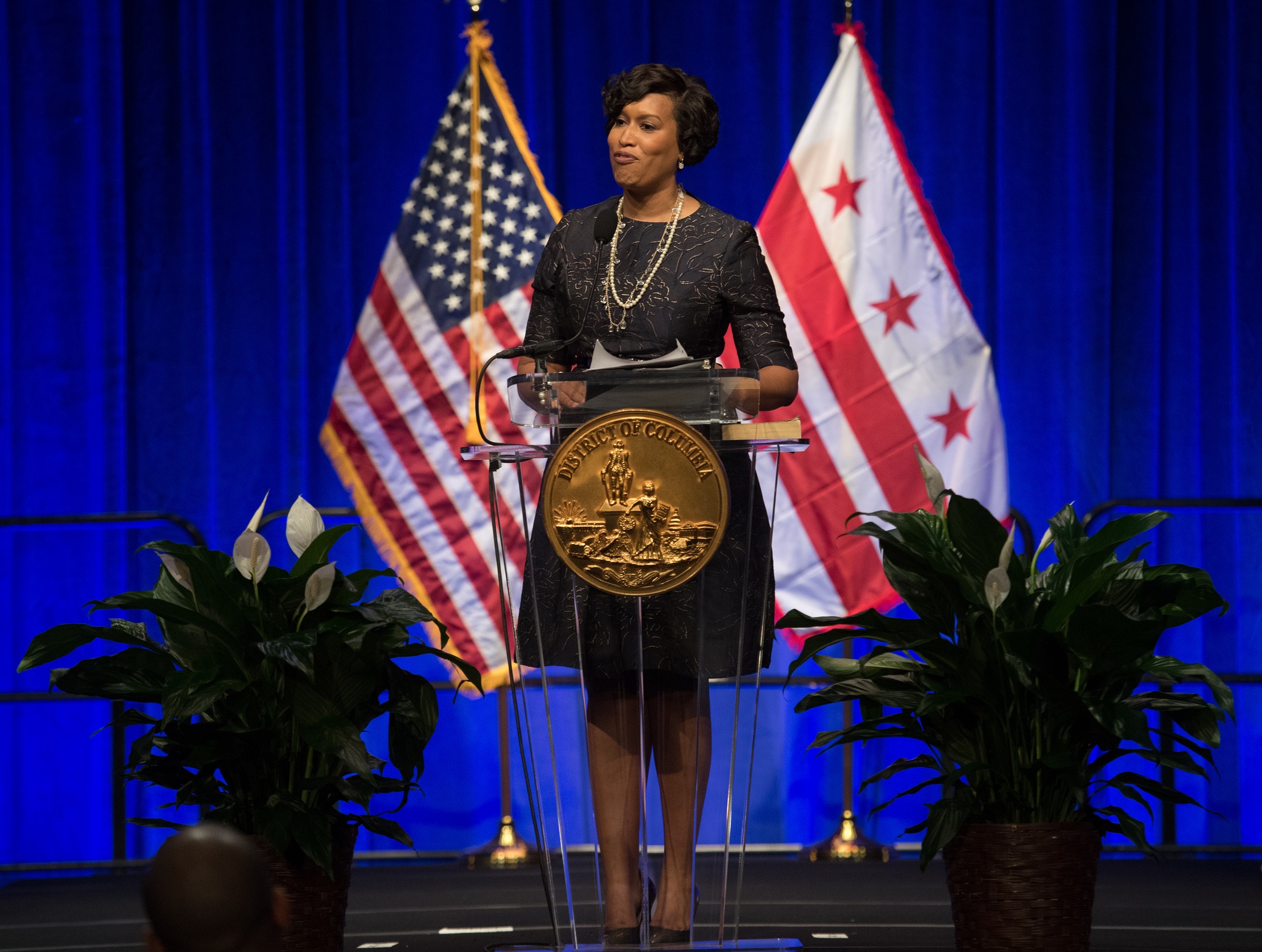
Try to imagine a 16th Street with no cars. Mayor Muriel Bowser can.
In a speech at Gallaudet University on Tuesday evening outlining her vision for her second term in office, Bowser pledged to consider “creative solutions” to some of the city’s most pressing problems, from the persistent achievement gap to a painful shortage of affordable housing.
And yes, those solutions could include ideas as seemingly radical as removing cars from 16th Street Northwest, a traffic-choked corridor from the Maryland line all the way into downtown. D.C. Bowser floated the suggestion — which did not appear in a copy of her prepared remarks — as one way to increase mobility across the city.
“If we are to make significant changes in how fast we move, how much it costs, [and] how safe it is, what are we willing to do to get there? Are we willing to prioritize some of our corridors just for public transit? Does that mean you’re going to take those cars off of 16th Street?” she asked, to uncomfortable murmurs from the audience, made up largely of government workers and supporters.
“Should we think about adding additional school transportation in our city? More bike routes? Car-free days on different corridors? There is no low-hanging fruit. They’re all tough questions, and some of them will involve tradeoffs. You’re going to have to give up something to get something else,” she said.
Since being inaugurated for her second term earlier this month, Bowser has spoken about “boldly” addressing existing challenges in D.C., from the gap in wealth to the need for more housing. During a press conference last week, Bowser pledged to build 36,000 more housing units across the city over the next six years, both by allowing for taller construction and increasing density where possible.
She returned to housing on Tuesday, saying “there is not a single bigger issue in the District of Columbia.” And expanding upon past comments, she said she would develop housing-construction targets for every part of the city.
“It’s an all eight wards problem, so all eight wards have to be part of the solution. So I’ve charged my team with looking across the city and setting goals for each part of the city that we can reach,” she said.
Bowser also pledged to continue reforming the city’s schools, potentially by reimagining vocational education and two- and four-year college options for students, and to improve workforce development.
She also made a number of organizational changes, including announcing the creation of a new Deputy Mayor of Operations and Infrastructure, who will be charged with overseeing agencies that deal with transportation, environment and city services. There are currently deputy mayors for education, public safety, economic development, and health and human services.
“You can think of this as the office that will be responsible for ensuring that we reach our goal of becoming the greenest and most sustainable city in the world,” she said in her prepared remarks.
The existing Deputy Mayor for Greater Economic Opportunity, created at the start of her first term in order to better serve communities east of the Anacostia River, will instead become the Office of East of the River Coordination, answering to City Administrator Rashad Young.
More Police On Foot, Bike And Segway
Bowser also addressed the number of homicides, which spiked 40 percent last year and is currently 120 percent above what it was this time last year. She said the Metropolitan Police Department would increase staffing to 4,000 officers over the next four years, up from the 3,800 it has today. And she said those officers would not simply patrol the city in police cars.
“The chief is also committed to make sure that those additional officers are not closed up in their cars, but on foot, on bike, on Segways all over the District of Columbia,” she said.
Hitting 4,000 police officers has been the goal of multiple mayors, including former mayor Vince Gray, who now represents Ward 7 on the D.C. Council. One of his first bills after returning to the Council would have increased the number of officers to 4,200, largely by offering $60 million worth of raises and retention bonuses.
Speaking to WAMU after Bowser’s speech, Chief Peter Newsham was optimistic about the proposal. He said the department was seeing a lower level of attrition among older officers, and that academy classes for new officers were growing. He also said that while more police alone wouldn’t stop violence, it would help increase the department’s visibility across the city.
“Being able to have 150, 170 more officers to get out there on foot and on bikes and to be able to engage with people will increase our intelligence capacity. It will always increase our credibility with the community when they get to know these officers face to face. So I think it’s a great idea,” he said.
Critics of the police department disagreed, though. On Tuesday night, the Stop Police Terror Project D.C., which says that D.C. communities have been over-policed, tweeted that more officers would not help tamp down on violent crime and homicides.
“This is going backwards. MPD already gets $500m a year. That’s more than the 4 economic development agencies combined. More police won’t stop violence. Investing in jobs, housing, healthcare, opportunity, community, in people. That’s what works,” tweeted the group.
The Stop Police Terror Project and Black Lives Matters D.C. have been critical of Bowser for what they say is her slow implementation of the NEAR Act, a bill passed by the Council in 2016 that seeks to approach violence and crime as a public health problem that requires social services and violence interrupters, not more police.
But Newsham told WAMU that having more police officers would help communities dealing with crime.
“For the folks who would say that having more police in the community is a bad thing, what I would suggest to them is they really don’t know our police officers. Our police officers do an incredible amount of work dealing with young people, dealing with adults, dealing with seniors, all in a very positive way,” he said. “So I would have to fundamentally disagree with anyone who thinks having more police is a bad idea.”
Bowser will appear on WAMU’s The Politics Hour on Friday, January 18. This story originally appeared on WAMU.