Natalie Delgadillo
Update 1/24/2019
At its Thursday meeting, the WMATA board discussed several proposals that would extend Metro’s current nighttime hours, including simply reverting to the regular late night schedule from 2016. But the board did not vote on any proposals, delaying the decision until next month.
Metro General Manager Paul Wiedefeld will present all potential schedules on January 29 at a D.C. Council breakfast with Mayor Muriel Bowser, who has generally supported a return to late night service. Ward 2 Councilmember Jack Evans, who chairs the Metro board, said that he and the other D.C. delegate, Corbett Price, will decide on their votes after that meeting. Evans said at the meeting that he “understands the arguments on all sides,” despite adamantly opposing a continuation of late night service cuts just a few weeks ago.
Wiedefeld also said that the agency is looking into a potential partnership with ride hailing apps (like Uber or Lyft) that would guarantee a ride home for restaurant workers and other employees who work late into the night, past Metro’s operating hours.
Original
A few short weeks ago it seemed likely that we would get late-night Metro hours back, but the transit agency isn’t losing that maintenance time without a fight: the WMATA board will consider a proposal on Thursday for two alternative Metro schedules that give riders some late-night service back, though not all of it. The agency says the alternative schedules will preserve some time for crews to do preventive maintenance work and cost the agency less money over the long term.
“The challenge is balancing all of the competing demands on track time, since the tracks cannot be maintained and many other critical maintenance and capital activities cannot be completed when trains are running,” the proposal reads. “At this time, any increase in service hours will reduce time available for safety and reliability improvements, negatively impact capital program execution and increase net cost to jurisdictions.”
For the uninitiated, here’s the background: Metro first significantly cut back on hours in June 2016, when it launched its intensive year-long track work program known as “Safe Track.” Then, the board approved a two-year-long service reduction starting in July 2017 that basically eliminated late night service to accommodate track work. It was controversial at the time. Ward 2 Councilmember Jack Evans, who chairs the Metro board, was initially resistant to the idea, though he was eventually convinced to approve the two-year cuts.
“I agreed to two years … for Metro to do some necessary work on our system,” Evans told DCist back in December. General Manager Paul Wiedefeld, however, planned to propose another extension at a December Metro board meeting. Evans announced that he and Corbett Price, D.C.’s other Metro board representative, would vote against that proposal, triggering an automatic veto (Metro board rules hold that at least one representative from every jurisdiction—D.C., Maryland, and Virginia—has to approve of a measure in order for it to survive.)
The veto would have reverted service hours back to the previous levels—with Friday and Saturday hours extending all the way up to 3 a.m., and weeknight hours going until midnight. The board pushed the matter off, though, to give Metro some time to come up with alternative proposals.
And here we find ourselves. The board will consider two alternatives on Thursday, one of which preserves later closing times but drastically curtails Sunday morning service, and the other of which keeps mostly the same hours that exist now, but extends weekend times by one hour, closing service at 2 a.m.
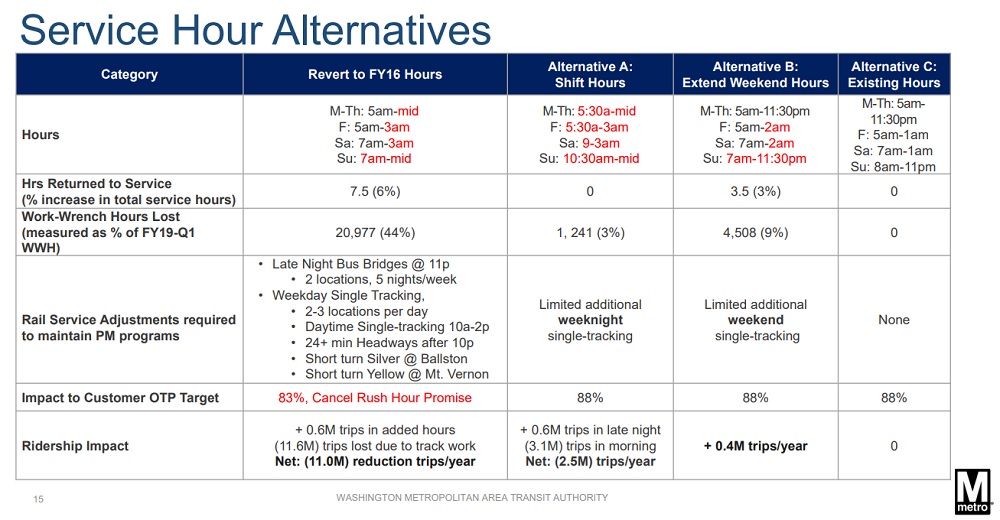
According to Metro’s analysis, going back to regular late night service with no other adjustments basically spells doom for ridership and trip timing. It would reportedly reduce ridership by 11 million trips per year because of track work happening during regular, high-demand service hours. It would require the agency to cancel its rush hour promise because trains would be consistently late. The two alternatives proposals will add trips, according to the agency, and keep train-timing the same as it is now.
Evans has not responded to a request for comment about the two options.
The agency maintains that single tracking during the day cannot replace overnight work hours. On a typical weeknight, 48 crews are doing track work across the system; during single tracking, only three crews can be safely accommodated at once, according to WMATA. This means about 75 percent of crews would have to extend their project schedules.
Overnight times are important for track work because of how long it takes for crews to be able to actually start working on the tracks, according to Metro. In a five hour window set aside for work, only two hours are actually productive “wrench work.” Several hours are dedicated to getting all the trains off the tracks and shutting off the power in the necessary places.
The transit agency’s intensive track work comes after years of letting the system fall behind in maintenance, with some portions actually falling into disrepair. Ineffective maintenance practices were found to have caused a fatal 2015 accident at L’Enfant Station, where passengers were stuck on a train in a tunnel as the car filled with smoke.