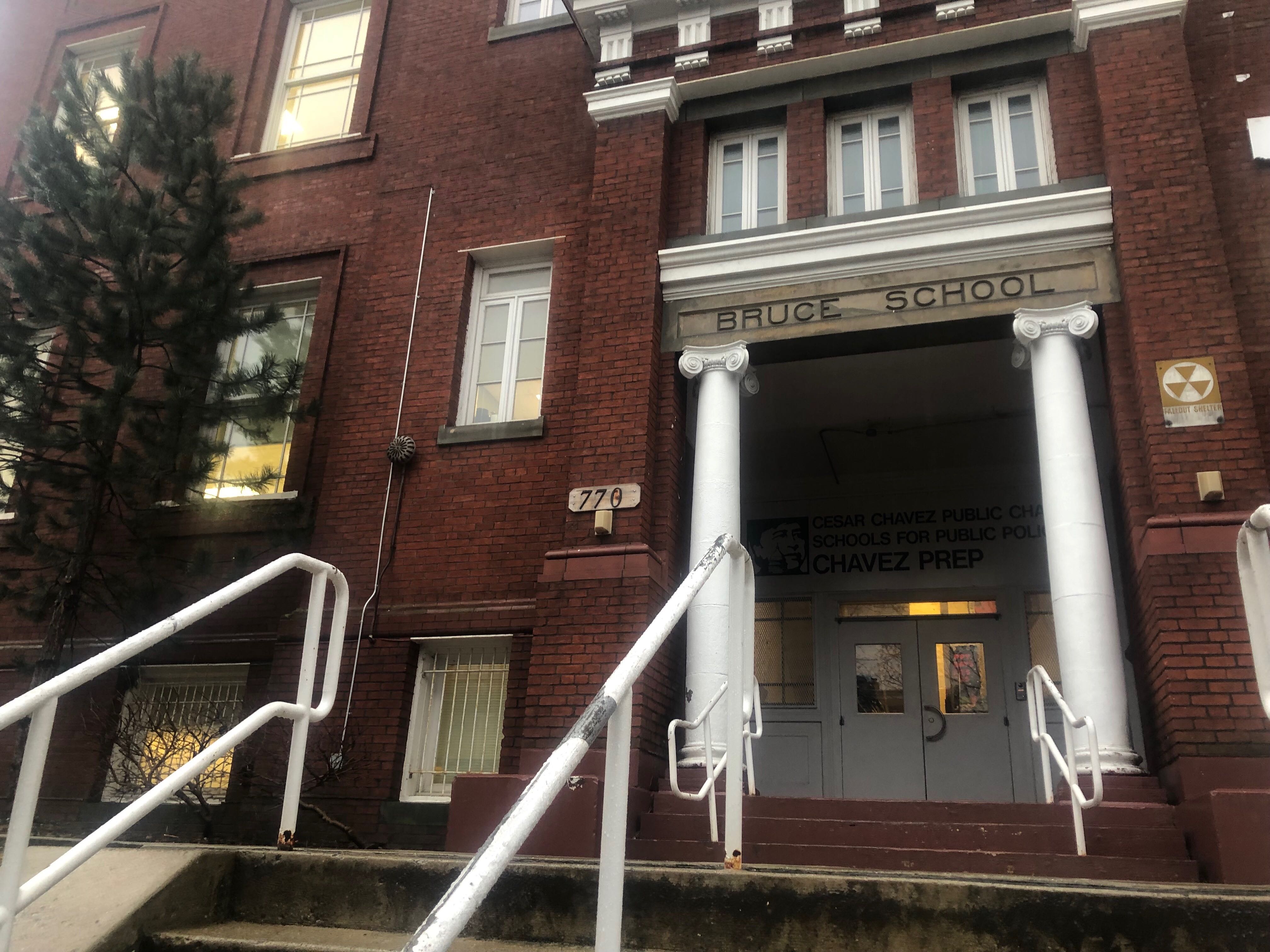
This rainy Thursday morning should have been a normal workday at César Chávez PCS for Public Policy (Prep) Middle School, but the educators entering the school were tired and distraught.
“My plan is to go in there for about five minutes and pull myself together because this is going to be really challenging for the kids,” said Allison Theis, a school social worker through tears. “It’s going to be a hard day.
The night before, the Chávez Prep staff learned that their school’s 235 students would need to find a new place to study next year; the school will be closing in June. The move was part of a larger restructuring plan put in place by the charter’s trustees. It includes the merger of two Chavez high schools, also set to occur in June.
This restructuring agreement would take the Chavez charter network from four schools to one by the end of 2020. Another middle school owned by the network was already scheduled to close by the end of the 2019-20 school year due to poor academic performance. This closure is what Chavez network’s leaders say put their finances in a precarious position, triggering the need for the consolidation of the schools.
But for the 30 or so employees at Chávez Prep, who have had tense relations with the network’s management, the news of their school’s closing was shocking. At the end of the 2016-17 academic year, the school became the first charter in D.C. to unionize. Since then, the employees have been trying to negotiate a contract.
“We started bargaining our contract in August of 2017. We’ve been bargaining on contract ever since, which is a ridiculous amount of time to bargain a contract,” said Christian Herr, one of the union leaders, who is also a science teacher at the school. “It still remains to be seen how that process is going to play out given what happened yesterday.”
Herr says the main goal of the union was to stabilize the school, which had been through five principals, five assistant principals, and multiple network CEOs over the last six years. He says the union had made progress on some negotiations, setting tentative agreements for working hours, teacher evaluations, and adding a sanctuary status policy for the school. But many other issues, like salary scales and an employment just-cause article, which would have required the school to give a just reason for firing an employee, are still being debated.
One Of The Longest Standing Charter Networks
Chavez Schools, which was established in 1998, is one of the longest-standing charter school networks in D.C. After a tumultuous 2016-17 school year, management of the network was taken over by TenSquare, an education consulting firm. Union leaders have complained about the amount of money spent on the firm and the lack of transparency between the board, trustees, the firm, and school staff. With this latest closure, union leaders expressed more discontent about closed-door meetings between the firm and the trustees.
A spokesperson for the network said Chavez schools CEO Emily Silberstein noted in a meeting about a year ago with the D.C. Public Charter School Board that these closures were imminent. Silberstein says the restructuring is a “new vision and direction” for the network.
“This is not a closure of the network by any stretch. This is actually an investment in one campus to build it out to a very stable and strong school that will serve our students down the road in grades 6-12 for years to come,” Silberstein said.
Network leaders also say there will be some positions that school staff can apply for in the new merged high school, but multiple employees at Chávez Prep say they will be looking elsewhere after this experience.
“We’re an amazing group of educators, and I think that we are all going to find positions elsewhere,” said Jennie Tomlinson, the librarian at Chávez Prep, who is also part of the school’s union. “I’m not worried about us. I’m worried about our students.”
Tomlinson notes that the Chávez Prep students face challenges finding a new school. The My School D.C. lottery closes for high school applications on Feb. 1, meaning that Chávez Prep’s 50 8th-graders have only nine days to decide where they want to apply. The rest of the students have until March 1 to enter the lottery to apply to attend a new middle school.
“Our priority over these next 10 days is ensuring that all of our students have a place to go next year,” Tomlinson continued through tears.
Multiple Charter Closures
The Chávez network closures follow the announcement of multiple charter closures in D.C.. This week the D.C. Public Charter School Board also announced the closure of National Collegiate Prep High School in Ward 8 by end of the 2019-20 school year. SEED D.C. middle school is also set to close in 2020, and Democracy Prep will relinquish its charter at the end of June and close. City Arts & Prep PCS is also set to close at the end of the current school year.
Silberstein says some of the challenges charter leaders are facing are merging high standards and competing for staff with limited finances.
“It’s a difficult thing to do in any circumstance…[it’s] in our faces here in Washington D.C. more than other places because we have school choice. But to me, school choice is incredibly important for a parent to be able to say this is where I want my student to go and this is where I think my student will succeed,” said Silberstein.
The closures will leave more than 1,500 students looking for new schools.