Martin Austermuhle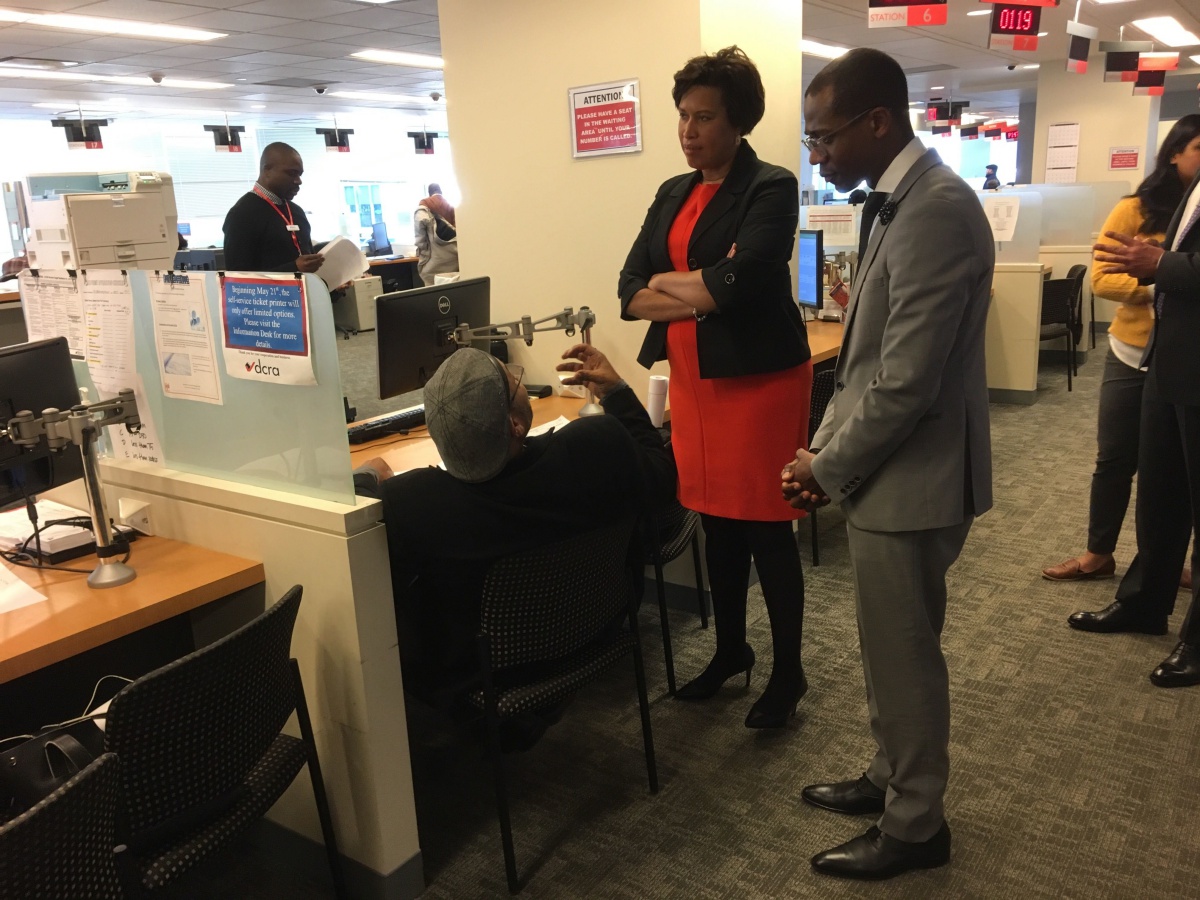
As Mayor Muriel Bowser walked around the permit center at the D.C. Department of Consumer and Regulatory Affairs (DCRA) on Tuesday afternoon, one thing seemed to be on her mind: how much of what people were waiting in line for could simply be done online?
“We have to evolve our way of thinking about how to serve our customers,” she said.
Bowser says she’s found someone to take up that challenge as the head of the long-troubled agency: Ernest Chrappah. Chrappah, who formerly led the Department of For-Hire Vehicles, which regulates taxicabs and ride-sharing services like Uber, has been serving as interim director of DCRA since former director Melinda Bolling left suddenly late last year for a job in Prince George’s County.
Speaking alongside Bowser after touring the permit center, Chrappah said his emphasis will be on bringing about “bold transformation” of the agency, which oversees everything from licensing and regulating businesses to issuing building permits and enforcing the housing code.
“We are in an environment where people can push a button in an app and see a car come to them, where you can find a handyman online,” he said. “So we have to transform the delivery of city services in a way that’s convenient, is affordable and is repeatable, and that allows us to scale our resources efficiently.”
Transforming A Troubled Agency
“Transformation” may sound like music to the ears of many residents and elected officials, who have long criticized the agency as unresponsive and overly bureaucratic.
DCRA has been accused of being slow to respond to complaints of illegal construction and vacant properties, and builders say the agency can be cumbersome and costly to deal with when it comes to get building permits approved.
Housing advocates also say DCRA has failed to police housing code violations, leaving low-income residents living in perilous conditions. Last year, the D.C. Auditor issued a report outlining shortcomings in how DCRA inspects properties for housing code violations, and how it sanctions owners to ensure compliance.
Last September, D.C. halted work on the historic Franklin School, which is being converted into a linguistics museum, for apparently removing significant amounts of historically protected interior materials, prompting criticism that DCRA inspectors had not properly policed the project.
A push to fix what ails DCRA isn’t new; in mid-2016, Bowser spent an entire week at the agency trying to find ways to best improve it. And it’s currently in the sights of the D.C. Council. This year, Council Chairman Phil Mendelson again introduced a bill that would split the agency in two; almost all of his colleagues have signed onto the measure. (Bowser says she opposes it.)
“[Chrappah’s] biggest challenge is going to be straightening out the bureaucracy, making it possible that the agency can respond quickly and effectively when there are complaints about illegal construction, when there are complaints about housing code conditions,” Mendelson said.
Using Technology To Stick To Promises
If any of that is weighing on Chrappah, he’s not yet showing it. Instead, he says he’s currently focused on making sure DCRA can live up to what it already promises to do — whether that’s meeting deadlines for issuing permits or re-inspecting problematic properties at regular intervals.
“Rather than come up with new standards, I want us to be operationally excellent in those areas,” he said. “Once we meet or exceed our performance targets, then we can get creative and take on more ambitious goals. But it starts with doing what you’re supposed to do.”
Chrappah has already shown his commitment to using technology and transparency to make sure the agency is moving forward. In his two months as interim director of DCRA, Chrappah made public an online dashboard that shows how far along the agency is in meeting targeted goals.
On renewing business licenses in less than a day, DCRA reports it is consistently beating its goal of 70 percent. On assessing and assigning permit applications within two days, a consistent string of exceeding the 90 percent benchmark in 2017 has turned into shortfalls in 2018 and 2019. And on processing notices of infraction handed out to property owners and landlords within 30 days, DCRA hasn’t met its 70 percent goal over the last two years.
Mendelson says that technology can be helpful in reforming city agencies, but only “if the technology is focused properly.”
Chrappah’s last post at the Department of For-Hire Vehicles could offer a hint of what’s to come at DCRA.
“He was always innovative and willing to think of new ideas to make the government work better. I found his approach refreshing,” said Council member Mary Cheh (D-Ward 3) who wrote legislation reforming and modernizing what was once the Taxicab Commission, introducing everything from a uniform color for cabs to dome lights and app-based hailing.
“When I passed legislation and I reformed the taxi operation, it took somebody to implement it. The Taxicab Commission was never very effective, it sort of just plodded along. He got in there, rolled up his sleeves and went to work,” she added.
From A Small Agency To A Big One
But Cheh also says DCRA is an agency on another scale. The Department of For-Hire Vehicles has an annual budget of under $20 million and roughly 70 employees; DCRA’s budget is roughly $60 million and employs some 440 people.
“It is a whole different kind of operation,” says Cheh. “You have an agency where people have been around a long time. It’s going to be harder to move that needle.”
Some residents have expressed similar concerns. Last week, Chrappah held a listening session with the city’s Advisory Neighborhood Commissioners — elected officials who represent neighborhoods across the city. According to those who attended, skepticism abounded over whether Chrappah will be able to change DCRA, which many commissioners say has been slow and ineffective in tackling rogue developers and righting poor housing conditions.
“He’s coming into it having the baggage that DCRA brought with it,” said Michael Wray, an ANC commissioner from Ward 1. “But he did not give answers that made it seem like he was ready to make big changes, which was disappointing to some.”
Another big listening session comes on Wednesday, when the Council will hold a hearing to ask the public what it should focus on when it comes to DCRA. The planned speakers include ANC commissioners, business leaders, housing advocates and building officials.
Chrappah says despite what residents may think of DCRA from past experience, he believes that technology can help change their attitudes. He wants to use it to make services faster and easier as well as to better track how well the agency is performing.
“That is the first step in building confidence by being transparent and managing to outcomes,” Chrappah said.
This story originally appeared on WAMU.