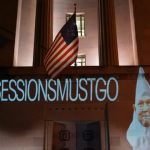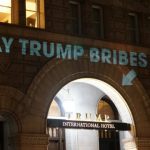

Robin Bell is no stranger to controversy. In 2017, Bell, a video journalist and multimedia artist, stoked it with his work Emoluments Welcome, when he projected the wording of the Constitution’s emoluments clause on the front of the Trump International Hotel on 12th Street, NW. He further pushed his message with an arrow pointing to the entrance with the words “Pay Trump Bribes Here.”
With the projection, which lasted only a few minutes before hotel security ordered it shut down, Bell’s idea was to bring the emoluments clause into clear focus and to open a conversation about what its violation means for our country.
The desire for openness, honesty, and transparency is the central concern of Bell’s new installation at the George Washington University Corcoran School of the Arts and Design. His first solo installation at the museum, Open, is rooted both in the controversies of today and those of 30 years ago.
Open serves as a prelude to the upcoming Corcoran exhibition 6.13.89, which will explore a controversial decision at the Corcoran Gallery of Art.
In 1989, the Corcoran cancelled the planned retrospective Robert Mapplethorpe: The Perfect Moment, which featured more than 150 works, and included homoerotic and sadomasochistic imagery. At the time, Corcoran administrators said they feared controversy would hurt federal funding for both the museum and arts organizations across the country. Although the Corcoran had not itself received National Endowment for the Arts funding for the show, the exhibition was organized by the University of Pennsylvania’s Institute of Contemporary Art, which had received $30,000 in NEA grants.
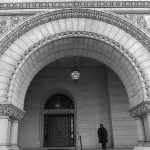
While some saw the Corcoran’s decision to cancel the exhibition as strategic, others viewed it as a betrayal. On what would have been opening night, artist Rockne Krebs projected images of Mapplethorpe and his photography on the Corcoran’s facade. The Washington Post reported that more than 900 protesters showed up to both demonstrate against the decision and honor Mapplethorpe. The artist had died just three months before the show was set to open of complications from HIV/AIDS.
Although Bell was just a kid in 1989, he says he witnessed the ripple effects of the Mapplethorpe controversy.
“For the District, and for the Corcoran, in particular, [the cancellation] was a real blemish because it wasn’t handled properly in a lot of people’s opinions,” says Bell, who previously taught video production at the Corcoran School. (The school was absorbed by George Washington University in 2014).
While the Mapplethorpe cancellation was a painful time for the museum, the planned June exhibition promises to look at the controversy with honesty and clarity, examining the decision, the protest and the after-effects. “I think that’s an important lesson to look back on,” says Bell. “When you lose your own moral ground; when you silence people, it’s bad, and it can have a lasting effect.”
For Open, Bell was invited to reflect on that contentious moment in the museum’s history, and revisit the intention and emotion of Krebs’ protest projections onto the Corcoran. Bell brings the protest from the outside of the building, inside. While his context is certainly our current political landscape, he has calibrated his work to reflect on the Mapplethorpe exhibition, censorship, and the artist community in the moment that followed.
In the atrium, Bell’s projection on the stairs and landing is comprised from previous projections on places such as the Trump International Hotel and the Supreme Court. The mix of text, faces, and bursts of orange and yellow light pull the viewer into the open space of the atrium. While the dimensions of the space turn most of the images into abstract shapes, it resonates as a protest piece. The call to action is for openness: freedom of speech, transparency, open society, open platforms, open minds.
As the natural light changes throughout the day, the work will appear differently in the space. Also, too, the work may continue to evolve over time. “Because it is temporal in nature, during the duration of this installation there is opportunity for [Bell] to change and shift the imagery that people are going to see,” says Sanjit Sethi, director of the Corcoran.
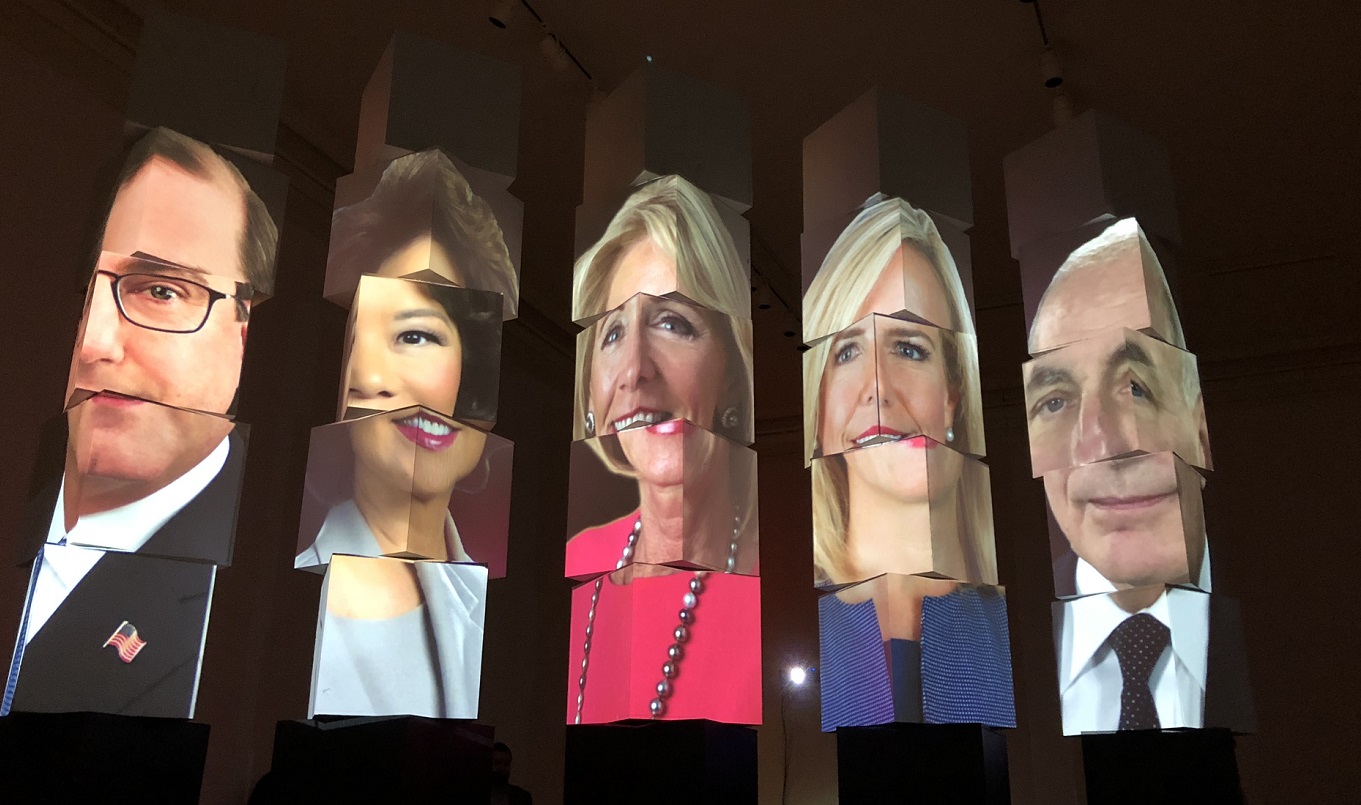
Another piece of Open is located in a darkened gallery. “Swamp Monsters” is comprised of a row of five towers, each 14 feet tall (which Bell notes is less than half the height of the proposed border wall). The towers are projected with images of federal and local politicians. The result is a sculpture that flickers with neon colors, abstract shapes, official headshots, video clips, and eerie, ghostly illuminations of smiling faces.
While the artwork is playful, it allows for reflection. Some may try to identify the political faces, while others will realize how few of them they know.
“‘Swamp Monsters’ is a very deliberate attempt to try to visualize the complexity of politics in this country,” says Bell. The government is bigger than the President or any one player, he adds.
Open invites visitors to stop, ask questions, and think critically. “[Bell’s] work has been at the forefront of timely dialogues that stand at the intersections of culture, politics, community and resilience,” says Sethi. “At a time where much of our current discourse revolves around shutdowns, walls, isolation and intractability, [Bell] asks us to think about the freedom that comes with being open, transparent, and poetic.”
Bell hopes this is just the beginning of the discussion. “As a country, as a nation, as a people, as a civilization, what we have to do is look at what we have done; look at the mistakes that we have made and grow from that,” says Bell.
Open: An Installation by Robin Bell is on view at The George Washington University Corcoran School of the Arts and Design Feb. 7-March 31. Opening reception Thursday 6 p.m.-8 p.m., FREE.