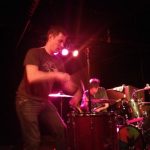
 Eliza Tebo
“We write music around the table, and we somehow manage to eat and make cocktails and drink and have hours-long conversations” says Erin Frisby, lead vocalist of all-female D.C. supergroup The OSYX.
From one of those lengthy rehearsal chats came This Could Go Boom!, a new D.C.-based record label the group created that’s presenting one in a series of showcases this Saturday at the Dew Drop Inn. With the tagline “your soundtrack for destroying the patriarchy,” the label wants to level the playing field in the D.C.-area music scene by promoting underrepresented, gender-diverse artists.
Look at the music industry, Frisby says, and you’ll see “it’s not necessarily music that is being conceived of, produced by, and for women and nonbinary people. So we just started really brainstorming around, ‘What could we do to shift that power in our own community?’ And what we came up with was the record label.”
Indeed, for all the Taylor Swifts, Cardi Bs, and Ariana Grandes of the world, the data on gender equality within mainstream music remains pretty bleak. A 2018 study by the Annenberg School for Communication and Journalism at the University of Southern California found that, among the 600 most popular songs from 2012 to 2017, a mere 22.4 percent of recording artists were female. And only 16.8 percent of musicians on the top charts were female in 2017, the lowest rate among the years examined.
As they developed the label, The OSYX band members—Frisby (of FuzzQueen and City Witch), Maya Renfro (of Pagan Reagan and Sonic Eddy), Selena Benally (of More AM Than FM and FuzzQueen), Robzie Trulove (of RadaR) and Ara Casey (of Honey Kill)—discussed some of the trials they have faced as female musicians in a male-dominated industry.
Renfro says her audience members—mostly drunk, older males—have approached her after shows and handled her guitars and violin without permission. Benally says she’s been mistaken for a roadie when toting her instruments. And Frisby says a man once wrapped his hands around her throat after a performance as he talked to her about her voice.
Yet the women behind TCGB, while demanding more opportunity and respect for female and nonbinary artists, don’t want to be dismissive of their cis male counterparts, Frisby says.
“I’m in bands with men, including my partner, and we have a ton of bands that we’re friends with and support, who are also supportive of the label,” says Frisby, TCGB’s board president. “The issue is more that I know that there are avenues for them to put their music out and to be heard and to be respected and to be listened to.”
Certainly, there are plenty of other locally run labels for musicians to choose from, including Babe City Records, Sister Polygon Records and the long-established Dischord Records. And some have a socially minded mission: The relatively new Working Order Records, for example, is a nonprofit that donates profits from a signed artist’s vinyl sales to a designated charity. Yet Frisby says TCGB is unique, not just because it wants to focus on underrepresented artists, but also in terms of its artist-development process.
We are “going to tailor every single release and the campaign surrounding” it to the artist, Frisby says, noting that some musicians might need childcare or be struggling with homelessness. “Every single one of our collaborations with an artist is going to look completely different.”
So just what does it take to put a record out and “make it” in the local music scene, and possibly beyond? According to Lisa Said, lead vocalist and guitarist for D.C. rock band Piramid Scheme, the answer is a lot of money and and a lot of work. Said is a TCGB board member and her band will be performing Saturday.
“If you want your music heard in this corporate landscape, you have to be ready to either be able to fund it” through your own or others’ efforts, says Said, who started her own label in 2017 to release her solo and band EPs but says she hasn’t had the bandwidth to nurture it as she had hoped.
To get TCGB, a 501 c3 nonprofit, off the ground, its organizers raised nearly $13,500 in an Indiegogo campaign that wrapped up last November and received a $600 crowd favorite award from The Awesome Foundation. They have also forged partnerships with local recording studios and other music entities, and have secured their first volunteer board members. And they have conducted informal surveys and hosted a focus group with musicians in the area.
“We aim to reflect our community—we’re not trying to define what our community needs,” Renfro says.
For Arlington singer-songwriter Jasmine Gillison, also scheduled to perform at the TCGB showcase on Saturday, the label is a necessary presence in D.C., offering a “safe space” for nonbinary and other underrepresented artists.
“This Could Go Boom! is just adding more bricks to the foundation of that in the D.C. music scene. I’ve been in a few different environments, and I feel like they really are amplifying the voices that are not heard and amplifying people who are not seen as much,” Gillison says.
Likewise, Krys Fernandez of unsigned local punk/rock outfit Company Calls, who participated in a showcase last September, says the band would like to sign with the label, calling it highly organized and noting the “supportive group of people that follow them.”
The label has hit the the ground running with workshops and panels, and was recently selected as the beneficiary for the D.C. Womxn Fuck Shit Up festival. TCGB’s first band is The OSYX (who did not charge recording costs to the label and will split proceeds with TCGB), which will give the label the chance to “experiment” with the many moving parts of representing a band and distributing its music, Frisby says. It plans to sign at least one additional artist this year as well as release a compilation record of local artists.
Within the next five years, the label would like to establish a well-known national presence as representation for gender-diverse artists, have the funds to hire staff, have a press presence at most shows, and get at least 100,000 streams or downloads for each track the label releases, Frisby says.
For Said, who says she sometimes gets “lumped into being singer-songwriter chick music” on local show bills, the D.C. music community has become more welcoming and less biased of late.
“Being a woman in music means constantly being second-guessed and condescended to by some dudes who think they know better,” Said said via email. “What I love about this community is that those of us that want to rise [above] the noise found each other and started working together. We have a ways to go, but it’s happening, and I’m excited to see how far we can take it.”
This Could Go Boom!’s next showcase takes place at Dew Drop Inn, Saturday, 7:30 p.m.-11:30 p.m. $10 donation at the door.