On an evening in early December, 11 Washingtonians gathered in the Rhizome community art space in Takoma to write their own obituaries. Those who sat in the chilly living room were not unfamiliar with death. Some had worked as hospice nurses, others had friends who were dying of old age. One participant was idly sketching headstones in a notebook in lime-green pen.
Sarah Farr, founder of Death Positive DC, held a “Write Your Own Obituary” workshop to give Washingtonians the chance to do a creative experiment around a taboo topic. Writing one’s own obituary is an exercise, she says, in examining one’s own life and legacy.
“What if,” Farr asked the group, “your obituary was about your ‘essence,’ not so much the accomplishments you accumulate as the years go by?”
Formal obituaries rarely take this approach. Rather, they have long been the domain of society’s prominent movers and shakers, those deemed most “newsworthy.” But the very nature of the form is changing.
Obituaries of everyday people go viral for frank depictions of a life claimed by addiction. People request that theirs be tongue-in-cheek. The New York Times has been adding new obituaries of overlooked historical figures to their archives. The “art and craft of an obit” was explored recently in a radio show on Washington’s NPR station and a documentary film.
“This is a time in history when so many more people are allowed to participate, and be a part of decision making, and be co-creators in our society,” said Farr. “ I still think that in the past, women and people of color were huge contributors, it just wasn’t acknowledged … that said, we still have a long way to go.”
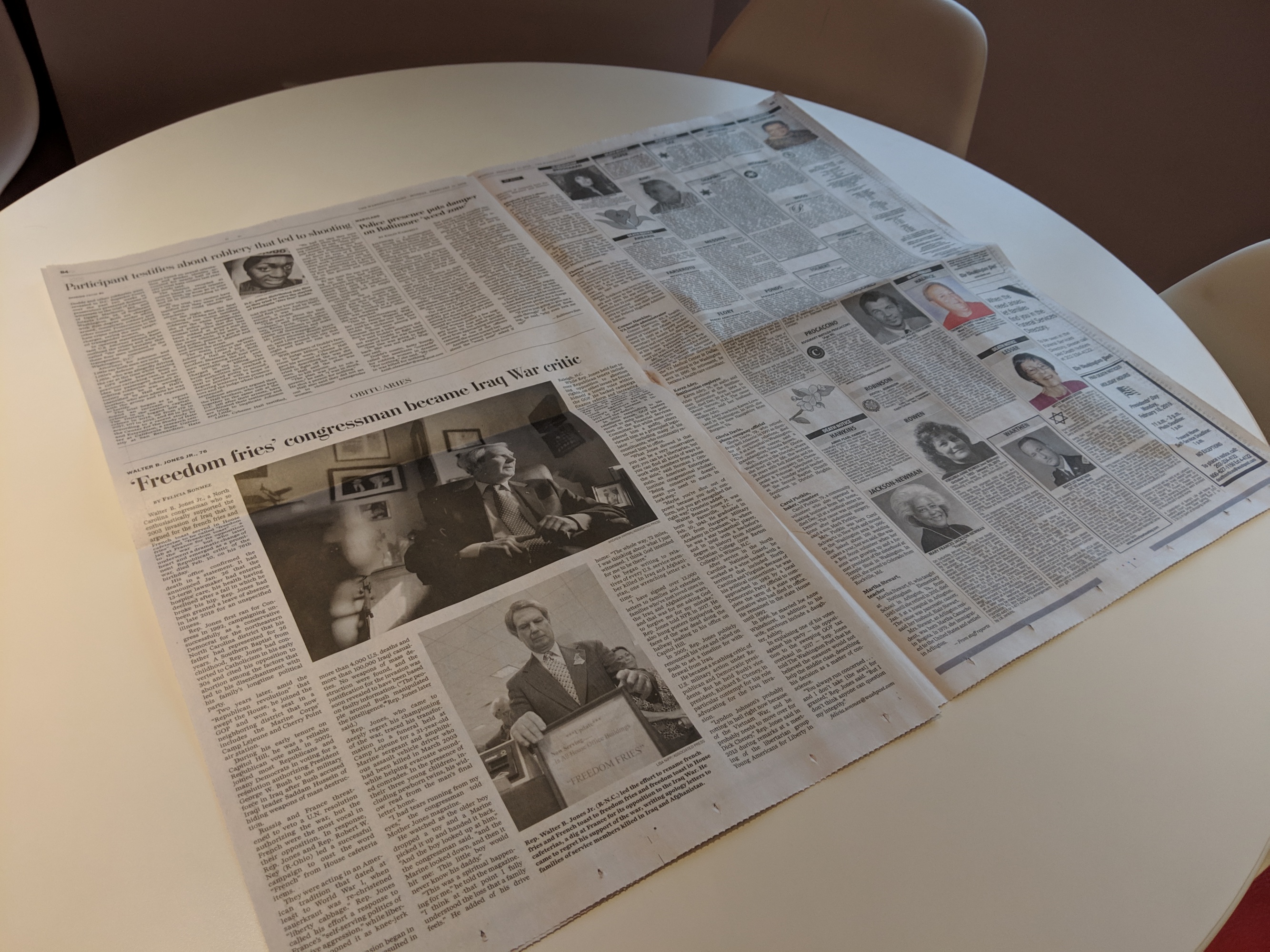
Locally, the Washington Post has the most widely read obituary section. The paper publishes news obituary stories about “people who have had a major impact on the Washington region and beyond” and have lived in the area for at least 20 years.
Harrison Smith, who has been a reporter on the Post’s obituaries desk since 2015, emailed me a selection of obituaries he wrote over the last year. They included the life stories of locals like Charles Lazarus, who turned a Washington bike business into Toys R Us; Dovey Johnson Roundtree, a civil rights activist and woman who shattered boundaries as a African American lawyer in the 1960s; and George Walker, the first African American composer to win the Pulitzer Prize.
While the Post’s recent coverage does include plenty of people outside the “old white man” mold, they are still, mostly, champions of their fields: foreign ministers, lawyers, writers — people who made news while they were alive.
But Farr’s workshop took a different approach. Participants tried different types writing exercises to brainstorm and write their obits — one asked writers to consider: “At your core, who were you?”
Another directed people to “write an obituary as a true account of your life to date,” but then to “write a fantasy obituary in which you write down all of the things you wish you had done with your life.”
Alex Snider, 33, of Petworth, tried the “fantasy obituary” exercise. He’s since drawn up a Google Doc called “You’re not dead yet,” where he’s categorized some of his values.
“My goal is to use this as a way to help live a better life,” Snider told DCist via email after the workshop.
“At funerals, I’ve been moved most not by people who lived ‘impactful’ lives on a global or regional scale,” he continues, “but by those who embody things that I value — kindness, empathy, responding to life’s challenges with humor.”
Smith has noticed a small shift in the scope of the Post’s obituary coverage. “I do think it’s fair to say that obituary writers in 2018 are probably taking a little bit more time in deciding who merits an obituary,” he said.
Traditionally, obituary writers would consider if the deceased is “very obviously newsworthy, there’s something that they did that landed them on the pages of the Washington Post or the New York Times over the course of their life,” he explains.
Other times, people might not have appeared in print much, but they had a unique career or interest, they affected their community in a significant way, or there is something compelling about their personal story.
Certainly, thousands of people in the Washington area have lived fascinating lives but never made it into print — isn’t it a bit rankling that they have to already have news clips about them to get a final one? What does it really mean to be “newsworthy”?
“That word, ‘newsworthy,’ is really screwed up,” says Smith. “There were plenty of people who did important things whose work was not being reported on in the country’s leading papers.”
In the Post, a formal news obituary is a full-length story written by a journalist. A death notice, however, is usually written (and paid for) by family, and what are called “community deaths” in the Post are short obituaries of longtime Washington-area people that typically come from the hundreds of submissions per year to the Post’s online submission form. Smith says some full-length, bylined obituaries do come from the online submission form as well, but the bar to get one is rather high.
Smith says he has tried to consider deconstruct what makes a person unworthy of coverage. Is it because they didn’t appear in the paper? Or because their identities and interests were considered socially unacceptable or outside the mainstream?
“Or, because they were a person of color, or a woman, or their sexual identity didn’t match what the rest of the country considered ‘normal,’” Smith says.
So while D.C. obituary writers are broadening their view of what makes a person obituary-newsworthy, locals are writing their own and considering what makes their lives notable, even if only to themselves.
In the end, a formal obituary in a paper of record isn’t necessarily the coda of exercises like those in Farr’s workshop.
“For some people it might not be about the finished product, it might be about reflecting and writing about your own life,” she says. Farr plans on doing another obituary workshop this year.
Barbara, 75, who lives in Maryland, also attended Farr’s workshop. She wanted only her first name used so she could speak openly about subjects sensitive to her family, and wanted to write her own obituary because there isn’t anyone else who will write about what she calls her “back assward” life with honesty and humor.
Barbara’s first husband, who she married at 18, “ran off” with a branch of the motorcycle club Hells Angels and was later convicted of attempted murder.
“Somehow, that has to be in [my] obituary, because it really framed my whole life,” she says.
Barbara says when she puts the finishing touches on her obituary, she’ll share it with her current husband and children. She’d never been able to write down her life story before.
“It doesn’t matter if it doesn’t get published,” she says. “What matters is that they know from my point of view how things went.”