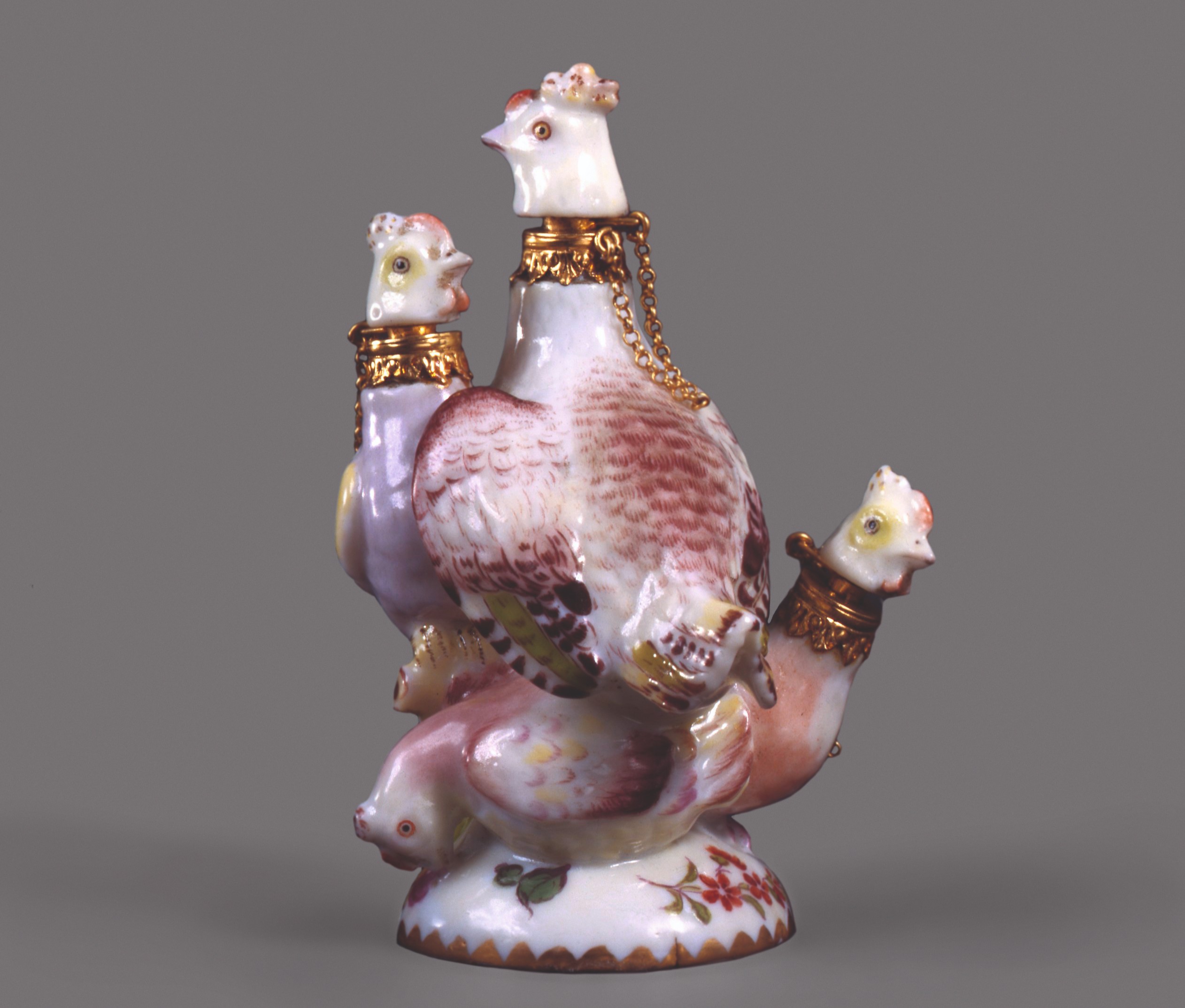

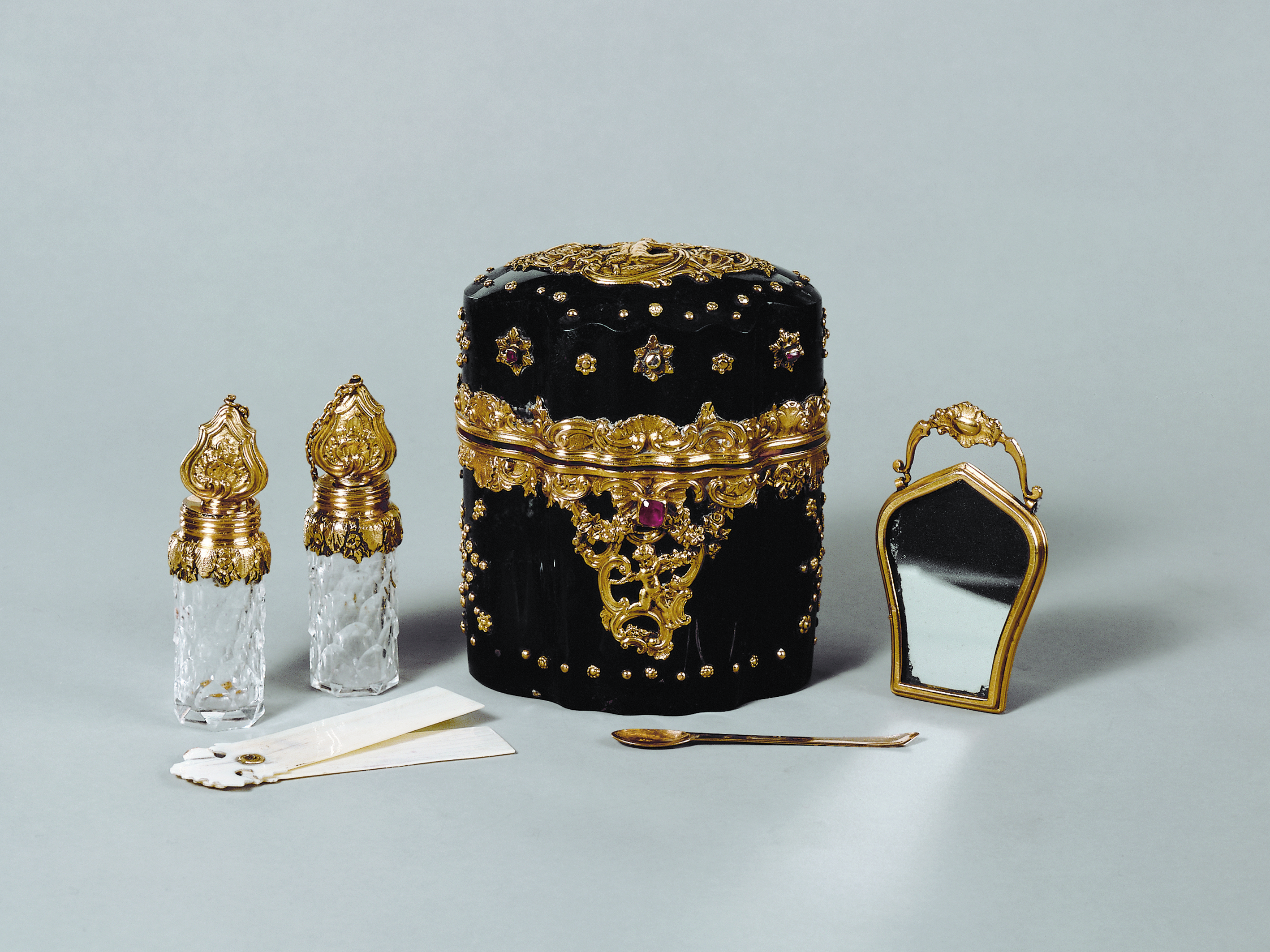
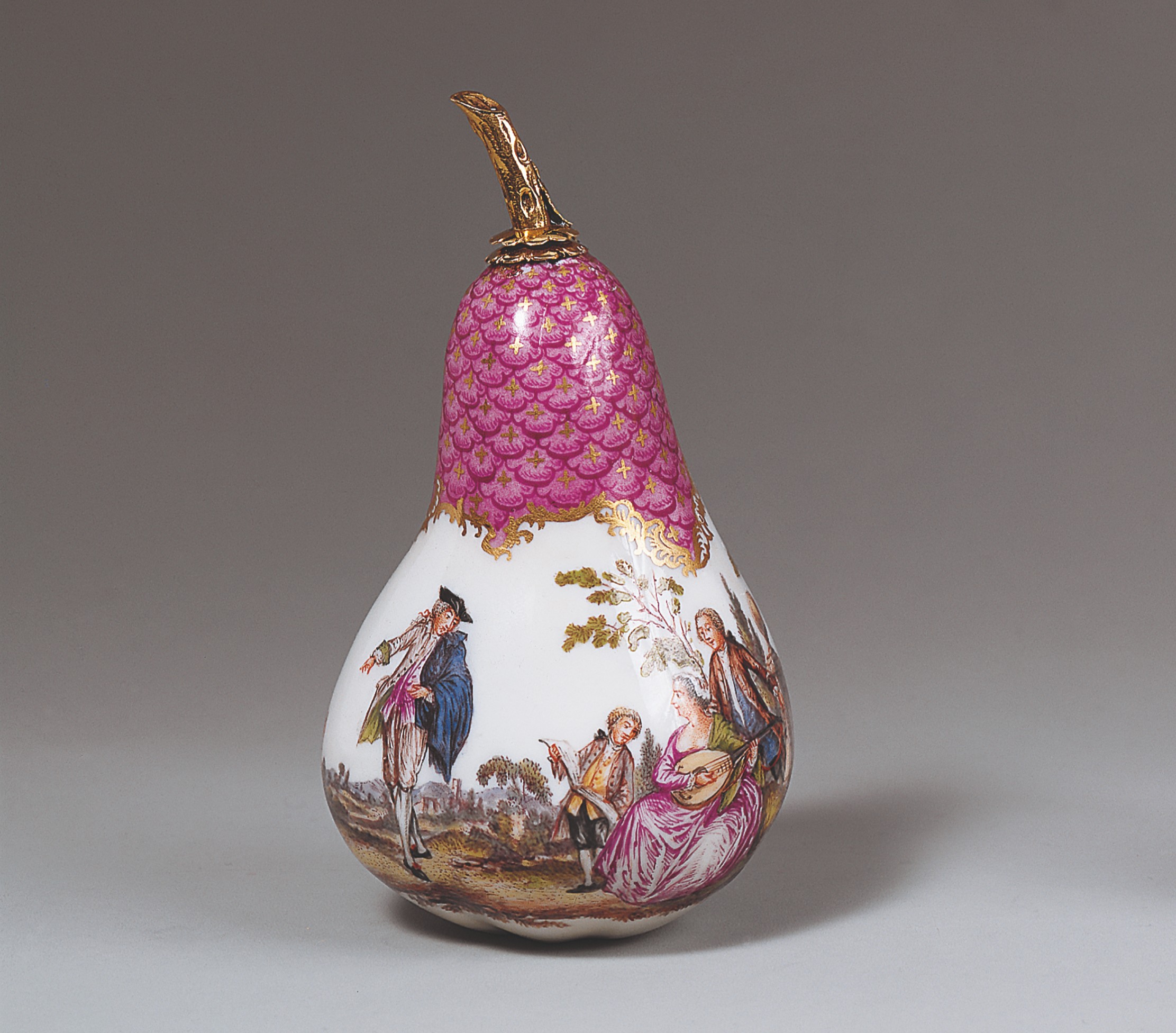
There’s something strange brewing deep in Rock Creek Park—and it smells terrific too. Would you believe it’s a three-headed chicken? That’s just one of the magical creatures and miniature vessels that await you in a new exhibition at Hillwood.
Perfume and Seduction brings together some 150 items in a dazzling show that draws from two major collections of toiletries: the decorative arts owned by Hillwood founder Marjorie Merriweather Post, and prized specimens from French chemist and perfumer Leon Givaudan.
For the most part, these objects were manufactured to capture that most elusive of stimuli: scent. The three centuries of perfume bottles on display are a testament to elegance and ornate craftsmanship; to technological advances in decorative materials; and to the evolution of the very substance of fine fragrances.
They also testify to changing ideas about personal hygiene.
Perfume critic Luca Turin bluntly wrote that the 20th century perfume industry arose from the plain fact that “postwar France stank.” Rebecca Tilles, associate curator of 18th century French & Western European fine and decorative arts at Hillwood, says the, well, stench gave rise to what the French called “la toilette.” The ritual of preparing your body and clothes became “extremely prolonged and theatrical,” she says. “The root of toilet and toiletries really comes from this moment.”
Every time you get ready for a Valentine’s Day dinner, a blind date, or an important interview? Merci, la toilette. It’s thanks to that and the Gallic aristocracy that brung it that we spend billions a year on cologne, aftershave and roll-on deodorant. For 18th century French nobles, this ritual, Tilles says, was performed “to welcome lovers, to welcome friends, to talk about politics and gossip.”
The rage for hygiene led to a new level of gift-giving. The scent dispensers that Merriweather Post and Givaudan collected were the most extravagant type of luxury items that members of a European court would have owned or given away—often to lovers.
Martine Uzan, communications manager of Givaudan, explains that secret messages were sometimes inscribed in these aromatic vessels. “Friendship unites us,” Uzan translates one such dedication, clarifying, “friendship in the 18th century means love.”
Which is part of why these tiny specimens, which pack gorgeous artistry in a minimum of space, are so meaningful even beyond their beauty. Tilles remarks that Merriweather Post did not exactly collect perfume bottles, even though she gravitated toward examples of the finest materials and craftsmanship. There was something else that drew her, she explains: “The sentimentality of objects that were tokens of affection.”
As the modern romantic may show affection by means of gag gifts, so did the 18th century Lothario. There’s a whole case full of Western European miniatures on display, almost all of them from the Givaudan collection, that seem like refined ancestors of Precious Moments figurines.
This Lilliputian community is populated by residents barely two inches high, porcelain figures depicting a Polish hunter, a nun, or a monk, or characters from the Italian commedia dell’arte.
William Shakespeare wrote that, “All the perfumes of Arabia will not sweeten this little hand”—but, with an 18th century piece made by the Derby Porcelain Manufactory, you could pull the Bard’s head off for a dose of your favorite scent.
And the animals!
Wait, why use animal shapes, however tiny and adorable, to carry sophisticated perfumes? Because they were exotic, and symbolic.
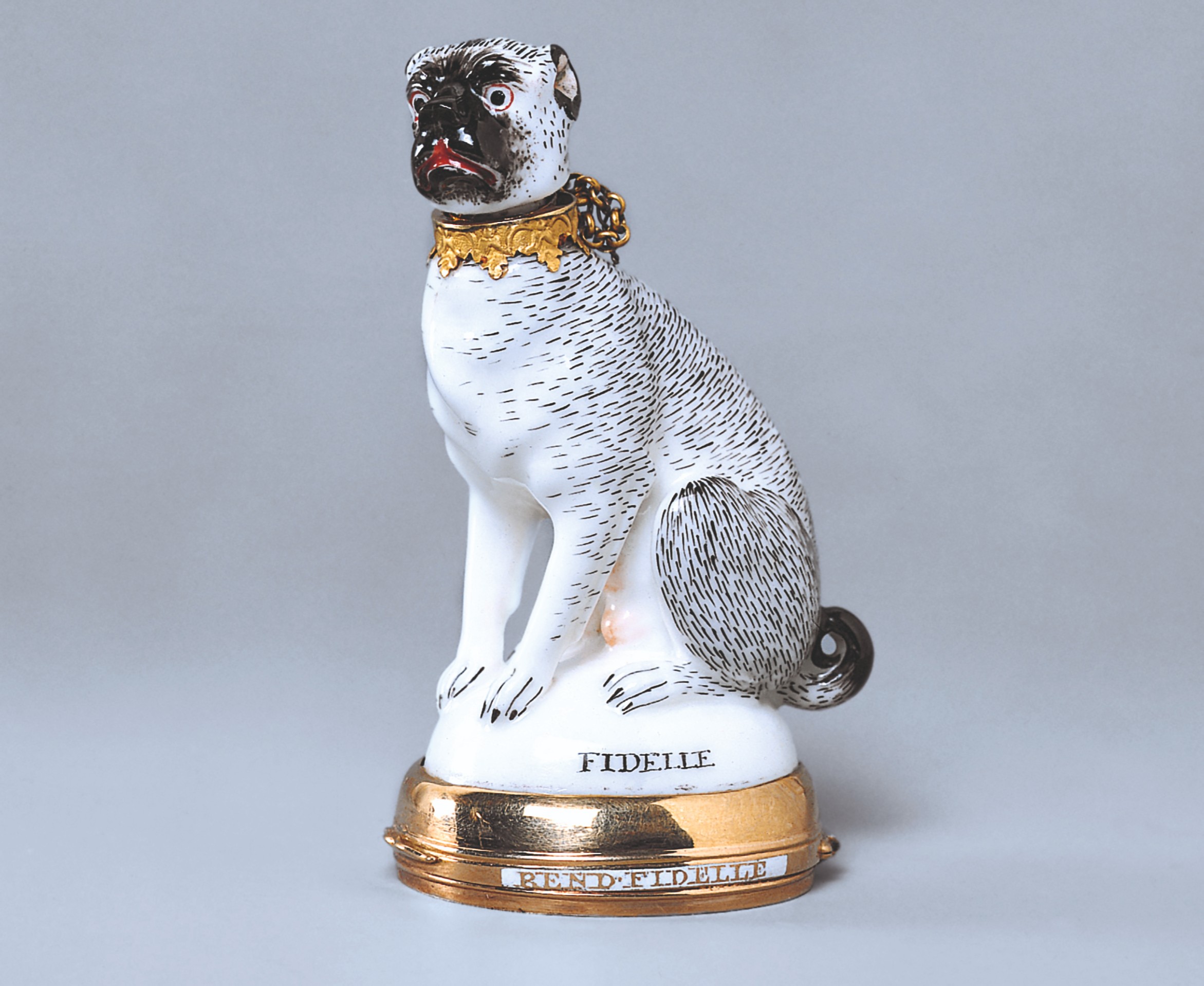
“A dog is the symbol of faithfulness,” Uzan explains. Which is why, at the base of a pug-shaped bottle from London’s short-lived Girl-in-a-Swing porcelain factory, the word “Fidelite” is written, as well as a slogan that Uzan translates as, “Liberty makes me faithful’–which is by the way very modern!”
The most fantastical object in the exhibition is a triple perfume bottle in the form of three chickens—regarded from a certain angle, it looks for all the world like a three-headed chicken. The proud owner of this piece from London’s Chelsea Porcelain Manufactory could use this chicken to transport three of their most prized fragrances—one for whichever mood floats their feathers.
All this vanity could come at a price. The exhibit includes a display of vinaigrettes–small boxes that held a vinegar sponge one could inhale to mask unpleasant smells (don’t get Luca Turin started on the French subway). The sponges were also used to revive someone who had fainted from a tight corset or the toxicity of makeup—which in the 18th century cause a high incidence of lead poisoning.
Those were dangerous times, but man, they smelled good.
Perfume and Seduction is on view at Hillwood Museum from February 16-June 9. Open Tues-Sun 10 a.m.-5 p.m. $18 suggested donation.
This post has been updated to reflect the correct suggested donation price for Hillwood Museum.