As the students of Marjory Stoneman Douglas High School emerged from an unspeakable tragedy as national leaders in the fight for gun control, as household names, as forces to be reckoned with, they inspired teenagers around the country.
In the D.C. region, students sprang into action: taking part in a massive walkout, protesting on the National Mall, discussing gun control at town halls. One year later, their activism is still going strong.
‘All the joy was sucked out of the room’
In a small art gallery in downtown D.C. on Tuesday night, an intimate crowd looked at photographs of the anti-gun violence protests at the Capitol, at a sculpture of a child hiding under a desk, at a clock whose big hand was instead fashioned as an assault rifle. Underneath the clock, a plaque read: “As the hands on this clock tick, bullets hit innocence to death.”
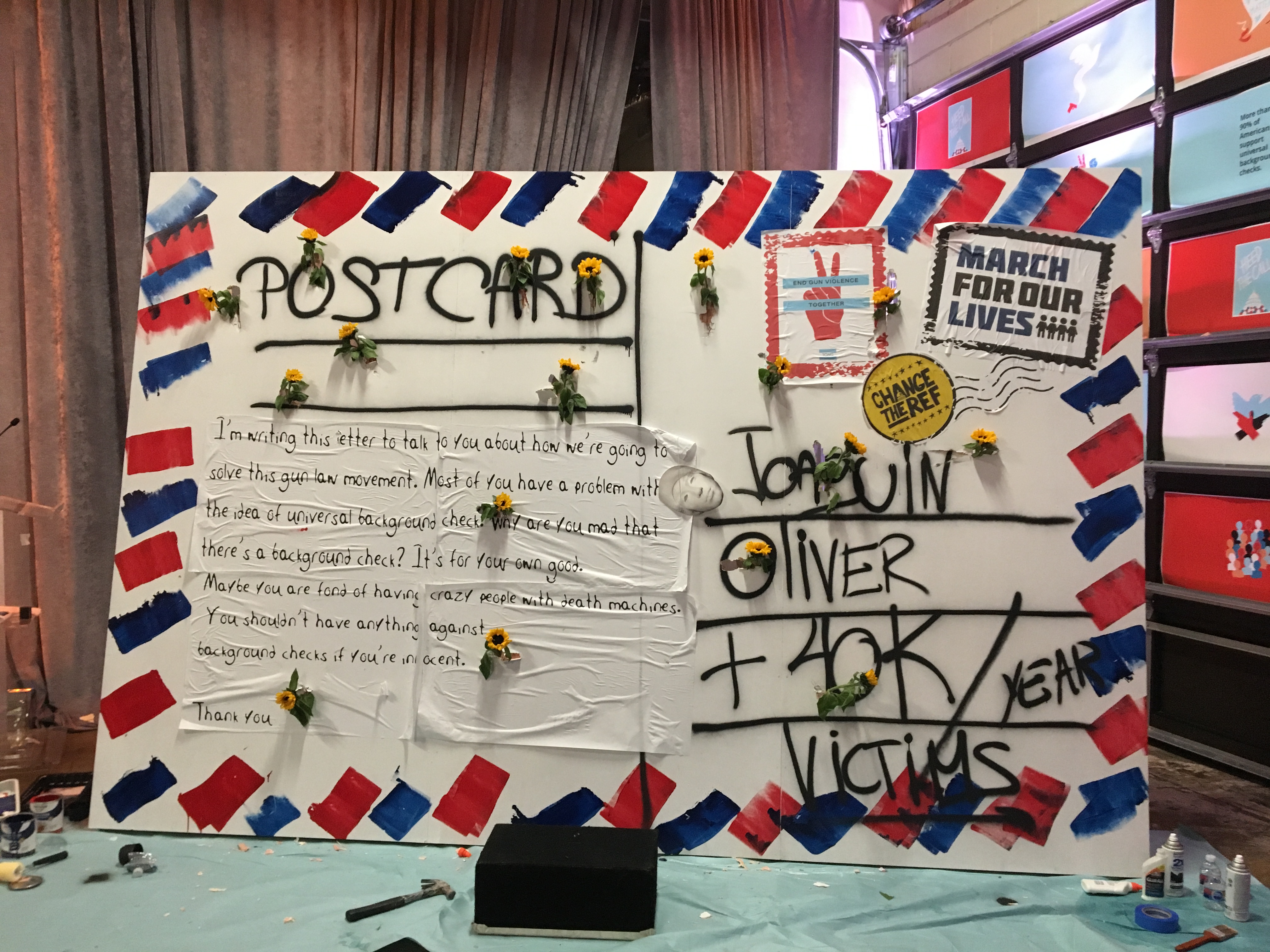
Perhaps nothing was quite as arresting as a series of plastic bags of blood-stained valentines with police reports attached. The artwork was made by Tori Gonzalez, whose boyfriend, Joaquin Oliver, was killed in the Parkland shooting. Manny Oliver, Joaquin’s father, also displayed a series of murals—entitled “Walls of Demand”—to commemorate his son.
The show, on view at the Center for Contemporary Political Art, was organized by MoCo for Change, a group of students in Montgomery County who were galvanized by the shooting in Parkland.
“All the joy was sucked out of the room,” said Dani Miller, 18, recalling the moment she returned home from high school and saw the news from Florida on TV.
As students around the country planned protests, Miller teamed up with more than two dozen schools in Montgomery County to organize a school walkout into the District. Now a senior at Churchill High School in Potomac, she continues to serve as the co-president of MoCo for Change.
Over the last year, the group has campaigned in the midterms, organized sit-ins at Congressional offices, and marched to the NRA headquarters in Fairfax, Virginia.
‘This is not normal’
At a rally on Monday night, hundreds of people—many wearing shirts that read “March For Our Lives” and “Black Lives Matter”—packed into Union Market’s Dock 5 warehouse.
Hosted by Toms (yes, the shoewear company), the End Gun Violence Together Rally drew Taye Diggs, Martin Luther King III, Vic Mensa, and other well-known figures, along with national youth organizations.
The rally’s focus was largely on national gun issues, but in addition to Mayor Muriel Bowser, students from Thurgood Marshall Academy, a charter school in Southeast, D.C., were also in attendance.
It was not a school shooting that killed their classmates, D.C. teens Zaire Kelly and Paris Brown. Sixteen-year-old Kelly was shot to death in September 2017 while defending himself against an attempted robbery in Northeast, D.C. Four months later, Brown’s killing in Southeast marked the first fatal shooting of 2018.
Their deaths at the hands of routine gun violence sparked the students of Thurgood Marshall to form the activist group Pathways 2 Power.
“Pathways 2 Power was more so created out of that, created out of the grief and empowerment of the students we lost,” says 18-year-old N’yana Martin.
In November, Pathways 2 Power released a powerful PSA. It opens with one student saying, “At a certain point you start to think that this is normal. You think gun violence is just going to happen.”
Another student chimes in: “But this is not normal. Every community does not experience this.”
In the past year, P2P has brought their voices directly to the Metropolitan Police Department, the D.C. Council, and Capitol Hill, most recently meeting with members of Congress to advocate for House Bill H.R. 8, which would require universal background checks.
‘I just lost it’
For some students in the region, their protests weren’t just about the Parkland school shooting, but for a school shooting closer to home.
On March 20, just days before the March For Our Lives, a student killed his ex-girlfriend, 16-year-old Jaelynn Willey, at Great Mills High School in St. Mary’s County, Maryland.
Mollie Davis’ classroom was just above the shooting. When her classmates realized there was someone in the school with a gun, they immediately locked the door and hid.
“We were so in shock,” Davis said. “We didn’t know what to think, that something had actually happened.”
A couple of days later, Davis, who was already involved in planning school walkouts, returned home from a press conference to texts from her friends that Willey had been taken off of life support. “I just lost it,” she said.
Davis, now a student at Hollins University, began to get involved by planning national “die-ins.” She is also in the process of planning a march from Maryland to the NRA headquarters in Virginia sometime in June.
‘We’re still out here’
A year later and the rest of the teens aren’t stopping either, though many of them say their focus has shifted away from protests toward concentrated legislative and local action.
“We’ve had sustained action after the March For Our Lives, after the midterms,” said Miller, the president of MoCo for Change. “It’s been months and we’re still out here.”
Daniel Gellilo, 18, a former student from Richmond Montgomery High School in Rockville who took part in organizing school walkouts following the Parkland shooting, said efforts to pass legislation like H.R.8. is the right focus for now.
“If it gets bogged down [in the Senate] or not will kind of determine if we go back to protesting,” Gellilo said of the bill.
Miller said they’re also working to register young people to vote. This shift, she said, keeps the movement sustainable.
Back at the gallery, Montgomery County student Julia Pavlick shared a painting entitled 4.3. It commemorates the lives of eight transgender woman who were killed across the United States in 2018. The title comes from the fact that transgender woman are 4.3 percent more likely to be killed than cisgender women.
“It is incredibly vital to the gun discussion to acknowledge not only the statistic, but the individual trans lives that have been lost,” Pavlick said.
While March for Lives DC, which is the D.C. chapter of the national March For Our Lives organization, originally focused on school shootings, it has grown to encompass everyday gun violence, too.
It was important to acknowledge that gun violence isn’t just a “school shooting phenomenon,” but rather “something that happens every day in underprivileged, underrepresented communities,” said Ethan Somers, 19, a current junior at George Washington University and communications director of March For Our Lives DC. “700,000 people here in D.C. face gun violence and do not have a voice on the national stage.”
The organization is now engaging with local groups that have been working on gun violence prevention since before the March For Our Lives movement, said Brian Toscano, an organizer for the group.
One of them is Pathways 2 Power, which is in the midst of planning a series of conversations aimed at fostering change at the city level.
P2P is planning a youth summit where they hope to have a diverse audience of problem-solvers, including councilmembers and policy makers, to talk about gun violence in the city, according to Martin.
Member Destiny Young, 18, said they’re also working on a roundtable discussion with elected officials and members of the Metropolitan Police Department, designed with students in the center of the circle and the officers and officials outside of it.
And Malia McMillan, 17, said the group is having students participate in focus groups on community health, mental health, education, safety, and transportation.
While the TraRon Center, a non-profit that provides services to help people cope with gun violence, is not directly involved with the student activists, founder by Ryane Nickens said that they “hope to build the advocacy in the young people, no matter how young they are …. they are the ones who are suffering, the ones whose voices are being ignored.”
An important piece of fostering advocacy is mental health, she said, urging young people involved in anti-gun violence activism to practice self-care.
“You are not their voice. You are a part of the voices that give them power. You are a part of the voices almost like a choir,” she said. “We’re all singing together.”