Ally Schweitzer
After Amazon axed plans to open a campus in Long Island City, New York, left-leaning activists there declared a resounding victory. Now the surprising turn of events is raising questions about whether the same could happen in Northern Virginia.
Local organizers have been protesting Virginia’s Amazon deal for months, even before it was made official in November. They’ve called on local leaders to either cancel the deal, reject public incentives for it or extract more community benefits from the company if it does come. Meanwhile, business leaders and elected officials largely support the project, saying it will reap enormous economic benefits for the region.
But with Amazon now pulling out of New York, what’s the probability of the same thing happening here? What lessons have stakeholders taken from the collapse of Amazon’s Long Island City deal? And what can local residents expect next from the dueling efforts to either land Amazon or call the whole thing off?
Here’s what people on both sides are saying.
How are local activists reacting to the New York news?
Mostly, they’ve reacted with tempered excitement, according to Roshan Abraham and Alex Howe, two organizers affiliated with the local For Us, Not Amazon coalition.
“My first thought was that this was an amazing victory for the New York City community,” says Abraham, who’s with Our Revolution Arlington, a group that opposes taxpayer-funded incentives for Amazon. Activists’ success in Long Island City has stirred up energy in the D.C. area, he says, generating more public interest in local activists’ efforts against Amazon.
But the events in New York also shed light on a key advantage activists had there, says Alex Howe, an organizer with a local chapter of the Democratic Socialists of America: They had support from politicians.
Amazon executives regularly faced tough questions from elected officials in New York City. At a contentious December hearing, city council members reportedly grilled company representatives while activists chanted “GTFO, Amazon has got to go.”
“We haven’t had anything like that,” Howe says. “The Virginia politicians have been completely bending over backwards and just kind of carrying [Amazon executives] around on a sedan chair.”
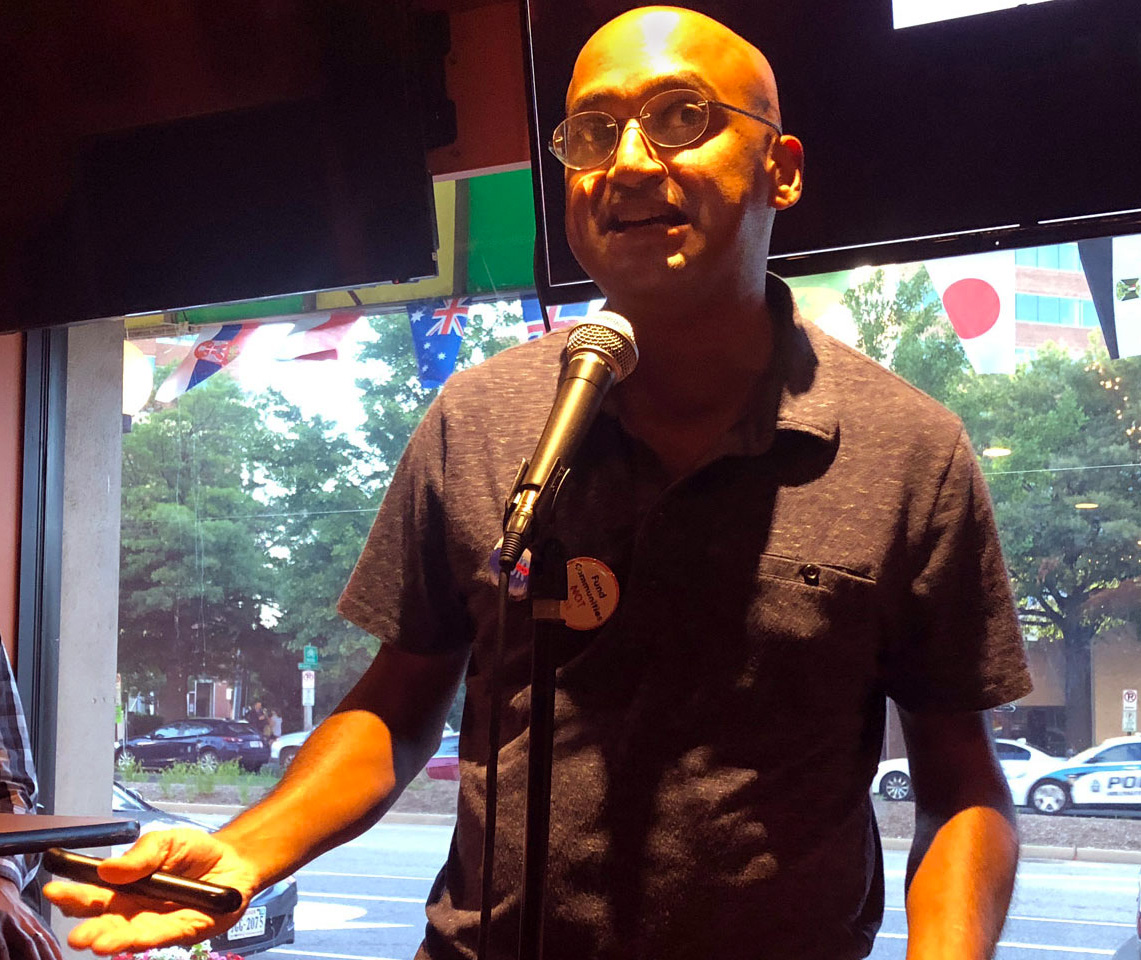
Roshan Abraham, an organizer with Our Revolution Arlington, says activists are mobilizing residents to pack a public hearing on Arlington’s incentives deal for Amazon.Ally Schweitzer / WAMU
It’s unclear whether Amazon has actually gotten the royal treatment from state and Arlington County officials, but activists say Virginia’s easy approval of a state incentives package, combined with Arlington County Board members’ largely neutral or positive public comments about Amazon, signal their support for bringing the company here.
Members of the Arlington County Board haven’t publicly criticized Amazon or any incentives the county or state have offered the company. Board Chair Christian Dorsey has said incentives must produce equal benefits for Arlington residents, but he’s emphasized Amazon’s potentially positive impact on Arlington — namely, its capacity to fill a lot of vacant office space there, which would help solve a significant budget shortfall.
Dorsey also issued a statement after the New York City news broke last week, saying Arlington is “still honored” that Amazon chose the region for a new campus.
Abraham says Dorsey’s choice of words exemplifies how Arlington leaders generally talk about Amazon.
“That was their signal that, ‘We’re going through with this, we’re doubling down,’” Abraham says. “Because there’s such strong buy-in on this deal by our leaders, it’s come to a point where it feels like they are selling us the deal. It feels like they’re doing the work that Amazon would have otherwise had to do themselves.”
What concerns have activists raised about Amazon opening a campus in Virginia?
A major concern is Amazon’s partnership with Immigration and Customs Enforcement, or ICE, the U.S. government’s chief agency for enforcing immigration law.
In October, it was revealed that Amazon had pitched its facial recognition surveillance technology to ICE. Around the same time, a report commissioned by pro-immigration groups called Amazon and other tech firms “the backbone for the federal government’s immigration and law enforcement dragnet.”
None of that sat well with local activists, especially those in the region’s large Latino community.
“How does that reflect Arlington values, when we state ourselves to be an inclusive community?” says Abraham. “We’ve even made a resolution saying we won’t support policies or practices that harm immigrant communities. But subsidizing Amazon does that.”
Activists have also raised concerns about the impact Amazon could have on housing prices in Northern Virginia. They say an influx of highly paid workers will only exacerbate the region’s existing shortage of affordable housing, displacing residents — particularly Central American immigrants — who can’t afford even slight increases in rent or property taxes.
“Unless [leaders] actually respond very strongly to this, with Amazon coming here, [housing is] going to be a big, big problem,” Howe says.
Affordable housing advocates agree, calling on jurisdictions to take concrete steps toward preserving or building more affordable homes in Northern Virginia to gird against price increases. Crystal City residents say feverish speculation over Amazon has already raised housing costs on the neighborhood level.
But some economists say those concerns are overblown, and they don’t expect Amazon alone to increase housing prices in a region that’s already one of the most expensive in the country. Some also say the focus on housing prices overlooks Amazon’s larger potential benefits for the region.
The retailer is expected to generate lots of new tax revenue, which could help enhance public services, says Kate Bates, president of the Arlington Chamber of Commerce.
“No matter what you care about, if it’s schools, libraries [or] social services, you need the business community to be doing well in order to fund those priorities,” Bates says.
That perspective is echoed by Thomas Cooke, a professor at Georgetown University’s McDonough School of Business, who says activists focused on housing prices fail to see the bigger picture.
“A lot of individuals do not see this as benefiting them personally. [They say,] ‘How’s it going to benefit me? My rent is going to go up. My property value is going up, therefore my real estate taxes are going up,’” Cooke says. “But if you look at this simply as an individual, with your self-serving interest, and not for the good of the whole, you reach what I think is an unreasonable conclusion.”
Cooke says there’s an argument to be made that New York offered too much money to Amazon. But Virginia’s deal, he says, looks good on balance, and it’s bound to produce longer-term wins for the region.
“It [will be] a great infusion of talent and opportunities in Crystal City,” the professor says.
Where does Virginia’s Amazon deal stand now — and what’s next?
For the most part, Amazon is proceeding as though its Northern Virginia campus is a done deal. The company has signed leases with JBG Smith, the developer that owns most commercial property in Crystal City. Filings with the Securities and Exchange Commission show Amazon is also planning to make billions of dollars in construction investments and buy millions of dollars in real estate in Northern Virginia.
Meanwhile, Virginia Gov. Ralph Northam has signed the state’s incentives package into law, committing to up to $750 million in public incentives for Amazon and related infrastructure and education spending.
But Arlington County’s proposed $23 million incentive package for Amazon hasn’t been approved yet, and an expected March vote on the package has become the focal point for both supporters and opponents of the deal.
“We cannot take anything for granted until the board vote moves forward,” says Kate Bates with the Arlington Chamber of Commerce. “We’ve had a lot of outreach from local businesses here who want to band together to show support.”
Meanwhile, activists are rallying their troops, too. Members of the For Us, Not Amazon coalition canvassed residents in South Arlington over the weekend, and they’re planning a community forum Feb. 18. Abraham says organizers are calling on residents to pack a public hearing on the incentives vote, expected sometime in March.
“What I’d like to see is, on the day of the hearing, the county board looks out and they see all these members of the [Arlington Chamber of Commerce] and Amazon, just saying how great the deal is,” Abraham says, “then looking back and seeing all the residents of Arlington, all the people from these marginalized communities who are going to be impacted by Amazon, and then decide which community they stand behind.”
This story first appeared on WAMU.