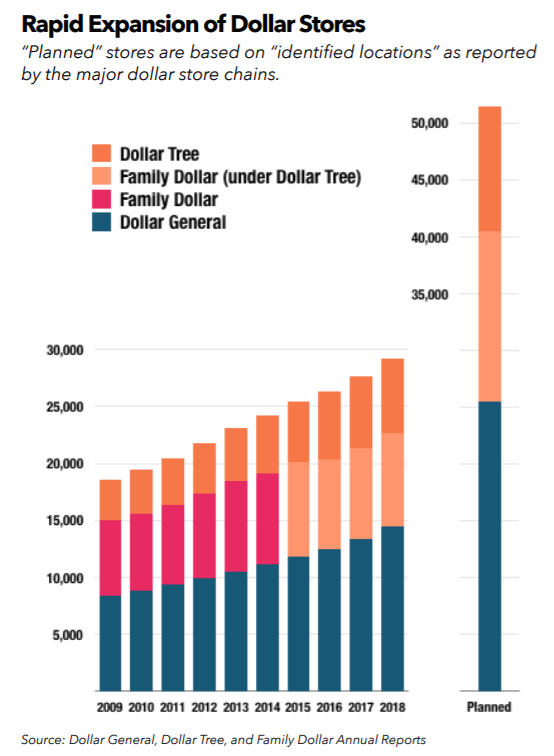
Dollar stores are wedged into nearly every nook and cranny of the Washington metropolitan area. More than 100 of them are located within a 25-mile radius—and there are plans for more. Since 2011, Dollar General and Dollar Tree, which acquired Family Dollar in 2015, have grown from about 20,000 to nearly 30,000 locations across the country.
According to a recent report by the Institute for Local Self-Reliance (ILSR), dollar stores have masterfully side-stepped more affluent, whiter communities and are woven into neighborhoods with higher poverty and more minority residents.
“When you look at the maps of the share of residents who are African American, it just jumps right out,” said Stacy Mitchell, co-director of ILSR and the co-author of the report. It looked at the national impact of the wildly popular discount chains and revealed that as the number of dollar stores increase, shoppers who frequent them continue to struggle financially.

The above graphics show an overview of demographics and dollar store locations in the D.C. region. Most dollar stores are situated in Northeast or Southeast neighborhoods and are even more prevalent across the border in Prince George’s County, where mostly African American residents live.Institute for Local Self-Reliance
Mitchell said dollar stores are rapidly moving into rural communities, too, and local shops suffer when they arrive. Dollar stores chip away at the profitability of nearby grocers and retail outlets, while taking advantage of the void left by the departure of those stores.
And, Mitchell said, it’s all part of the dollar store strategy.
“Dollar stores, particularly Family Dollar and Dollar General, target locations where there are not competing grocery stores,” said Mitchell. “They want to go to places that are already food deserts.”
Dollar Stores: A Food Oasis?
The issue of food insecurity in the D.C. region is well-documented. More than three-quarters of the District’s food deserts are in Wards 7 and 8. With fewer grocery stores, residents are forced to take multiple buses or walk more than a mile to buy fresh, healthy food. Residents of Ward 8 will have more options starting this fall when the ward’s second grocery store opens.
Most dollar stores in the District are situated in Northeast or Southeast neighborhoods. They are even more prevalent across the border in Prince George’s County, Maryland.
“I don’t trust food from the Dollar Tree. I just don’t,” said Chivonnie Gius, a recent shopper at the store’s Michigan Ave. Northeast location.
Gius, a 36-year-old dance teacher who lives in Beltsville, Maryland, said she relies on dollar stores to keep costs low when buying knick-knacks for her students.
“It’s more economical for me to outfit a gift bag for 20 little girls at a Dollar Tree or a Dollar General, as opposed to a Target,” Gius said.

Despite the lack of fresh vegetables, fruits or meats, Gius said the store is often busy, feeding area residents with its limited options. She said the mostly older African Americans who shop at that Dollar Tree location rely on the store to rack up great deals on everyday household items and basic groceries, such as milk and eggs.
Some dollar stores, however, are fine-tuning their formats to offer higher-quality groceries. Last year, Dollar General launched its “Better-For-You” initiative, adding around 125 healthier food items to its shelves in roughly 2,700 stores nationwide.
“They’re trying to target remodeling stores that have a little space for cooling, so that they can actually offer produce and more perishable foods,” said Elaine Waxman, a senior fellow at the Urban Institute.
Waxman also studies discount retail chains and their effect on food insecurity. She said that although dollar stores can play a role in fixing the problem, they were not designed to function as supermarkets—and shouldn’t be treated as such.
“If we’re not doing something to make food more affordable overall, and also make sure people have resources for that food, then we’re not really tackling the root problem which goes way beyond what kind of store format there is,” Waxman said.
Big Expansions Hit Small Towns
In recent annual reports, the two dominant dollar store chains indicate they have identified locations for a combined total of 20,000 additional outlets. Currently, there are more dollar stores across the U.S. than Walmart and McDonald’s locations combined, according to ILSR.
Cities and towns have authority to adopt ordinances that place limits on the ability of chains to open new locations. These measures apply to dollar store chains and they’ve been enacted in dozens of U.S. cities and towns.Institute for Local Self-Reliance
Data released in 2016 from the Economic Innovation Group explores how living conditions in small-town America have declined, with few signs of improvement on the horizon. Rural communities have not yet recovered the jobs they lost in the recession. Corporate mergers have triggered factory closures. As a result, the ILSR report finds, rural neighborhoods have experienced little in the way of new business and job growth during the current economic recovery.
In a statement to WAMU, Dollar General Corporation wrote, in part:
“In each of the communities we serve, we strive to be a strong business partner and a good neighbor. The addition of each new Dollar General store represents positive economic development, including new local career opportunities.”
But Stacy Mitchell said the surge of dollar stores instead leads to a decline in employment. They typically employ a low-wage staff of 8 or 9 people, while driving small independent grocery stores that employ an average of 14 people out of business. Mitchell said court records reveal that dollar chains frequently face class-action lawsuits for violating fair labor laws, typically paying millions to settle out of court. And, she said, this presents another dilemma for minority residents and entrepreneurs.
“The ability of local entrepreneurs to start grocery stores, or for chain grocery stores to be there is less in black neighborhoods,” she said.
The Pricing Gap: Family Dollar, Dollar General and Walmart
Analysts at the investment banking firm Raymond James have also been studying the effects of dollar stores. They report that Dollar Tree has a different issue on its hands and provide this advice: sell Family Dollar.
The analysts said the Family Dollar chain, which Dollar Tree bought for $9 billion, prices items too high (not all are sold for $1) and is dragging its business down.
“It is our view that low-income families are keenly aware of who offers the lowest pricing in the neighborhood,” researchers wrote in a December 2018 industry brief.

Chivonnie Gius, a Beltsville, Maryland resident, shows off a handheld fan she purchased at Dollar Tree on Michigan Ave. Northeast. The dance teacher said she relies on dollar stores to keep costs low when buying gifts for her students.Sasha-Ann Simons / WAMU
Family Dollar had been struggling for three years prior to its acquisition by Dollar Tree, despite trying different strategies under several different management teams and activist investors.
“We believe a more realistic solution for Family Dollar would include taking a large charge-off to close a significant number of poor performing store locations, as well taking a more aggressive pricing strategy that would bring Family Dollar prices in-line with Dollar General and Walmart,” the brief concluded.
Community Solutions
New dollar stores, which are generally smaller than 10,000 square feet, are often subject to little or no planning review or other permitting challenges. But according to the ILSR study, communities do have the authority to stop their spread—and some are starting to use it.
City officials in Tulsa, Oklahoma and Mesquite, Texas, for example, have passed ordinances in those cities limiting how close new dollar store locations can be to existing stores. In Tulsa, the measure prohibits the discount chains from opening within one mile of an existing dollar store and prioritizes full-service grocery stores by cutting in half the number of parking spaces they are required to have.
Among her recommendations, Elaine Waxman said people in high poverty areas need to be equipped with better wages, and more robust public benefits (including food stamps programs) that help them in the event they’re not able to work.
“The important thing, too, is to ask low-income people themselves,” Waxman said. “Researchers and advocates often run the risk of speaking for low-income neighborhoods when they critique what’s available, and those residents ultimately need to speak up and drive what they want.”
In the meantime, while they live on constrained budgets and need to solve their most basic needs, Waxman said an overflowing of dollar stores probably isn’t such a bad thing.
This story originally appeared on WAMU.