Jacob Fenston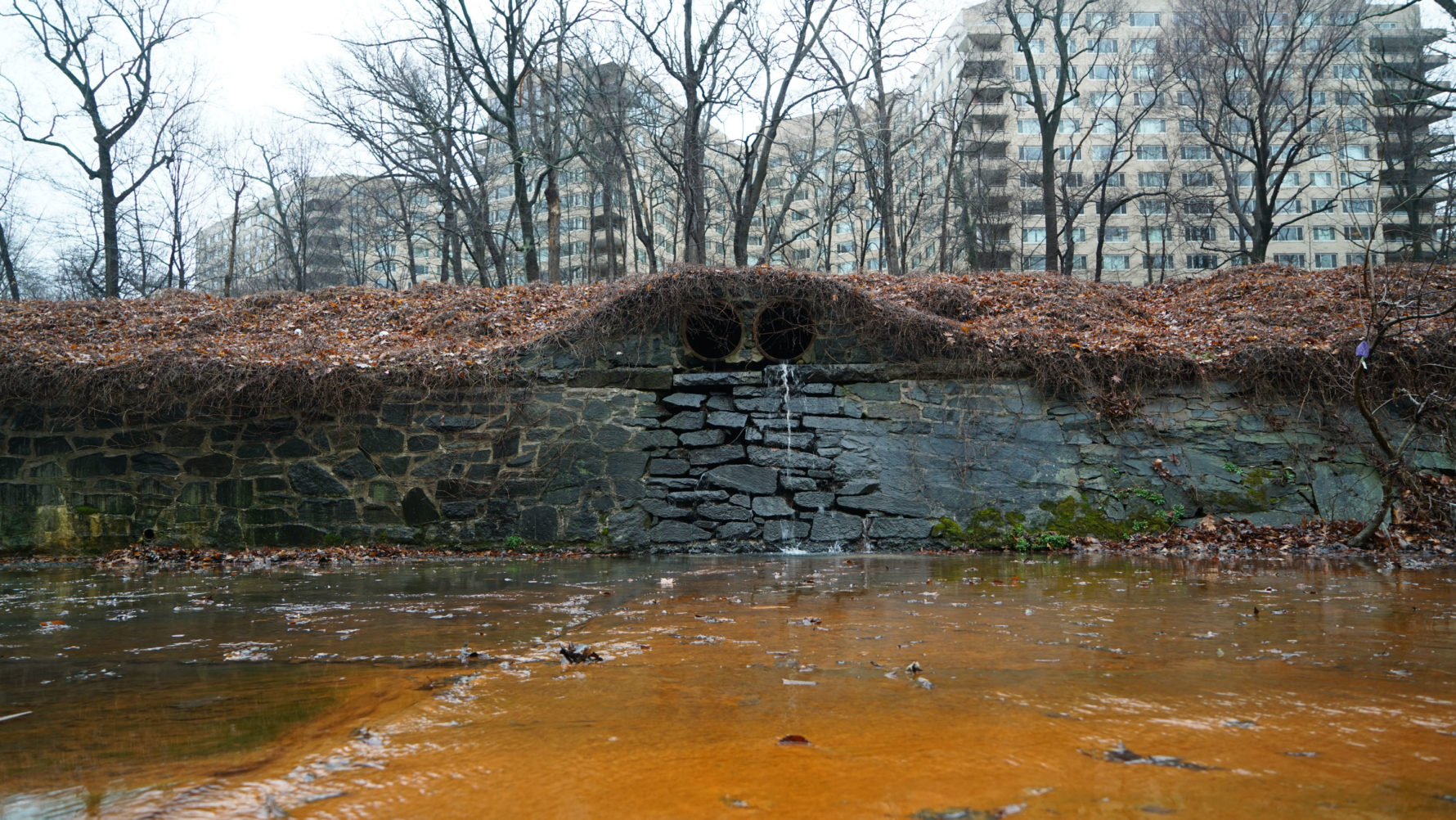
If you’ve ever been for a hike in Rock Creek Park after a rainstorm, you probably know the smell.
“It smells like somebody has just flushed directly into the creek,” says Jeanne Braha, executive director of the nonprofit Rock Creek Conservancy. In a sense somebody — or many somebodies — have flushed directly into the creek. Each year, some 50 million gallons of raw sewage, mixed with stormwater, discharge into Rock Creek. It makes the creek inhospitable to aquatic life, and dangerous for humans to wade in.
The source of the sewage problem dates back to the early 20th century, and for the past two decades local officials have been working with regulators at the EPA on a plan to end the pollution. Now, they’ve just completed one of the first projects to stop sewage overflows — but it’s not what you might be thinking: it’s not a bigger sewer tunnel (like the one DC Water built under the Anacostia River). Instead, the water utility is installing dozens of small projects that look like glorified landscaping, in neighborhoods many blocks away from Rock Creek.
It’s called green infrastructure. It’s a way of re-engineering the city to reverse the damage done by engineers of generations past, using modern technology to imitate how nature handles stormwater.




A ‘Lusty Stream’
To find the cause of the sewage problem, drive up Piney Branch Parkway from Rock Creek. The road follows the twisty tributary up out of the valley, but then at 16th Street, the creek, Piney Branch, suddenly disappears completely.
Steve Dryden is an environmentalist and director of the nonprofit Rock Creek Songbirds. He has been studying Piney Branch and its history.
“I was just reading an article recently by a Washington Post reporter back in the 1930s, saying it was a ‘lusty stream,’” Dryden says. The creek, he says, was “very vigorous,” and named for the stands of Virginia pines growing along its banks. Nowadays, the pines are gone. “I can’t find any now, I’ve been looking around for quite a while.”
More problematic than the disappearing pines is the disappearing creek. Old maps of the District of Columbia show Piney Branch continuing past 16th Street, and winding its way up to the Maryland border, near present-day Takoma Park.
“Development in the early 20th century just paved all of this over,” Dryden says.
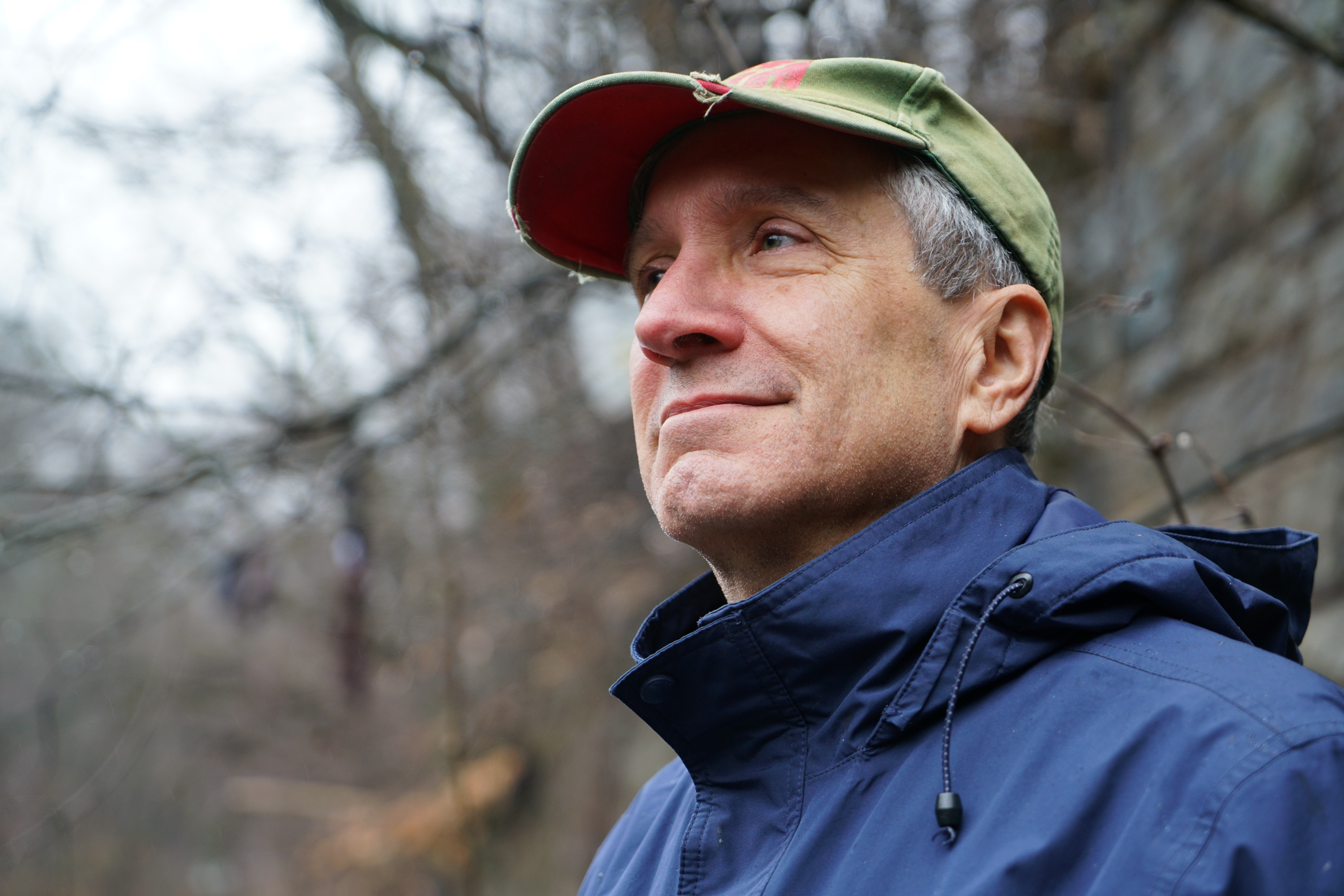
“This is the foundational mistake that was made in developing cities and suburbs,” says Steve Dryden.Jacob Fenston / WAMU
Before most of Piney Branch disappeared under pavement, the “lusty” creek drained storm water from more than 2,000 acres of forests and fields. The land naturally absorbed much of the rain, and the network of streams and creeks filtered water as it made its way to Rock Creek, the Potomac, and finally the Chesapeake Bay. Now, all that water is instead funneled into underground pipes.
“This is the foundational mistake that was made in developing cities and suburbs,” says Dryden.
In what is now the Piney Branch sewershed, the same pipes that carry rain also carry raw sewage from the rows and rows of houses, restaurants and stores in neighborhoods including Petworth, 16th Street Heights, Brightwood Park, Manor Park and Takoma. In a heavy storm, rain quickly fills these pipes, and they overflow — by design — into Rock Creek. (The same thing also happens in the Potomac and Anacostia Rivers, but on a larger scale.)

A civil-war era map of the District of Columbia, showing Piney Branch. The blue line indicates the creek’s current extent, while red shows where it used to flow. The white grid overlays the streets of today’s city.Noam Raffel / Library of Congress
Grey vs. Green
Nearly 800 cities across the United States have a similar problem: old, combined sewers, where stormwater and rain share the same pipes, and discharge into waterways during wet weather. Most of those cities are remedying the situation using what’s known as grey infrastructure: concrete tunnels and pipes. The idea is basically to increase the capacity of the old sewer pipes by building big new ones underneath them.
Green infrastructure takes a very different approach, preventing sewage overflows by keeping water out of the pipes to begin with. If rain never reaches the storm drains, the pipes won’t fill up and discharge sewage into waterways.
“What land can you take where you can redesign the landscape to absorb stormwater, and then use it as a benefit, rather than a problem to be captured and gotten rid of?” says George Hawkins. He was in charge of D.C.’s sewers until about a year ago, as general manager of DC Water. When Hawkins took the job, back in 2009, the water utility had signed a consent decree with the EPA and the justice department. It was a $2.6 billion plan to stop discharging sewage into the rivers, by building a series of enormous tunnels — grey infrastructure.
Hawkins wanted to renegotiate the consent decree, replacing all the planned tunnels with green infrastructure all over the city. That raised a lot of eyebrows. “Take something we just spent all these years negotiating and reopen it?”

Examples of some of the types of green infrastructure DC Water is installing.DC Water
Hawkins saw green infrastructure as a way to get the same outcome — a 96 percent reduction in sewage overflow — but with more benefits to the city. Green infrastructure boosts local jobs — tunnel construction is highly specialized, and the jobs don’t generally go to locals. Green infrastructure also has added environmental and quality-of-life benefits, adding trees and other landscaping to the city.
DC Water engineers, after crunching the numbers, told Hawkins, “Mr. Hawkins, we admire your goal.” But, they said, “There’s not enough space to put in green infrastructure to capture enough rain water. We’re gonna have to use green and grey.”
The final, modified consent decree includes the originally planned tunnels for the Anacostia and Potomac, but uses green infrastructure to handle Rock Creek. While its $60 million budget is a small fraction of the overall $2.6 billion Clean Rivers project, it’s still green infrastructure on a scale that hasn’t been tested in the region.
‘It looks just like regular pavement’
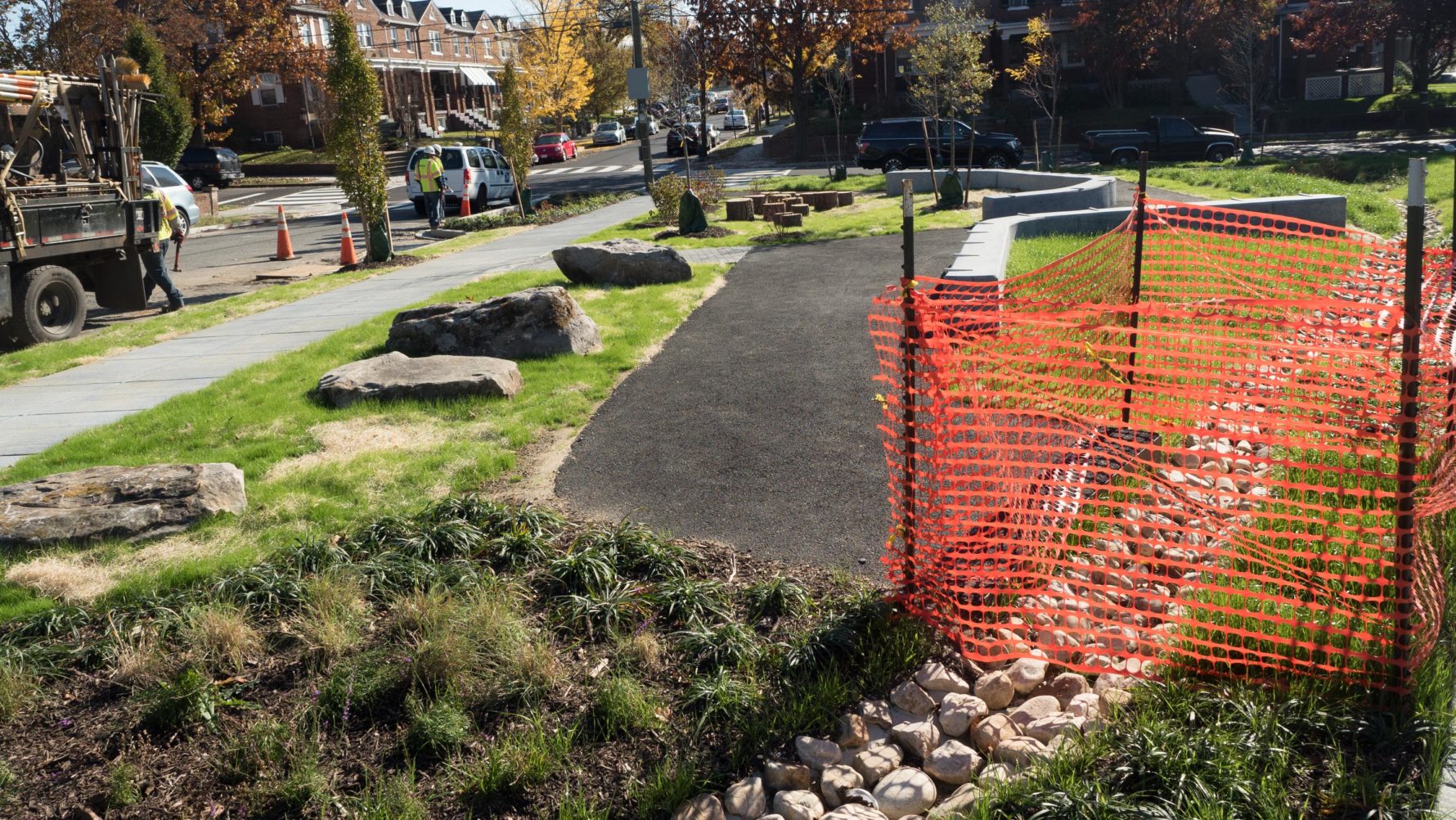
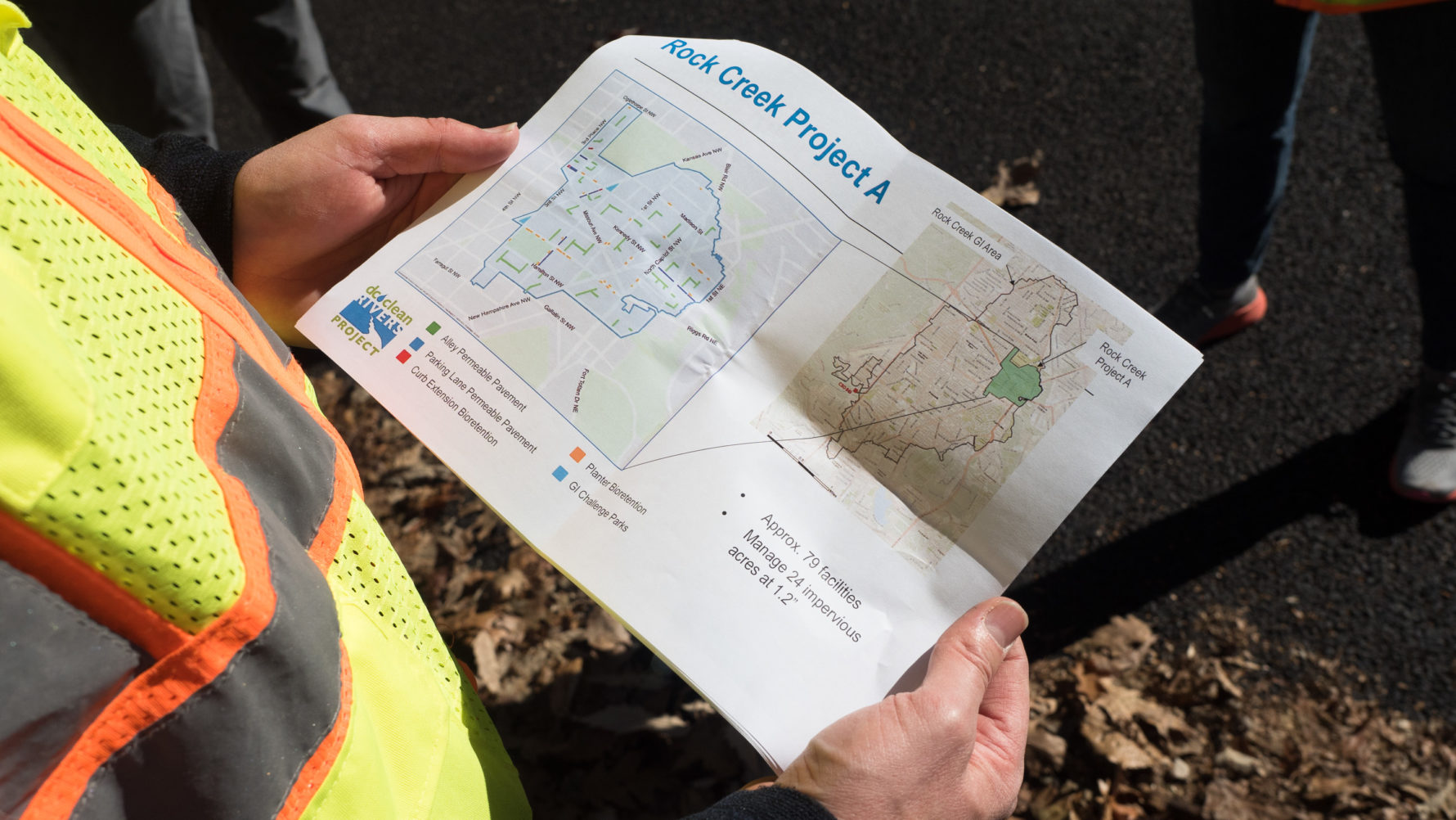
The first green infrastructure project, known as Rock Creek Project A, was recently completed, comprising 77 installations spread out across curbs, alleys, sidewalks and parks in the neighborhoods of Manor Park and Brightwood Park.
Seth Charde, who manages the project, showed off the work shortly after it was finished. The first stop was a curb extension, where a bit of unused road between a stop sign and parked cars had been dug up and turned into a highly engineered planter box. Underneath the native plants, there is a storage area for capturing water, several feel deep with gravel.
Half a block away, Charde points out an alley, covered with new pavers. “When you first look at it, it looks like just regular pavement,” says Charde. “But the water that’s flowing in is getting captured and stored.” The pavers have gaps to absorb water into the vast gravel storage area underneath. It holds the water as it filters into the ground.
A neighbor steps out of her back door to ask what we’re doing. She tells Charde how happy she is with the new alley. “I appreciate the alley, it’s a nice alley, far better than it used to be,” she yells from the doorway. She says water used to pool right behind her house. Now, the permeable pavers seem to suction the water underground.
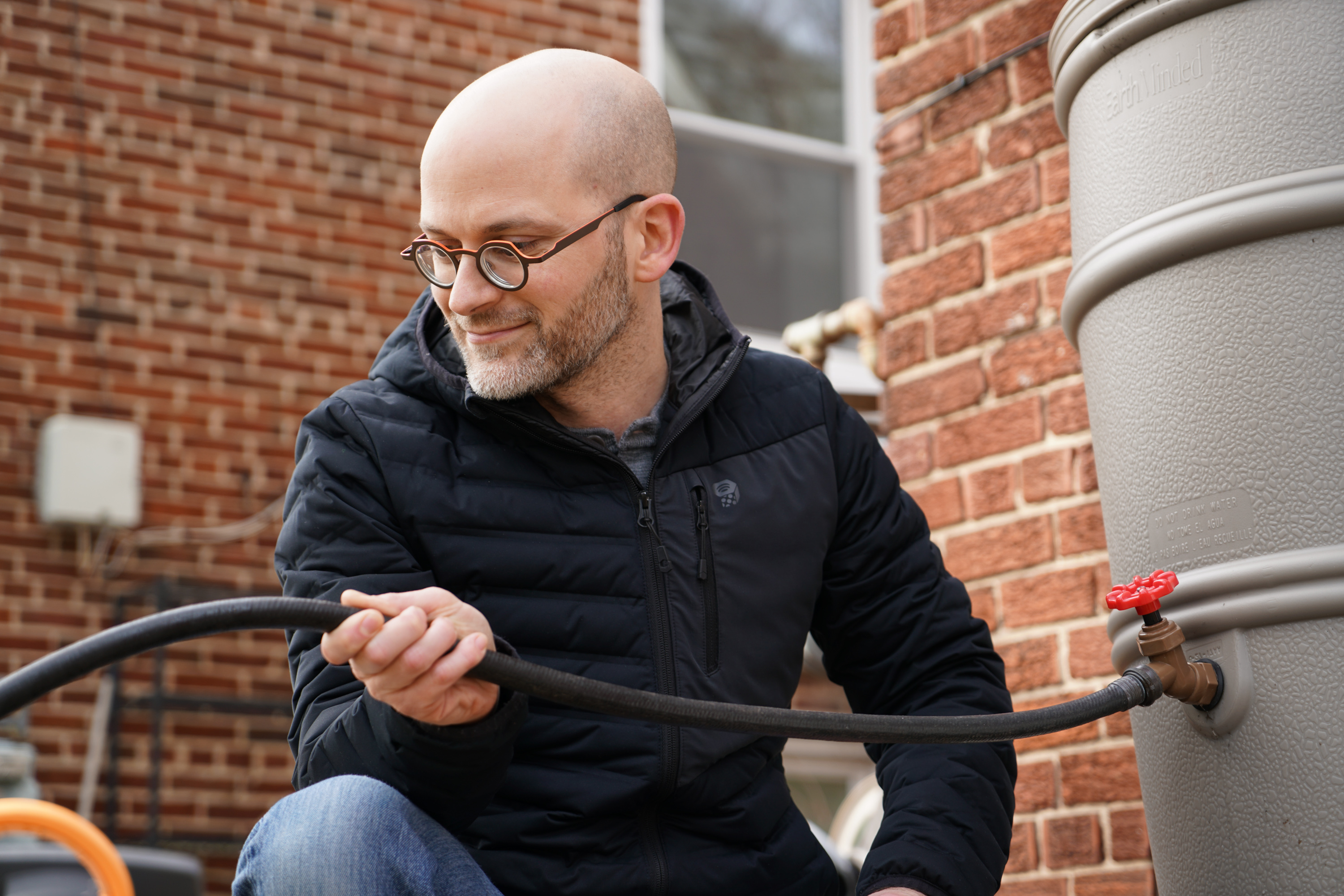
Alan Williams lives in the Piney Branch sewershed, and recently opted to disconnect his downspouts. He got a free rain barrel from DC Water.Jacob Fenston / WAMU
Homeowners, too, have gotten involved with green infrastructure. In some areas, gutter downspouts from houses connect directly into the sewer system, rather than discharging into yards. DC Water worked with Rock Creek Conservancy to convince homeowners to disconnect their downspouts and install rain barrels, storing water that can then be used for gardening.
Alan Williams disconnected downspouts from his house, and had a rain barrel installed last summer — all for free. “One morning, they knocked on our door,” says Williams. “They pointed out some other houses they’d been working on, talked about the benefits of the program, both for our own purposes, but as well as helping the watershed.”
Jeanne Braha, with Rock Creek Conservancy, says her team has gone door-to-door and contacted 5,000 homeowners, and disconnected 250 downspouts. She says even though the area they’re currently working in is a ways from Rock Creek, working in the developed parts of the city is an essential park of restoring the watershed.
“A lot of people think of Rock Creek Park as where we keep our nature in the District,” she says. But in order to really restore Rock Creek, we’re going to need to find ways to make those two things compatible.”


Rock Creek Project A is just the beginning, capturing runoff from the equivalent of about 12 city blocks of impervious surfaces. Over the next decade, DC Water plans to spend $60 million dollars on green infrastructure, capturing water from more than 220 city blocks in the Rock Creek Watershed.
But first, DC Water will monitor this first project to make sure it performs as engineers expect. If it doesn’t, the water utility is still on the hook for the amount of pollution reduction agreed to in the consent decree. Worst case, if green infrastructure doesn’t perform, DC Water would have to build the originally planned tunnel to handle Rock Creek sewage overflow.
Currently, sewage discharges into Piney Branch 30 times a year. When the green infrastructure projects are all finished, in 2030, DC Water estimates the outfall doors will open to discharge only during the biggest storms, about once a year.
This story originally appeared on WAMU.