Margaret Barthel
We’re digging into the past, present, and future of Eden Center, the mall that for more than 30 years has been a home for Virginia’s Vietnamese community. Yesterday we looked into how the shopping plaza was built; today we’re exploring how Eden Center is looking to the future.
On a recent Sunday morning, the dining room at Rice Paper is quiet. But by 10:03, just three minutes after the restaurant has officially opened for the day, there are already five people sliding into a sunny corner booth. After that, there’s a steady stream of customers—young and old, Vietnamese and not, families, couples, friends—continuing through the morning.
It’s not hard to see why. For one thing, the food at the restaurant, one of Eden Center’s most popular, is excellent (and you don’t have to take my word for it). For another, the menu is almost intimidatingly big: nineteen pages of Vietnamese noodle soups, rice dishes, vermicelli, salads, and rice paper rolls for which the restaurant is named. The space itself is casual, on just this side of hip: exposed brick and metallic ceiling moldings are prominent and big globular light bulbs hang from overhead.
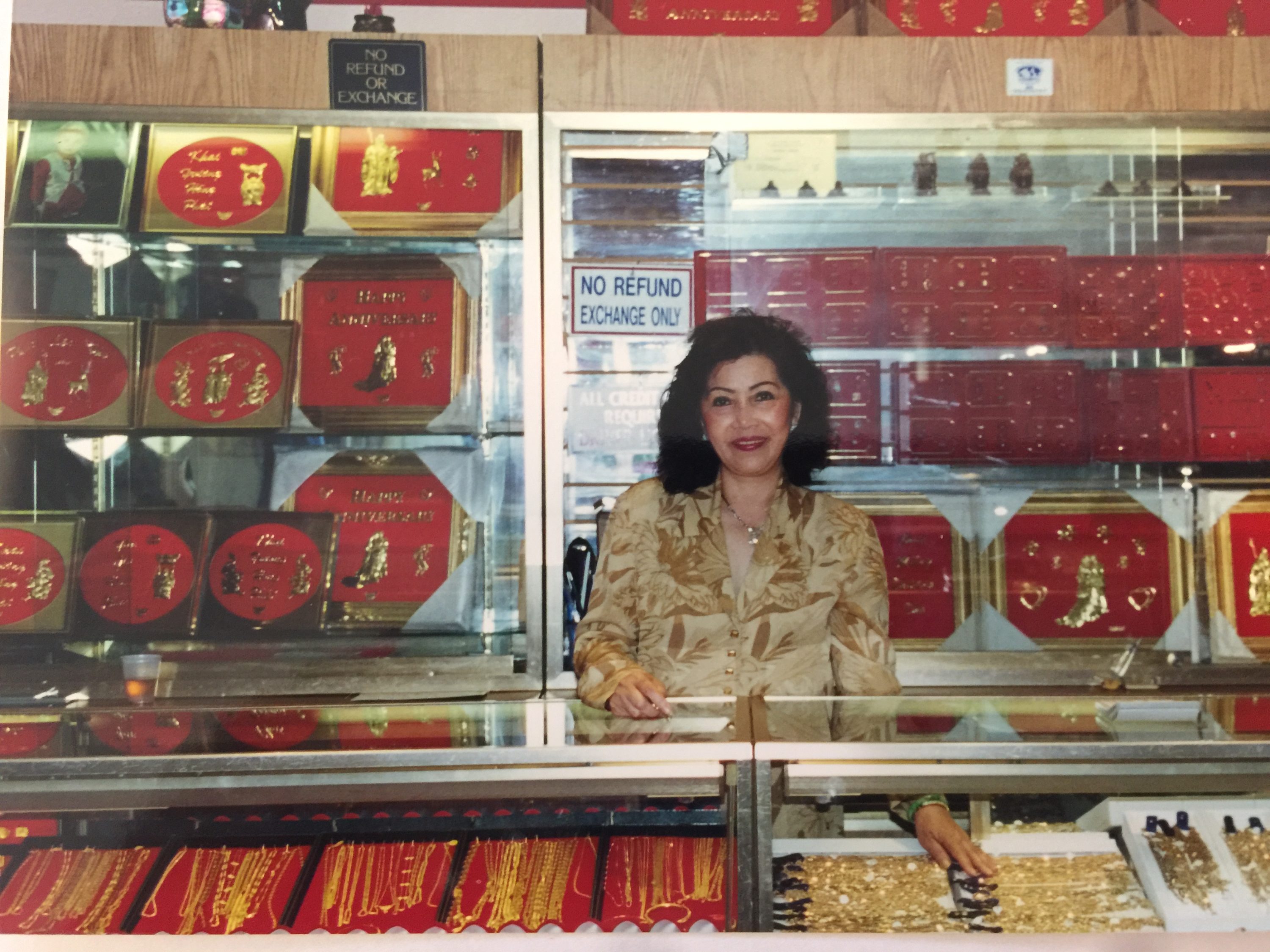
Owner Mai Lam says Rice Paper began life as a jewelry shop. Her parents opened the store in 1985, a few years after their family arrived in the United States as refugees from South Vietnam when Lam was five years old. Eden Center, which was rapidly becoming a hub for Vietnamese refugees and their businesses, was the perfect location. The place felt like home, and they kept the business running there for 27 years.
By 2012, Lam says, the recession and her father’s death prompted the family to reconsider their options. Her mother and her cousin both loved to cook, and had some experience catering, so they decided to open a restaurant.
The new mission? Cook for everyone—Vietnamese and non-Vietnamese, older immigrants and their children—but keep the food authentic while doing it. “I would love to introduce our food to this whole world,” she says.
That’s the challenge facing Eden Center as the decades-old shopping center looks to the future, according to Graham Eddy, the associate general counsel and vice president at Capital Commercial Properties, which owns the mall. “We have the customers who have always gone to Eden Center to get their hair cut or to eat food or buy their jewelry,” he says, “But we need their children and their children’s children to come and do the same thing.”
So, as retail across the country suffers and real estate prices in Northern Virginia continue to tick up, can the Eden Center maintain its historic identity as a home for the region’s Vietnamese community, and also find ways to attract a younger, diverse group of customers?
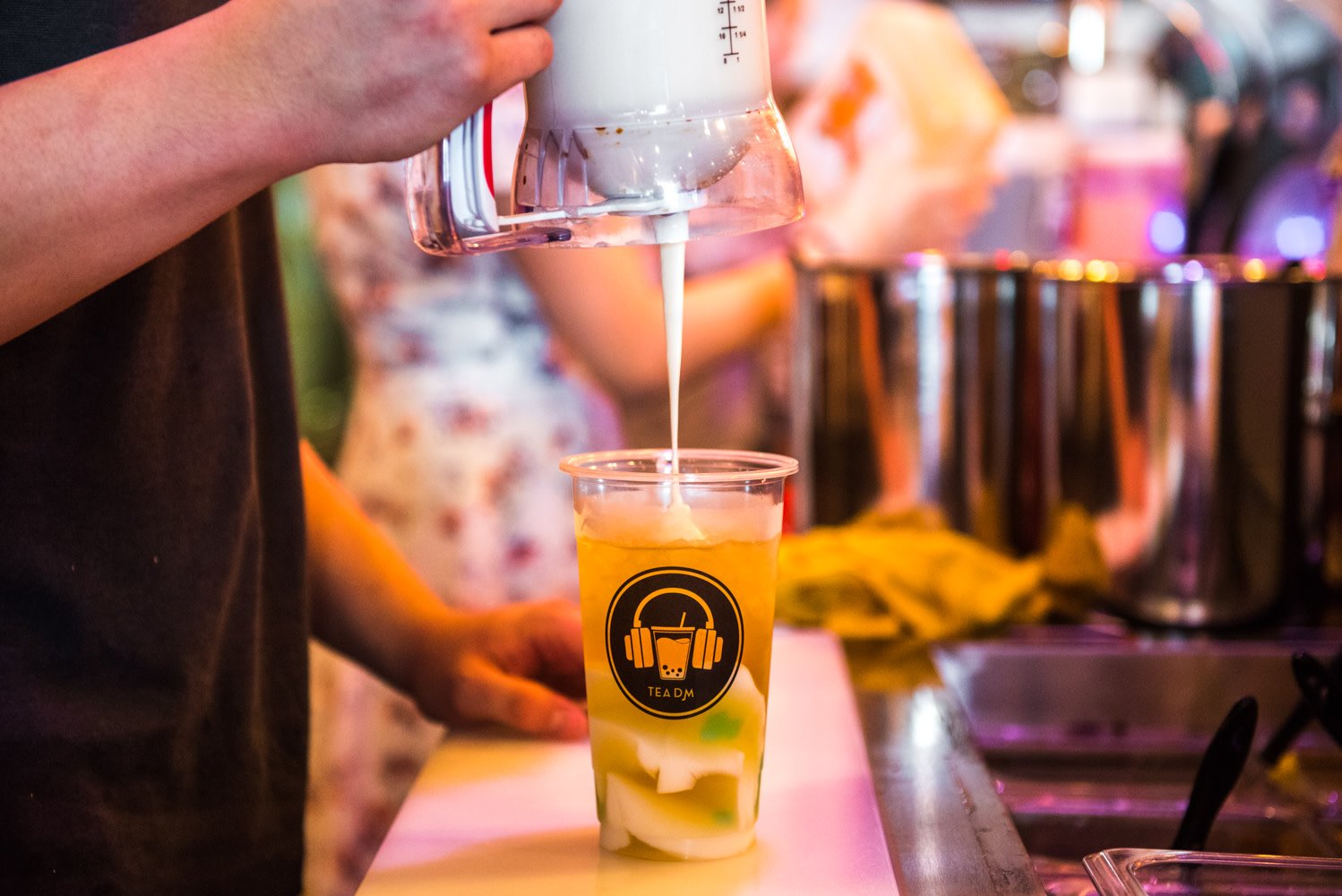
Across the parking lot from Rice Paper is TeaDM, a bubble tea shop with an EDM playlist betting big on attracting a younger crowd. Inside, twentysomethings, and teens slurp up boba and bowls of noodle soup from Pho Va, the pho shop that splits the storefront with TeaDM. The walls on the TeaDM side of the operation are decorated with larger-than-life, technicolor images of the drinks on the menu—traditional milk tea, fruit and green tea, yes, but also Vietnamese coffee drinks. The baristas wear black sweatshirts, printed with bold white headphones, a design created by the owner, Jay Tran.
Tran, 31, came to the Washington region from Vietnam as a student in 2006. He was struck by the lack of standalone bubble tea places in Northern Virginia at the time; the drink was only available on the menu in a few local restaurants. Trips to New York and California, where he says bubble tea shops “had taken over like Starbucks,” convinced him of a potential business opportunity. “I thought, ‘What if I were to bring that back to Virginia, to my community?’” he recalled.
Tran learned to make bubble tea and started selling it in local nail salons. Once he could no longer keep up with demand himself, he took the leap and opened TeaDM in Eden Center in 2016.
According to Eddy, Tran has overcome one of the big challenges facing Eden Center: creating a space that younger people can claim as their own. “There’s a whole generation, particularly of Vietnamese-American children, who’ve grown up thinking of Eden Center as their parents’ place,” he says. “So we’re trying hard to make Eden Center a place where you’d want to go without your parents, on your own.”
Several other bubble tea places have popped up in Eden Center–enough that Victoria Duong, a 30-year-old Northern Virginia resident who’s been coming to Eden Center with her family all her life, sees them as a barometer for Eden Center’s efforts to attract the younger generation on their own. “I like the fact that the younger crowd is coming for the bubble tea. It changes [the Center] a little bit, but it gets people there,” she says, though she adds that she’d hate to see the place completely pivot to trendier, hipper spots.
Unsurprisingly, TeaDM’s Tran is bullish about Eden Center’s prospects for becoming hip. “I think in the next two years, Eden Center will become the place for young people to come hang out,” he says. To achieve that, he’s leaned hard into social media, helping fellow business owners learn to “take a picture of the food and post it online, change the menu, change the design of the shop[s].”
Eddy advises Eden Center tenants to make similar adjustments in their businesses: remodeling interiors, creating unique outer facades, developing an online presence, translating menus into English, and accepting credit cards.
Some of those changes are taking hold, spurred by fierce competition that comes with packing similar businesses into the same complex. There are 40 sit-down restaurants in Eden Center alone, plus multiple bakeries, bubble tea shops, hair salons, jewelry stores, and cosmetics shops. When Rice Paper and another restaurant, Little Viet Garden, decided to remodel, Eddy saw the competitive ripple effect in action. “Some of our other tenants who had been there for a long time saw what was happening, and started to do the same thing to compete.”
Duong says she appreciates the changes and repairs, but that’s not the main thing that keeps her loyal. “For me, as long as the food’s good, atmosphere is good, that’s why I keep going back.”
Some of the non-food businesses in Eden Center have a harder task ahead. Rice Paper’s Lam says that there’s been a marked decrease in jewelry stores in the Center, which were plentiful when her parents got into the jewelry business in the 1980s. “The [younger generation] doesn’t care for it as much as the older generation.”
Amidst the energy and focus around attracting younger people to Eden Center, the older Vietnamese immigrant core of the place isn’t budging. Lam says she still needs servers who can speak Vietnamese to her older customers, and it’s a point of pride that many of them say the food at Rice Paper is authentic.
Even TeaDM has some generational diversity now. Some older Vietnamese customers come in the mornings for Tran’s sea salt coffee drink: strong Vietnamese coffee topped with sea salt cream, coffee jelly, and honey boba. It’s become one of his most popular offerings.
The playlist is mellower in the morning, in case you were wondering. Tran treats his older clientele to “chill house and trance music,” and turns on the more intense beats after two o’clock. “After five is when I really blast the music out,” he says.

Eden Center businesses are also looking to expand their clientele beyond the Vietnamese community, to broader Asian and non-Asian audiences.
Lam detailed several ways that she’s trying to make Rice Paper appeal to a more diverse customer base–without going too far from its Vietnamese roots. Figuring out how to split the difference was even part of naming the restaurant. “When we asked non-Vietnamese friends, ‘What’s the best restaurant in Eden?’ they would pronounce [the Vietnamese names] really awkward. They just couldn’t say it right,” she remembers. She landed on ‘Rice Paper’ because she felt it would be easy for more diners to pronounce.
And she’s always looking for ways to acclimate new palates to her cuisine. She says she doesn’t want non-Asian diners to stop at the pho selection when they come in to Rice Paper. And sometimes she tells them so: “If they do come back again, I’ll say, ‘Okay, would you like to be adventurous and try something new?’”
Another factor in Eden Center’s diversifying customer base: the handful of non-Vietnamese Asian restaurants and other businesses, like Kao Sarn, a Thai street food spot, Little Mongolian Sheep Hot Pot, and Gom Tang E, Eden Center’s first Korean restaurant. “I was surprised when different nationalities were willing to try [opening here], which is great,” says Lam. “They [are] bringing in a different clientele to come in as well.”
Duong says her non-Vietnamese friends are increasingly interested in learning more about the food. She usually starts them out at restaurants like Rice Paper that serve a variety of foods, as opposed to the smaller spots that specialize in a particular dish. “When places that feel like homes to me are able to make at least a few dishes where I know that not only I will enjoy, but other people will enjoy, I’ll take them there.”
Northern Virginia resident Bobby Leaton, who’s 34 and white, says a friend introduced him to the food at Eden Center and he’s made a habit of going there for the past decade. “In the beginning, it [was] a little overwhelming,” he says. “But if I had a question [about the menu], people were more than happy to help me.”
Could it ever go too far? “Even as the new generation comes in, all the people who work behind us are mostly not speaking English,” Lam says, noting that Rice Paper has created a significant number of jobs for her extended family, some of whom have immigrated from Vietnam more recently. To her, that means the central feel and focus of Eden Center won’t shift anytime soon.
Duong likes seeing her non-Vietnamese friends enjoy the cuisine at Eden Center. “I like them experiencing [it],” she says. “I don’t think that takes away the whole Vietnamese experience.”
Still, she adds, “I hope the chefs don’t change the way they make their meals just because they want to cater to non-Vietnamese people.”

For all the optimism, Eden Center does face some notable challenges ahead, starting with the question of who will take over its legacy businesses.
Lam says she’s surprised she ended up back at Eden Center in a professional capacity after college. “I never thought I would stay here,” she says. But she’s also figured out how to split the difference: She’s the public face of the restaurant, and she holds down a job in the computer industry.
It’s not clear to her if the rest of her generation—or the next one—will follow her lead. “A lot of kids nowadays, their vision is totally different. They might want to go to school and do other things, be a different entrepreneur, do something of their own,” she says. “And some people don’t even want to stay here, locally. They think that this area is not a place that they can go to the next level.”
There are other trends at work, too. Eddy is realistic about the steep climb ahead for any retail establishment, even one with as much cultural significance as Eden Center, in the digital age. “There’s an unlimited amount of what you can get delivered to your home right now,” he admits. “And in retail that’s been a hard trend.” He says he’s banking on the experience of Eden Center–its bustle and sense of serendipity–getting people out of the house.
Of course, “experience” is what everyone else is going for, too. Food halls like D.C.’s Union Market, Rockville’s The Spot, and Annandale’s The Block are springing up around the Washington region, hoping to offer what Eden Center has been for decades: high foot traffic and a wide variety of restaurants, each with their specialty dishes. But the trend doesn’t actually bother Eddy, who believes that more people exposed to Asian cuisine will mean more Eden Center customers in the long run.
Then there’s the fact that real estate in Northern Virginia is increasingly expensive, something that the mall’s community confronted decades ago, when gentrification pushed several of their businesses out to Eden Center from Clarendon. High rents at Eden were the subject of a lawsuit that about a dozen tenants filed in 2014, claiming that the building’s deteriorating condition did not merit its prices.
But Eddy says Eden Center has low turnover rates and a waitlist of businesses hoping for a place to set up shop. He also brushes off the concerns of the past few years about the Center changing and diversifying away from its original majority-Vietnamese model. “We’re always looking to increase our customer mix and in some cases our tenant mix, but it’s always at the forefront of our mind that we want to be open and welcoming and a home for the Vietnamese community,” he says.
For all the millennial-friendly tweaks now on offer at Eden Center, at the end of the day, stewardship seems to be the main thing on everyone’s mind. “Yeah, they’re going to add a little bit here and there,” says Duong. “But I think the whole idea of having Eden Center will always stay.”