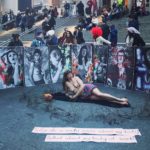
Michelle Sutherland, a New York-based artist and activist behind the art project Radical Matriarchy, orchestrated a protest on Valentine’s Day. She and a group of other women painted and performed topless outside D.C.’s National Gallery of Art to expose the lack of diversity in the museum. Then they went on their merry way.
Less than a week later, Sutherland went to Richmond to push the commonwealth to ratify the Equal Rights Amendment, the constitutional amendment that would ban discrimination based on sex. With another activist, she posed outside the Capitol with one breast visible. Then she was arrested.
Sutherland, who protests under the name Sister Leona, was charged with indecent exposure and, for a period of time, held without bond.
In two neighboring jurisdictions, there are two different approaches to public nudity.

In Richmond, Sutherland and activist Natalie White, an activist with the group Equal Means Equal, were depicting the state flag, which depicts the goddess Virtus with her left breast exposed while standing atop a clothed figure who represents Tyranny.
Despite the flag’s appearance of liberality, the commonwealth’s laws around toplessness are murky.
Virginia law bars people from exposing any part of their body deemed a “private part” in a sexual or obscene manner. The statute states: “Every person who intentionally makes an obscene display or exposure of his person, or the private parts thereof, in any public place, or in any place where others are present, or procures another to so expose himself, shall be guilty of a Class 1 misdemeanor.” The statute does not elaborate on the definition of “obscene” or “private parts,” but it does exclude the act of breastfeeding in public from the rule. A Class 1 misdemeanor comes with a penalty of up to a year in jail, or a fine of up to $2,500.
During the 2017 protests in Charlottesville, a woman who took her shirt off was arrested and charged with indecent exposure. While the charges were dropped, she went on to sue the police officers involved; the case was eventually settled for an undisclosed amount.
Virginia also criminalizes the performance of obscene art—which the state says includes a “tableau or scene”—in public spaces. Sutherland claims that her protest last week was art, but it’s unclear what exactly constitutes an “obscene” piece of art in Virginia.
When asked for clarification, the ACLU of Virginia’s executive director Claire Guthrie Gastañaga told DCist via email, “I don’t know. The Supreme Court has found it legal to ban nude dancing in clubs. They’ve distinguished public nudity bans from theater performances. I do know that it should be difficult, if not impossible, to get a conviction under the Virginia code of a person demonstrating dressed as Virtus.”
Sutherland says Richmond police claimed they arrested her because she refused to put her shirt on after they asked her to do so, and that they did so because there might have been children in the area.
The office of Richmond’s magistrate declined to comment on the case.
For her part, Sutherland believes that she didn’t break the law. “[Richmond police] were not informed and there should be proper police training,” she tells DCist. “For me to be arrested, the showing had to have been obscene or sexual in manner. That’s not what I was doing. I was protesting. It was just men who sexualize women.”
Her next court date is on March 21.
https://www.instagram.com/p/Bt4YcHNlf_6/
But this wouldn’t happen in the District, where it’s entirely legal to expose one’s breasts (for many years, there was even an annual “go topless” event outside the White House). Instead, D.C. Code stipulates that it’s unlawful for someone “to make an obscene or indecent exposure of his or her genitalia or anus, to engage in masturbation, or to engage in a sexual act.”
Still, D.C. law is more restrictive in a different way. Beyond the issue of toplessness, Gastañaga explained that “D.C. law arguably is more broadly applicable to more and different kinds of behaviors because of the use of the word ‘indecent’ to describe a prohibited act of exposure. Under Virginia law the exposure has to be intentionally obscene.”
The law is less clear in Maryland. Recently, there was a period of confusion about whether Ocean City could ban toplessness. The attorney general’s office eventually said it believed the ordinance is legal, but the ban is now the subject of an ongoing lawsuit.
Elsewhere around the country, rules around toplessness vary widely (and are often unclear). This isn’t the first time Sutherland has had a brush with the law about her topless protests. The activist says she also ran into an issue with police in Texas for protesting in the same fashion some years ago.
Despite the arrest, Sutherland continued to protest (clothed) on behalf of the Equal Rights Amendment outside the Capitol Building in Richmond for the remainder of the legislative session. The amendment failed in the Virginia House of Representatives last week.
“I would love to live in a world where women could walk around topless,” Sutherland says. “It would be a much better world. I hope to one day just live in a world where women could be free to just be.”