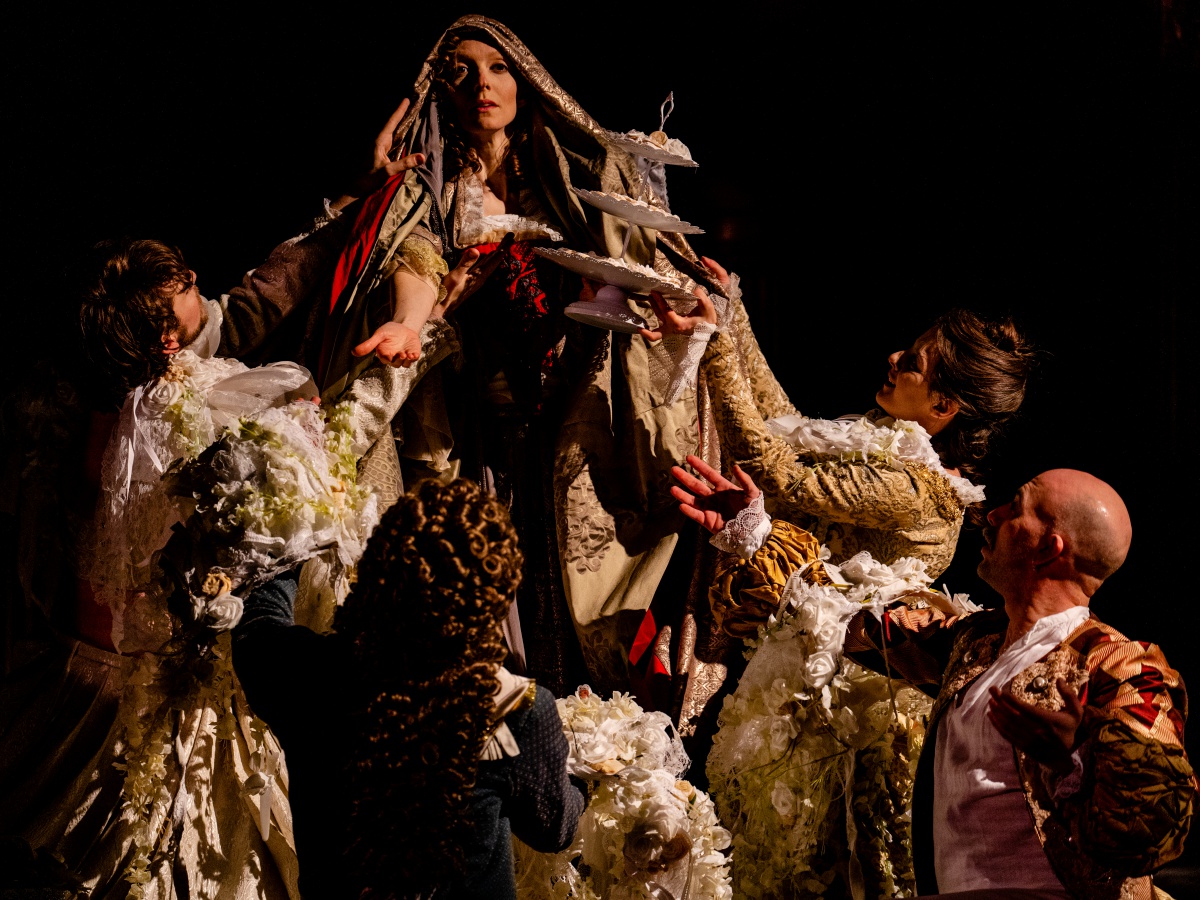
Attendees at Folger Theatre’s new immersive experience Confection get to experience some VIP treatment: They can enter the building’s usually off-limits reading rooms, interact with performers dressed in 17th-century period costumes, and even taste some sweets by D.C.’s Lupin Baking Company. But none of these delectable transgressions will be guilt-free. Set at a time when contact with the New World gave English aristocrats access to sugar, spices, and many other exciting foods, Confection juxtaposes this opulence with the depravity it caused. Beyond the elaborate banquet tables of the rich is a dark not-so-secret.
“That became the jumping off point for Confection—what is the cost of sweetness? What are the consequences about the choices we make around consumption?” says the show’s writer, director, and choreographer Zach Morris.
Morris worked with co-choreographers Tom Pearson and Jennine Willett on the production. The trio leads Third Rail Projects, a Brooklyn-based experiential theater company known for its site-specific productions. Their work defies the boundaries between audience and performers, theater and dance.
“We found ourselves creating work that is now called immersive theater, though it wasn’t necessarily called that when we started it” in 2000, says Morris.
Confection begins and ends in the Folger’s Paster Reading Room, a cathedral-like space ringed with balconies and lined with shelves upon shelves of books. A bust of Shakespeare oversees the proceedings. Five performers—Marissa Nielsen-Pincus, Elizabeth Carena, Alberto Denis, Joshua Dutton-Reaver, and Justin Lynch—use a long, tableclothed banquet table as a runway, dancing through the audience of about 50 people lining both sides. From there, the crowd is split into smaller groups to view a series of vignettes performed in the more understated Bond Reading Room, an intimate card catalog room, and back in the Paster, following the performers up staircases and through narrow doorways to transition between each scene.
Several compositions play on the idea of dining as a spectator sport in Restoration Britain (the same period in which Folger’s recent Macbeth and Nell Gwynn were set), when the commoners would literally view banquets from overlooking balconies. Confection is slightly different for each viewer depending on what they witness, from what vantage point, and in what order.
“Our work is to a traditional play like a Pablo Neruda poem is to a novel,” Morris says. “It has narrative elements but is non-linear. The images accumulate meaning over the course of” the performance.
Some scenes feature poetic monologues—a standout is an elaborate recitation of all of the ways to cut meat—while others feature only movement. In one choreographed duet, a performer rummages the bookshelves ringing an upper balcony and finds treats to pass down to a performer below. Another scene features a performer opening and closing the card catalog drawers and offering audience members wooden boxes for a game of “keep or share?”, a choice to either hog or offer the mystery in the box.
The thrill of Confection is being so close to the images, getting to feel the fabric of the costumes brush against your skin or sitting at a banquet table as the performers prance by at eye level. The show is at its best during its gaudiest and most absurd moments among the cast, when the performers seem to lose themselves in cravings and lust. But given the underlying themes of the show—inequality and the cruelty embedded in the food system— the kid gloves used on the audience seem a little too gentle, sparing attendees the very discomfort that the show is trying to elicit.
Confection is part of a larger collaborative research project at the Folger called Before ‘Farm to Table’: Early Modern Foodways and Culture, a Mellon Foundation initiative that continues through spring 2021. It was produced concurrently with the exhibit First Chefs: Fame and Foodways from Britain to the Americas displayed outside of the Reading Rooms, and Third Rail Projects worked closely with curator Amanda Herbert and her team as they researched the exhibit.
Confection “pulls you in with luxury and extravagance and wonder, but you go away with a little bit more,” says Herbert. “When you think of food in Shakespeare’s world you think of elaborate wealth, but you don’t think about all the hands that helped it get there.”
Spending some time in the First Chefs exhibit before entering Confection could help get you in the right, uneasy mindset about the show’s decadence. The exhibit highlights five “celebrity chefs” of the era: Hannah Woolley, the first woman to earn her living as a food writer; Robert May, a teenage chef who brought French cooking to England; Thomas Tusser, who wrote agricultural books in verse; William Hughes, a pirate-botanist who first told the English about chocolate; and Hercules, President George Washington’s enslaved chef who eventually escaped from Mount Vernon.
Other display cases highlight the injustices of the food system in early modern Britain. One ledger documents the mere shillings that an aristocrat paid his weeders and gardeners for many days of labor. Recipes written out in careful cursive are dispersed among contracts for indentured servants. In an image of a sugar plantation, Europeans oversee the work in long sleeves and boots while the enslaved Caribbea’s do the dangerous work shirtless and barefoot. This particular imagery is echoed later in Confection, when a dressed actor prods a shirtless one, riffing on the “measure of a man.”
Both Morris and Herbert emphasized the relevance of these centuries-old juxtapositions to our modern American food system with its Michelin-starred restaurants and its food stamps, its farmers markets and its food deserts, its obese and its hungry.
“There is no easy answer about why that [inequality] is, why that’s okay,” Morris says. “That’s one of the questions we’re asking, not necessarily why haven’t we learned this yet, but why is this still a problem?”
Even in the 17th century, society struggled between action and apathy.
“Some people [were] willing to fight against those injustices in the period, others willfully turned a blind eye,” says Herbert. “On the whole most people were on board and were culpable.”
And you, dear reader, may be culpable as well. At the culmination of Confection, you may find yourself as one of the crowd, sitting down at the impossibly long banquet table and lifting the lid unto a surprise dessert. Keep or share? These seem to be the choices at hand. To get up and walk away from the sweetness? Well, what good would that do?
Confection runs through March 24. Tickets $40-$60