Made of layers of paper, fabric and string, the colorful floor-to-ceiling artwork stretching almost 400 feet down a curving hallway at the Hirshhorn Museum is catnip for kids. Any one piece of it almost begs to be touched, poked, or pulled.
But the two-dozen children staring at Mark Bradford’s “Pickett’s Charge” on a chilly Wednesday morning in early March maintain a safe distance, sitting alongside their parents and caregivers as they take in the sprawling piece.
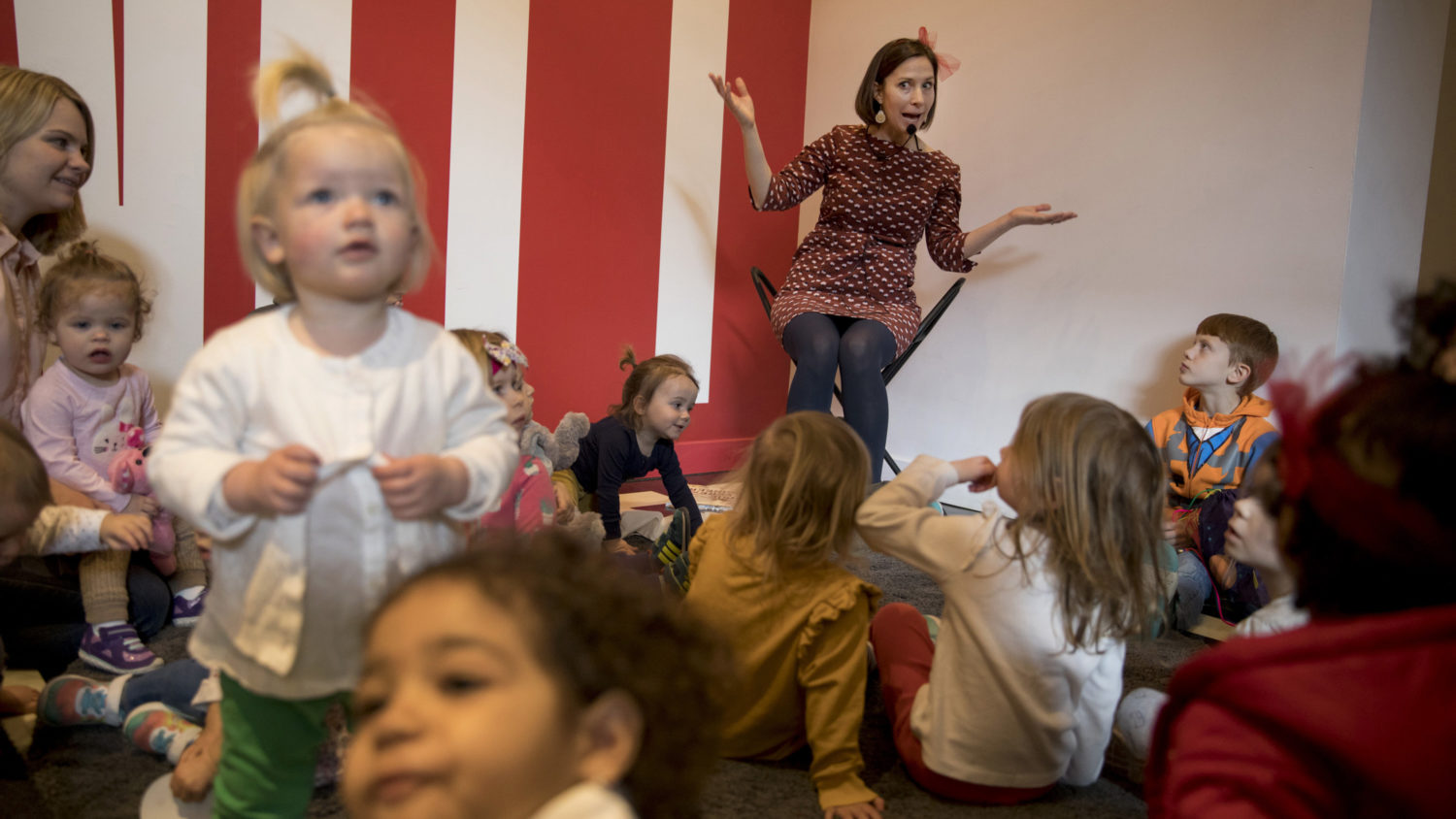
Tiffany McGettigan has reason to be relieved—and proud. The museum’s youth and family programs manager is leading the group on a twice-weekly excursion that includes observing a piece of art, reading a book tied to the artwork’s theme, and letting the kids make their own artwork.
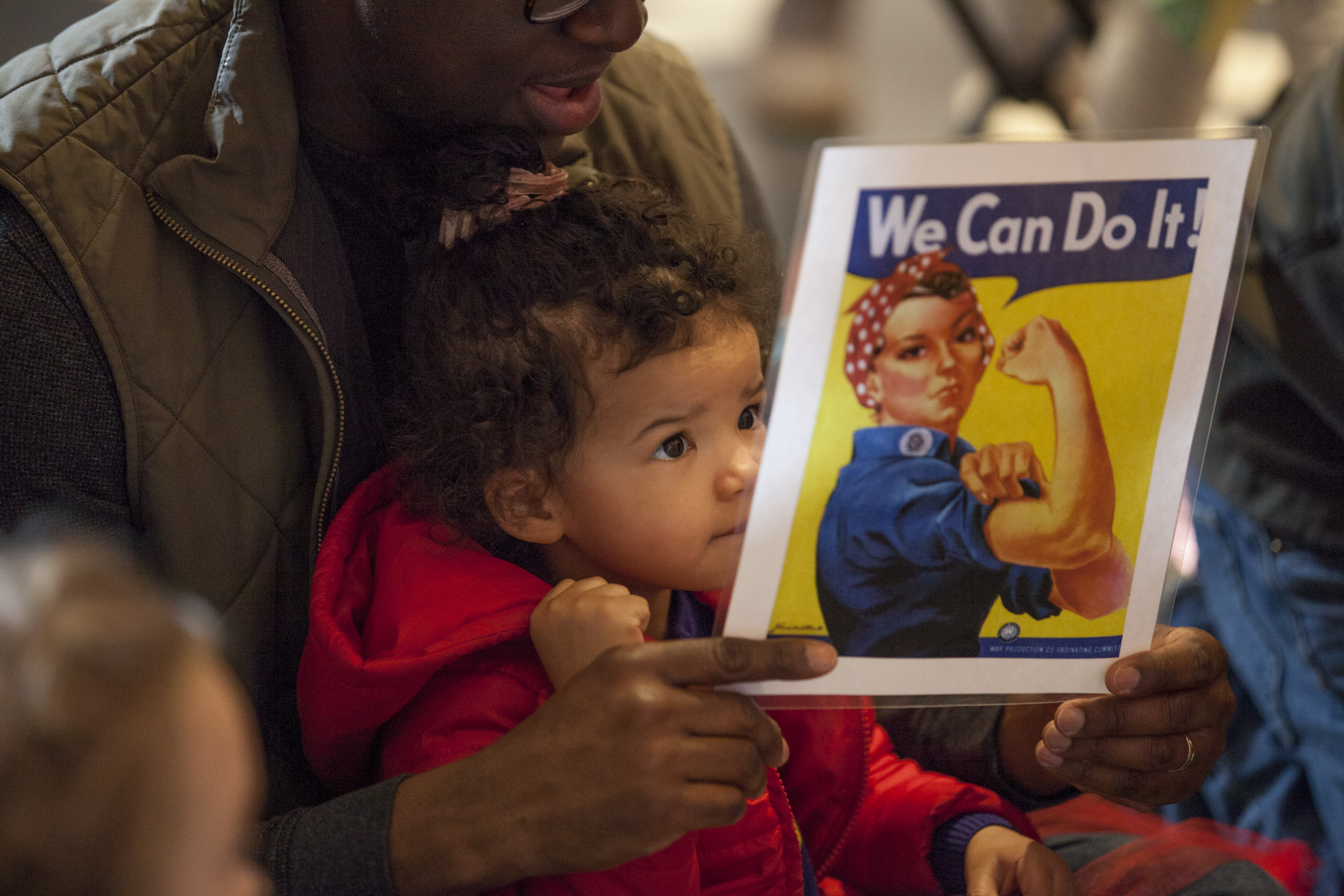
Homere Whyte holds his daughter, Julianna Whyte, 2, during story time at the Hirshhorn. They were talking about “Rosie the Riveter.”Tyrone Turner / WAMU
At the start of every excursion, McGettigan gathers with the kids and families in the Hirshhorn’s lobby, and lays out some simple rules, the most critical of which goes to the heart of what any child most wants to do.
“When we look at the art, we use our eyes and not our hands,” she says in a warm, albeit authoritative voice. “We have to keep the art safe, so we cannot touch it.”
When you think of the Smithsonian’s museums, the Hirshhorn may not come to mind as the sort of place you’d take your kids. Founded in the 1960s and housed in a cylindrical building made of naked concrete, the museum focuses on contemporary and modern art. And before McGettigan—herself a mother of two young boys—arrived three years ago, it offered very little programming for kids. Now, there are two weekly story times, among other activities.
“I think that contemporary art is actually really accessible for young children,” she says. “They’re really imaginative, they don’t think of art in the fixed way that adults do. I just thought, ‘What a great opportunity here to make a program that was really fun for children.’”
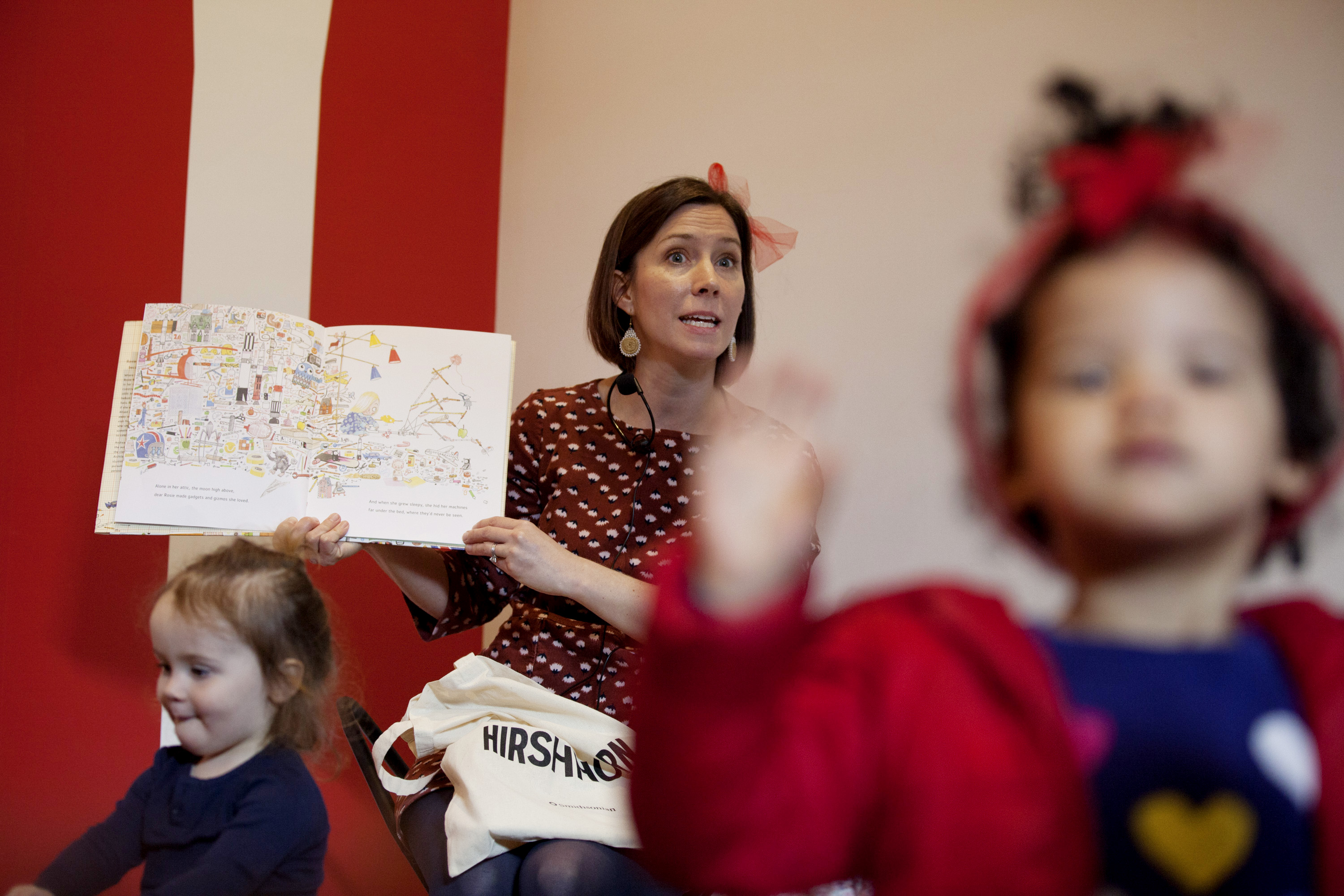
McGettigan reads “Rosie Revere, Engineer” by Andrea Beaty during the Hirshhorn’s story time. She tries to link her books to exhibits at the museum.Tyrone Turner / WAMU
The museum’s programs for kids are part of the Smithsonian’s ever-evolving effort to better cater its art, artifacts, and collections to children. And though the institution’s 19 museums are a draw for families, experts say that specifically engaging young children takes time, effort, and thought.
“There are defined pedagogies around what works for engaging children. It mirrors the way all humans develop. It’s about hands-on learning, about watching and doing,” says Laura Huerta Migus, the executive director of the Association of Children’s Museums.
It’s a lesson the Smithsonian has been learning and adapting since 1901, when it opened its first children’s room in the Smithsonian Castle. According to a report in The Washington Post that year, the room would feature exhibits that were more simply labeled:
Heretofore all exhibits in every museum in the world have been labeled with technical terms sufficiently unfamiliar to adults, and… far too scientific for children. The greatest advantage which the immature mind might derive from exhibitions of the usual museum character are lost through technicalities with which they are surrounded. For the first time in the history of museums, scientific names will be discarded and common names used.
But going beyond that has been a challenge for some of the Smithsonian’s flagship museums, like Natural History. In 1974, it opened the first Discovery Room, a space dedicated to children 10 and younger. One of the most appealing features of the room—now known as Q?rius jr.—is that kids can touch and feel fossils, shells, animal skulls and other artifacts.
“In 1974, hands-on learning and open-ended learning was a new concept,” says Cara Clark, the room’s coordinator. “But to actually use real artifacts for kids to touch, that was interesting. It was kind of a challenge; [the Smithsonian wasn’t] sure about it. We said, ‘We’re going to teach young children and families why we have artifacts, how to handle artifacts, and what you can learn from artifacts.’”
Clark says that allowing children to touch and interact with actual parts of the museum’s collection is critical to engaging them and helping them learn.
“For kids, they aren’t just little adults. They learn in a different way. They are scaffolding in a different way, and building ideas in a different way. So we want them to have an opportunity to ask their own questions and find ways to answer them. So that’s our goal,” she says.
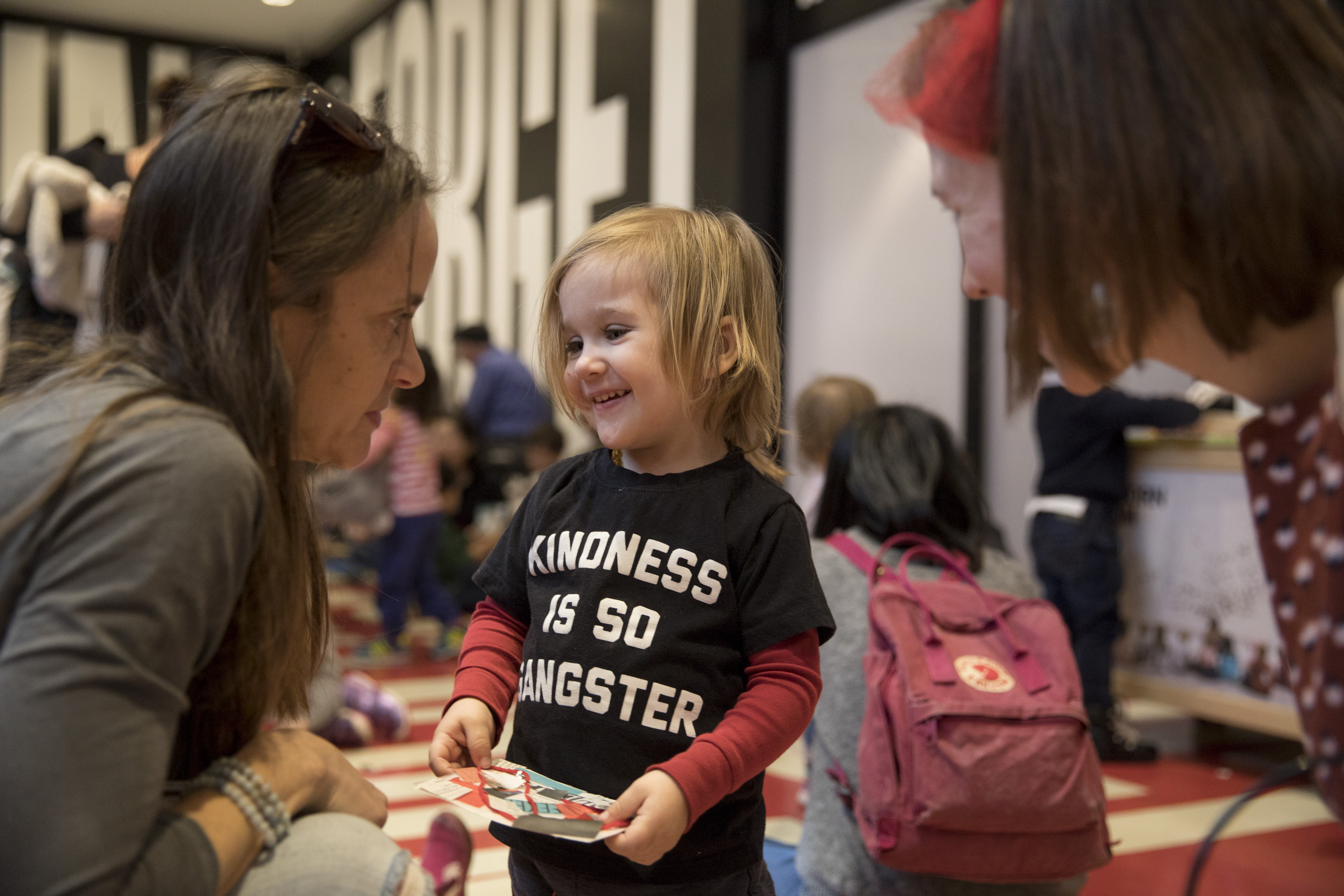
Tara Jansky left, with her son, Bodhi Nygaard, 2, during the activities after story time at the Hirshhorn.Tyrone Turner / WAMU
More of those strategies are also filtering into the museum’s broader exhibits, like the Fossil Hall, which is set to reopen in June after a five-year renovation. Gale Robertson, the museum’s family programs manager, says the new goal is to allow families to learn together, minimizing the expectation that a parent or staff member will have to be on hand to explain exhibits or answer questions.
“It really is like a game where we set it up for the families to learn together and we step away and let them work it out,” she says. “And that takes a lot of designing.”
It also takes overcoming challenges that are built into the Smithsonian’s DNA, she says. Founded as a research institution and serving as a repository of vast collections of art and artifacts, the Smithsonian’s museums revolve around content—not children.
“Children’s museums are all about the kid and how a kid learns,” says Robertson. “They embrace play as a way for kids to learn. We get a little pushback on that with being this prestigious institution, and a museum that is content-focused. When we choose books, we have to be very careful about the whimsy in the books, because we can’t have animals talking. We get our books vetted by scientists. And it’s a little tough. Our job is to push that a little bit, to represent how kids and families learn together. Scientists are experts on their content, we’re the experts on the audience.”
“So we find that balance of representing the content and the science authentically while also supporting how families and kids and learn. If a kid wants to pretend they are a sea urchin and they will learn how they eat by acting it out, then that’s what we do,” she adds.
The Natural History Museum also has a newer Q?rius room for teens. And there’s more: the American History Museum has the Wegmans Wonderplace for kids 0-6 and Spark!Lab for 6-12. The Sackler Gallery of Art has ImaginAsia, and the Air and Space Museum has a planetarium and flight simulators. And separate from the Smithsonian, the National Children’s Museum will reopen this fall at its new location in Federal Triangle.
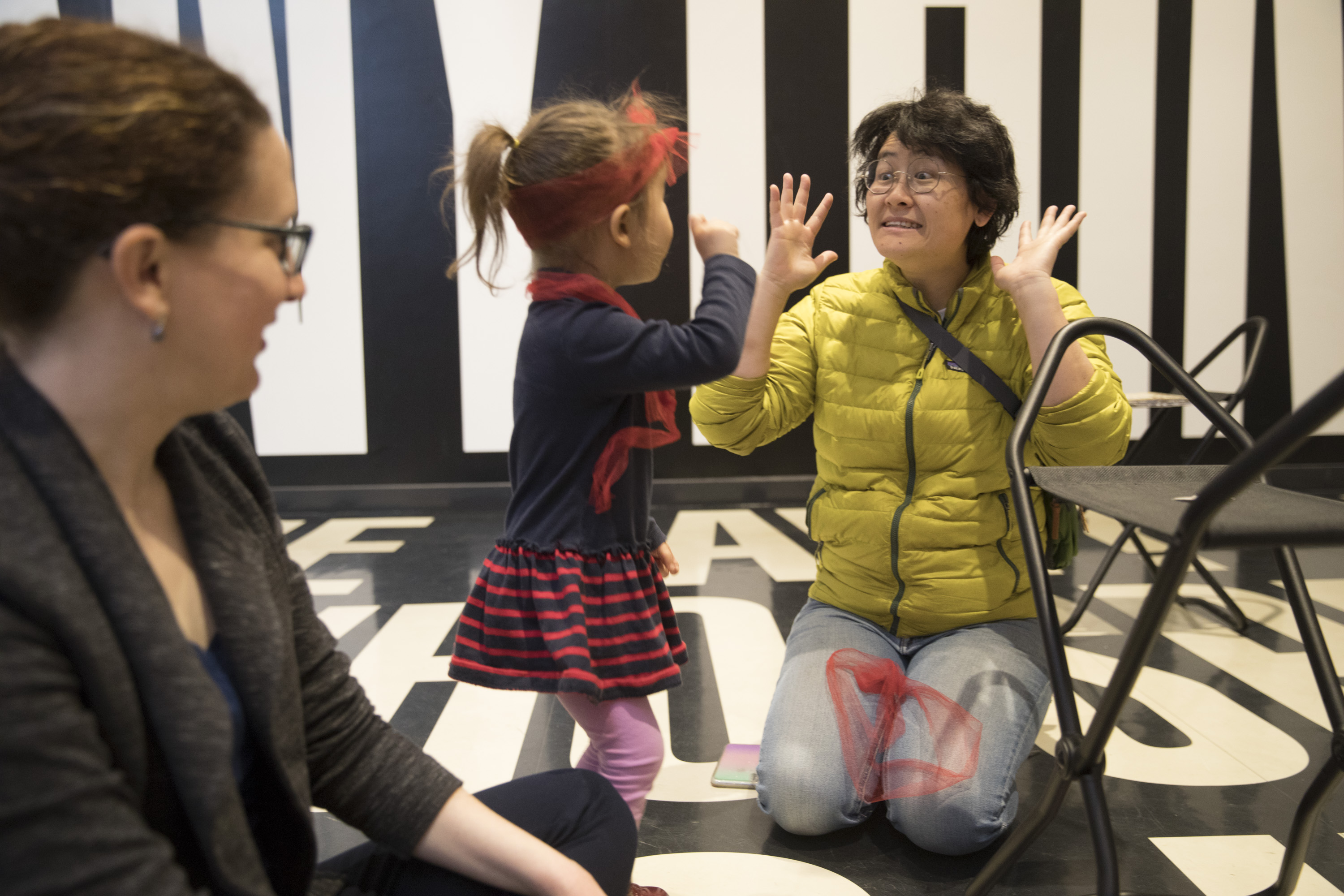
Kaori Takeuchi, right, who is deaf, signs with her daughter, Ria Kaika, 3, during the activities after story time. To the left is sign language translator Audrey Bastian, who helps the many deaf families that come for story time at the Hirshhorn.
At the Hirshhorn, McGettigan faces challenges of her own, including reminding children not to touch some of the artwork, and making sure that her arts-and-crafts times don’t include anything that could damage pieces in the museum. (Nothing wet, no scissors.)
But overcoming those challenges means finding a new audience for the museums. The programs—including Maker Mornings: Pump It Up!, an interactive kids event every Saturday that’s pegged to the current Pulse exhibit—are bringing in a steady stream of parents and children, including Tara Jansky, a mother of three who brought her three-year-old son to story time on Wednesday.
“I believe it’s bringing people here,” she says. “You don’t think to bring your kids to an art museum. You can’t touch stuff, you have to abide by the rules, you can’t run, you can’t be loud. So I think it’s awesome they are providing this and allowing children to learn how to respect an art museum their whole life.”