Natalie Delgadillo
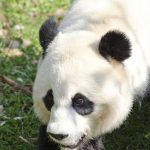
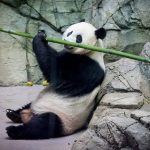
The National Zoo’s female giant panda, Mei Xiang, is frolicking a little more than usual, splashing about in the pools in her enclosure, and taking extra pleasure in her bubble baths.
This can only mean one thing: giant panda mating season is nearly upon us, yet another reason to love spring in the District of Columbia. According to the National Zoo, Mei Xiang started exhibiting some “behavioral signs that breeding season is approaching” on March 15.
See below for a look at one of her recent, rather vigorous bubble baths:
Urinary hormone analysis has verified that the giant panda’s estrogen levels are rising, signaling that her fertile time of the year is approaching. For pandas, this is a very narrow window—only up to three days out of the year. Scientists at the Smithsonian Conservation Biology Institute will continue keeping an eye on Mei Xiang’s hormone levels so they know when it’s time to artificially inseminate her with the biological material of her betrothed, male giant panda Tian Tian.
Tian Tian has taken notice of Mei Xiang’s behavioral changes and is responding in kind, says National Zoo spokesperson Devin Murphy. “He is very attuned to Mei Xiang. He is trying to keep her within his visual lines of sight all the time, he vocalizes at her. He is really focused on her,” Murphy says. Tian Tian has been spending lots of time at the “howdy window” separating their yards and bleating at her, the zoo adds.
Tian Tian and Mei Xiang have been together at the National Zoo since 2000, and they have three panda babies together: Bei Bei, Bao Bao, and Tai Shan. All of these babies, however, have been born by artificial insemination, since, for all their obvious excitement around one another, Mei Xiang and Tian Tian haven’t quite been able to figure the whole “mating” thing out. As the New Yorker explains: every time they try to make it happen, Mei Xiang splays herself out in a “pancake position” on her stomach, and Tian Tian simply steps onto her back and looks about, unsure where it’s all supposed to lead.
“They’ve just never gotten the positioning exactly right,” Murphy says.
Once Mei Xiang has reached “peak estrus” (the time when she’s fertile), zookeepers will be watching her behavior carefully to try to assess whether she’s pregnant. It’ll be hard to tell for sure, though, as pandas often experience “pseudo-pregnancies,” where they exhibit all the right behaviors for pregnancy but aren’t actually gestating. Last year, Mei Xiang faked us all out.