Avery Kleinman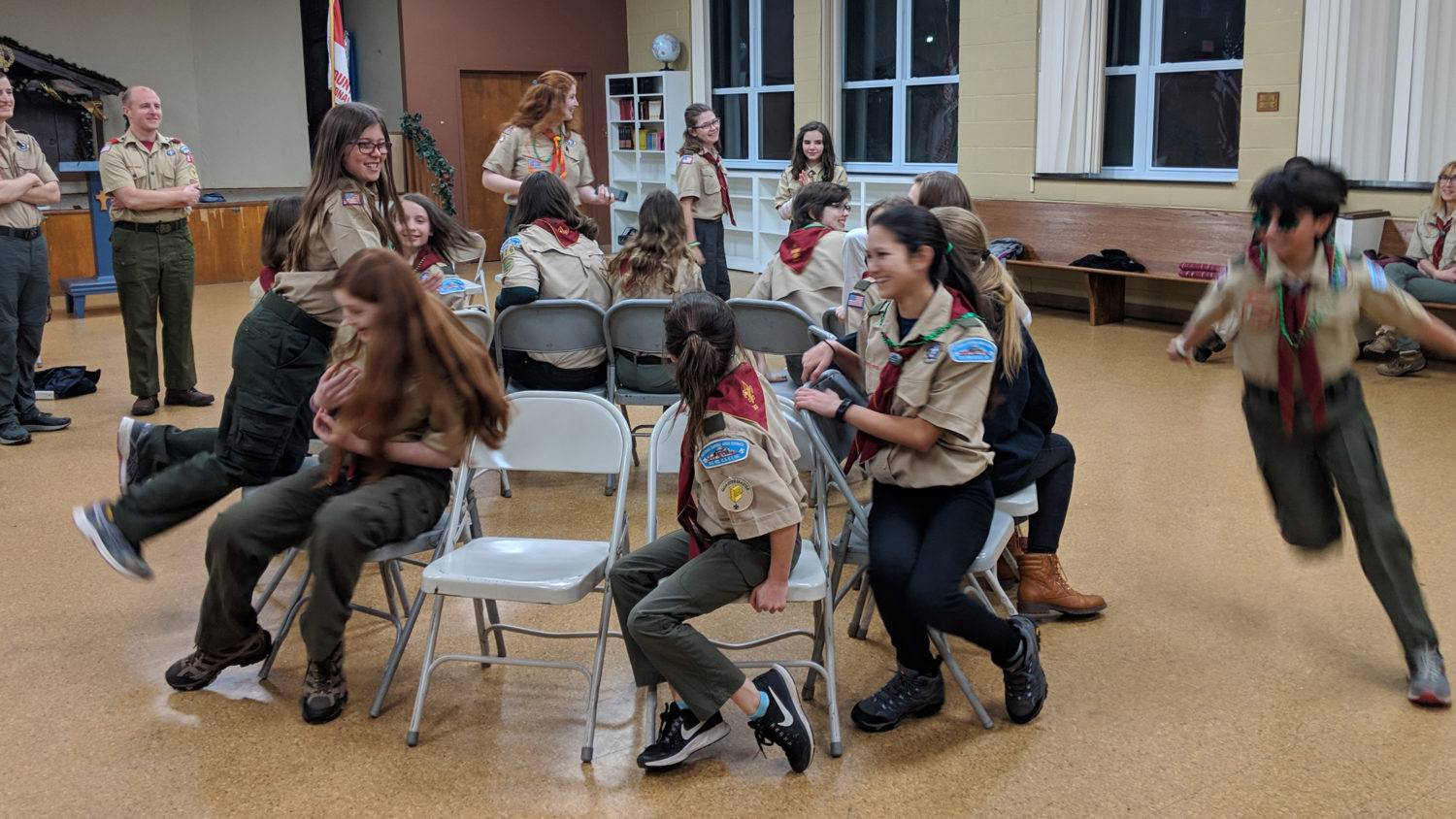
Meet Troop 876. They’re girls, and they’re scouts. But they’re not girl scouts.
Instead, they’re one of the first all-girl troops to join the program formerly known as Boy Scouts, now called Scouts BSA. After more than a century, girls are now allowed in.
Troop 876’s scouts are among the almost 400 girls who have officially registered for Scouts BSA in the Washington area. Boy Scouts of America National Capital Area Council officials say it has the most girl troops in the country — nearly 50.
“I was really, really glad that they opened up the program to us,” says 15-year-old Helen Wohlleben. She was elected by her fellow scouts to lead Troop 876 as its senior patrol leader.
Wohlleben says for years she watched with interest as her two older brothers climbed the Boy Scout ranks.
“I also want to earn my Eagle Award which is the highest rank in scouts,” she says. “It’s been a dream of mine for a long time, before they even announced girls could do it.”
Troop 876 met on a recent Tuesday night at Wesley United Methodist Church in Alexandria, Virginia. About 20 girls, ages 11 to 16, showed up for a presentation on gun safety. They shared green frosted cookies for a St. Patrick’s Day party and played a game of musical chairs.
Including boys, just over 57,162 local kids are involved in some sort of Boy Scouting program, spanning kindergarten through 12th grade, according to 2017-2018 data from the regional Boy Scout council.
The local Girl Scouts have slightly higher numbers, with 60,469 girls participating, according to data from 2017-2018.
That includes Janelle Ampedu and Cora Nuamah of Troop 5823, who are both ten years old. I met them outside Ace Hardware in Petworth doing what Girl Scouts are most well known for — selling cookies.
They say that isn’t necessarily the best part of being a Girl Scout.
“I really like the camping experience,” says Ampedu.
“I like that we get to help the less fortunate,” says Nuamah.
Natalie Stankiewicz was another Girl Scout at the meeting for Scouts BSA Troop 876. Natalie is 12 years old, and she’s been a Girl Scout for six years. Her mother, Carrie Stankiewicz, now shepherds her to two scout meetings a week.
“She’s determined to maintain both,” says Stankiewicz. “In fact, she swears she’s going to get both a Gold Award and an Eagle Scout.”
Those are the two highest achievements in Girl Scouts and Scouts BSA, respectively. But her mom isn’t convinced both will last.
“We’ll see. Time will tell if she can maintain it, and then which one she chooses,” Stankiewicz says.
Can the programs co-exist peacefully now that both include girls?
On the national level, the answer seems to be no. Last fall, Girl Scouts of the United States of America sued Boy Scouts of America for infringing on its trademark after the latter dropped the word “boys” from its program’s name.
But what about on the local level?
“I believe that we have the best leadership program for girls,” says Lidia Soto Hartman, the CEO of Girl Scouts of the Nation’s Capital.
That program focuses on STEM in an attempt to channel girls into the male-dominated fields of science, tech, engineering and math. The local council also helped sixth grade Girl Scout Alice Tapper, the son of CNN anchor Jake Tapper, create the “Raise Your Hand” badge after she noticed boys were participating more at school.
“I’m very grateful that there is a Boy Scouts organization that serves boys because my purpose is to serve girls,” says Soto Hartman.
The girls now in Scouts BSA are following a program initially designed with boys in mind. And the history of each organization, for some, is also a factor.
Carrie Stankiewicz, whose daughter Natalie now participates in both Girl Scouts and Scouts BSA, says she’s been disappointed by the ideology of the Boy Scouts over the past decade.
Until 2015, openly gay adults were banned from being leaders. Until 2013, openly gay scouts were banned. And in 2016, the organization kicked out a transgender boy from a Cub Scout pack, a policy it reversed the following year.
“I think that the Scouts BSA program is so steeped in tradition that sometimes maybe they’re not as culturally relevant,” says Stankiewicz. “Whereas the Girl Scouts program works really hard to stay relevant. And even simple things like updating the uniform, so the girls are comfortable and happy to wear them.”
The two organizations do agree on one thing, though; that single-gender troops are for the best.
“Because the world is coed, we are trying to make sure that there is a safe space for girls to be girls, for girls to fail, for girls to pick themselves up, to try new things,” says Soto Hartman.
For the girls in Troop 876, Scouts BSA is new. And if safe means a troop without boys, they have that too.
This story originally appeared on WAMU.