Matt Blitz
Inside of Georgia Avenue’s Howard University Hospital is where forgotten D.C. sports lore lives. Down the main hallway, around the corner from elevators, and next to a bathroom is a batter’s box, complete with a home plate. It was on this spot where Washington Senators pitcher Walter “Big Train” Johnson whizzed fastballs past overmatched hitters. It was here that Yankee Mickey Mantle smashed a still much-mythicized 565-foot home run. It was in this batter’s box where Josh Gibson, the so-called “Black Babe Ruth,” dug in his cleats and swung his mighty lumber.
Before Nationals Park, before RFK Stadium, there was Griffith Stadium. And this home plate in a busy hospital corridor is all that’s left of the once-proud stadium that for five decades hosted many of D.C.’s sports teams including the Washington Senators, D.C.’s former baseball team which played in the nation’s capital from 1901 to 1960. And, for several seasons, the legendary Homestead Grays also played in stadium. While it was torn down in 1965, memories of the steel and concrete structure still stand strong.
Talk show host and D.C. native Maury Povich attended ball games as a kid with his father, sports writer Shirley Povich. “It was a glorious edifice,” he says. “There was brick … on the outside and the field was immaculate.”
Stadium announcer Charlie Brotman remembers how small the 27,000-seat stadium could look. “Small, comfy, cozy,” says the now 91-year old Brotman. “I felt like I knew everybody in the ballpark.”
Hank Thomas, the 73-year-old grandson of Senators great Walter Johnson, recalls the blast of color upon entering the ballpark. “You went through the concourse and it opened up… and you see all this green,” says Thomas, “The grass, the paint, the seats. Everything.”
Kent Gilmore, who now owns Howard Deli just a few blocks down Georgia Avenue from where the stadium once stood, remembers being in school down the street and hearing the roars of the crowd. “You would be sitting in class and you could hear the crack of the bat and the crowd getting excited,” says Gilmore, 68. “We would rush over to games after school. Damn, for a kid, that was the best.”

Griffith Stadium was born out of destruction. In 1911, a plumber’s blowtorch accidentally burned down the rickety wooden stadium that had stood at the intersection of Florida, 7th, and Georgia avenues Northwest since the late 1800s. In its place, a state-of-the-art steel and concrete stadium was hastily built. Originally called American League Park, owner Clark Griffith decided in 1923 to rename it after himself, and the park became known as Griffith Stadium.
Even for the time, it was a bit of architectural oddity. While the stadium’s seating capacity was one of baseball’s lowest, the playing field itself was one of the largest. This compactness made it feel like the fans were practically on top of the players.
Pitcher Jim Kaat, who spent the early part of his career playing for the Senators—including at Griffith Stadium—and is now an MLB Network analyst, says it was bit too close for comfort. “The seats down the third base line actually protruded out past the home dugout,” says Kaat. “It was rather bizarre that the fans could actually look into our dugout. And they didn’t always see the most pleasant [things] in there.”
And then there was the oak tree in right center field. Legend has it that Griffith wasn’t able to buy the land around five row houses and a large oak tree. So he built around it, forcing the right-center field wall to have an indent. The tree became a fan-favorite landmark. “If you were going to meet somebody to give them a ticket, it was always under the oak tree,” says Povich.
An unexpected, sweet aroma also often permeated the stadium. During the beginning of the 20th century, several family-owned bakeries lined Georgia and Florida Ave making it D.C.’s bakery district. This included the Wonder Bread Factory, a remnant of which still stands today. “One of my first memories is the smell of bread baking as you went down Georgia Avenue,” says Povich. “It was just the most beautiful smell in the world.”

Like the city as a whole, Griffith Stadium had a complex history with race. Even at the time of its construction, the neighborhood around the ballpark was primarily African-American. Nearby LeDroit Park was an enclave for upper and middle class African-American families. Many of them worked at Howard University, one of the nation’s oldest historically black universities. Others worked at Freedmen’s Hospital, located a half mile from the stadium.
Kent Gilmore’s grandfather, Bradley Gilmore, grew up on the 2200 block of Georgia Avenue, mere blocks from Griffith. “He was a minister at LeDroit Park, at 4th and L,” says Gilmore. “[Clark Griffith] used to give ministers passes to get into the games … to pacify them so they could play on Sundays.” Bradley Gilmore loved going to games at Griffith Stadium, although he had to watch them from the right field pavilion. While there were no official signage, that was the African-American section, segregated from the white fans. “My grandfather wouldn’t talk too much about some of that [segregation] stuff to me,” says Gilmore. “As a kid, it was hard to understand the magnitude of what was going on.”
Of course, there were no African-American players in the major league baseball at the time either. A racial ban on players was instituted in the late 19th century and lasted until Jackie Robinson broke the color barrier in 1947.
That being said, the ballpark was much more open to fans of all races than others around the country at the time. According to Brad Snyder’s book Beyond the Shadow of the Senators, Clark Griffith often rented the stadium out for community events, semi-pro baseball games, and other African-American-centric events. It was one of only two stadiums in the country that hosted both white and black baseball games. Historian Henry Whitehead recalled that “Griffith Stadium was sort of like [an] outdoor theater for the black community.” This meant high school football games, drill team performances, religious events, and concerts. It meant everyone could attend not only baseball games, but scrap metal rallies, football games, and boxer Joe Louis defending his heavyweight title. While subtle racism continued to permeate (like a lack of appropriate number of facilities), for the time, this was certainly progressive—even if Griffith was well-known as a man who saw green over another any color.
The biggest coup was the arrival of the Homestead Grays. Throughout the 1930s and into the 40s, the Grays of Homestead, Pa., were the dominant team in the Negro League. Led by steady first baseman Buck Leonard and power-hitting catcher Josh Gibson, they didn’t just win often—they did so with style. And, in 1940, Griffith convinced them to come play a good portion of their home games at his stadium. For the Grays, it was a chance to pull in crowds and gain exposure with D.C.’s large, affluent African-American population.
The team was an immediate hit, playing their games primarily on weekends and when the Senators were out of town. “On the weekends, [fans] could watch the Grays hit the cover off of the ball,” says Brotman. “And, on Tuesdays, they could watch the Senators lose.”
And it was Josh Gibson, launching baseballs over the thirty-feet-high right field wall and into the stands, who the fans really wanted to see. He’s thought to be one of only two players (along with Mickey Mantle) to hit a homerun clear out of Griffith Stadium. For that feat, and many others, Gibson is immortalized in a bronze statue that now sits at Nats Park and on the Ben’s Chili Bowl mural (along with several of Gray’s teammates).
Shawn Gibson, Josh Gibson’s great-grandson and executive director of the Josh Gibson Foundation, says the elder Gibson really liked the fans and living in D.C. but nonetheless encountered racism that was typical of the era. He says often Gibson and his teammates would go to get food after the game, but would be denied service. “Someone who may have watched them play that afternoon and cheered them [might] own a restaurant but wouldn’t allow them to eat dinner there,” says Gibson.
Although the Grays would only play for three seasons at Griffith Stadium, it was an unforgettable time for many. “It was a crowd that was into baseball. Everyone wanted to come out to watch the games,” says Rose Hunter, Buck Leonard’s granddaughter, “It was one of the few things they all could enjoy as a group.”

For many of the years that the Washington Senators played at Griffith Stadium, they were a bad baseball team. After all, there’s a reason the saying “first in war, first in peace, last in the American League” existed. There were exceptions, however. The 1924 season marked the Washington Senators lone World Series win and, to this day, the city’s only baseball championship.
Even when the Senators weren’t any good, Opening Day still gave a reason to celebrate. That usually meant the president of the United States would be sitting in the front row in the presidential box and throwing out the first pitch. Kaat remembers his first Opening Day in 1960 with Eisenhower throwing out the first pitch. “[All the players] gathered around to try to catch the ball,” says Katt. “Our bullpen catcher outwrestled me for it.”
Brotman was there for Opening Day 1961, the last one at Griffith Stadium. His job was to give the baseball to President John F. Kennedy to throw out, but he couldn’t find him. Finally, Brotman tracked him down in a tunnel underneath the dugout. Kennedy was smoking a cigar. “He said to me, ‘I didn’t think the fans wanted to see their president smoke a cigar,’” says Brotman. “You know, I think he was right.”

By the late 1950s, attendance was dwindling at the old ballpark. By then, Clark Griffith had died and his nephew Calvin had taken over as owner of the team. Despite assurances he wasn’t going to move the ball club, that’s exactly what the younger Griffith did. In 1960, the Washington Senators became the Minnesota Twins. “We were devastated,” says Povich. “Our hometown team was moving.” Calvin Griffith became the most hated man in D.C., doubly so because of bigoted remarks he made about D.C.’s African-American fans.
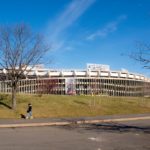
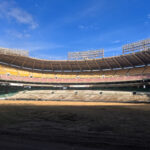
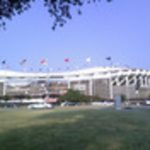
To make up for the loss, major league baseball awarded the nation’s capital a new expansion team also known, rather confusingly, as the Washington Senators (a decade later, they would move to Texas). They played one more season at Griffith Stadium before moving to D.C. Stadium—later, renamed to RFK Stadium—and the old ballpark on Georgia Avenue closed down for good. It sat disused, dilapidated, and vandalized until the land was finally sold in 1964 to Howard University for $1.5 million. The next year, cranes and wrecking balls finished the job and demolished the steel and concrete structure.
Today, there’s little left of Griffith Stadium besides the Howard University Hospital’s painted home plate and the memories, which are dwindling with each passing year.
“Griffith Stadium was …” Brotman says, pausing for a moment, “near and dear to me. It was a great place to watch a ball game.”