Martin Austermuhle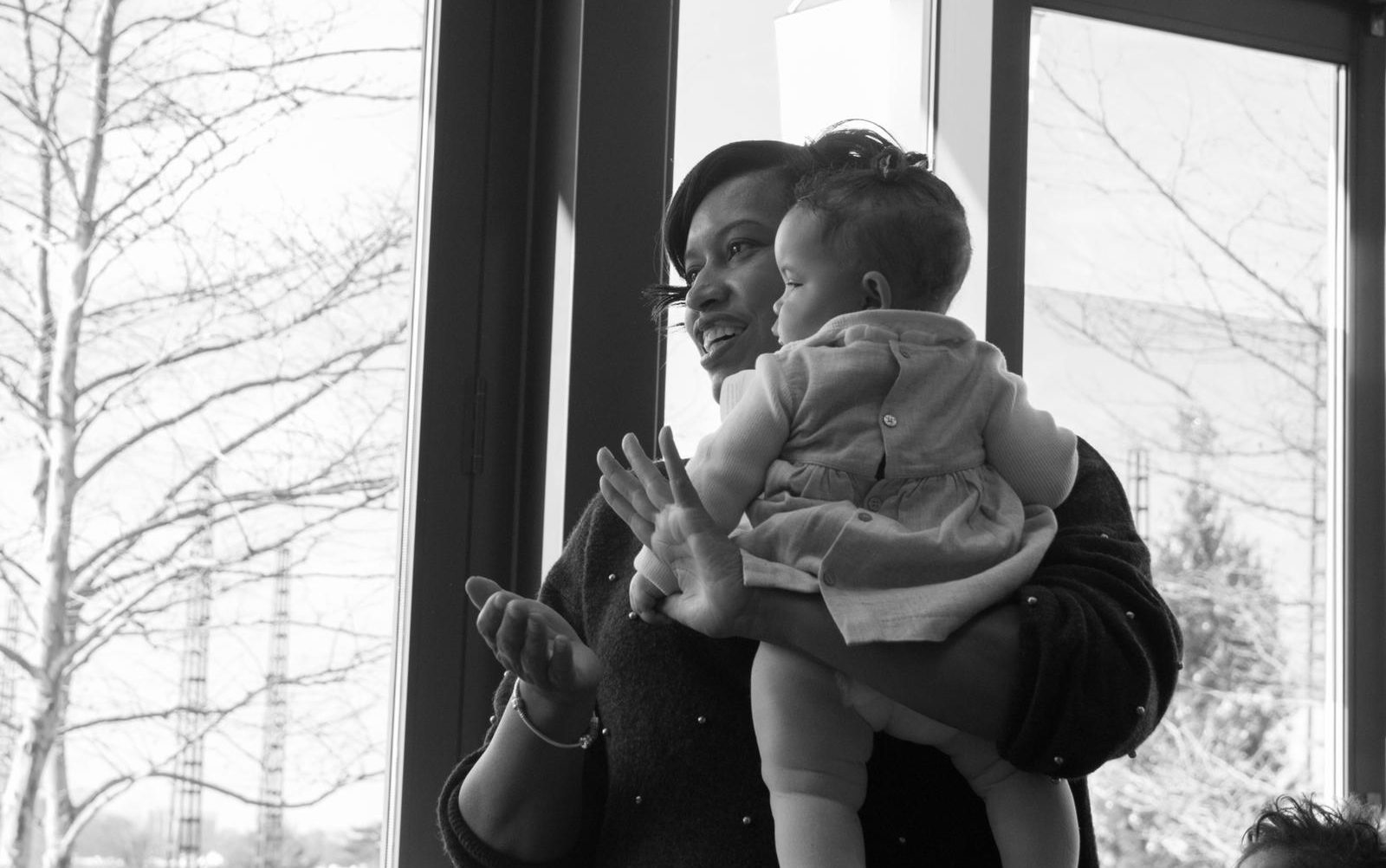
For over a decade, Muriel Bowser has been the boss: First of her D.C. Council office and its small staff, then of the entire D.C. government, a $15 billion enterprise that employs more than 35,000 people.
But when the mayor announced suddenly last May that she had adopted a child, she found herself in a strange place: taking orders from someone else.
“Miranda’s in charge, basically of how you go, when you go, when she wants to eat,” Mayor Bowser says of her 10-month-old daughter. “Luckily, she is a sweetheart. She has a very pleasant temperament, but you fully realize you can’t control everything.”
Since she brought home the baby that Washington soon came to know as Miranda Elizabeth, Bowser has been working to balance the duties of being a new mother and the mayor of a major American city. While Bowser is not the first D.C. mayor to have young children while in office—Marion Barry’s son, Christopher, was born during his first term; Adrian Fenty came into office in 2007 with twin sons, and his daughter was born two years later—she is the first to do it all alone.
She is part of a growing trend, both nationally and locally. Nearly a third of U.S. children live with a single parent, and that number has doubled over the last 50 years. In D.C., 41 percent of kids live in single-parent households, as of 2016. Parenthood is rarely easy, and Bowser concedes single parenthood requires an additional degree of thought and effort to balance the personal and professional.
“I have tried very hard to build a village of friends and family that can be helpful when I need it,” Bowser says. “I have a non-traditional work schedule. For me, it’s just about being able to manage. My work is cyclical. Sometimes I have more longer-hour days than other times of the year, so just being able to look ahead and plan a lot better than I used to to make sure we’re covered.”
Bowser, 46, has in-home child care, and her parents—Joe and Joan, who still live in her childhood home in North Michigan Park—help watch Miranda one day a week. When she has to work weekends, Bowser asks her staff to try and make the events family-friendly. (Miranda also comes out to some weekday events, like the recent Nationals home-opener and a birthday celebration for 110-year-old resident Virginia McLaurin.) While she tries to make it home for as many bedtimes as possible, she admits it’s not always possible.
#OpeningDay in the greatest city in the world and soon to be the #51stState#OnePursuit #SportsCapital pic.twitter.com/p6WKkS54Vz
— Muriel Bowser (@MurielBowser) March 28, 2019
Some of Bowser’s counterparts in the city’s legislative branch can relate to her struggle. Three D.C. Council members currently have young children. Robert White’s (D-At Large) second daughter was born in March. In late 2017, when new mother Brianne Nadeau (D-Ward 1) was chairing a hearing that ran long, she pumped breast milk while sitting at the dais.
“I won’t say it’s always easy because there are always a lot of competing demands,” Bowser says.
Despite the difficulty of constantly being on-call, Bowser tries to work screen-free time into her family’s daily routines, keeping her phones quiet during her mornings alone with Miranda.
“When I’m with Miranda in the morning, that is just our time. To wake up, get her dressed, read to her in the morning, and I try not to be interrupted. That’s not always possible. We’ll make up for that time,” she says.
Bowser says she often reads to Miranda (“I think in a next life I may be a critic of children’s books,” jokes the mayor), walks her around the house pointing out pictures and paintings (one of former President Barack Obama; “I think that’s going to be one of the first things she says, Barack Obama”) and takes her on walks around her neighborhood in Northwest D.C.
Being a new mother has given Bowser a newfound appreciation for some of the local challenges many parents face. She says she’s noticed smaller things that may not have been all that apparent to her before—like sidewalks.
“That is one issue that I probably didn’t see as well, but if you try and push your kid through a road where people are going 50 miles per hour and there’s no sidewalk, you really see how important it is to get missing sidewalks done,” she says.
Bowser also says that being a parent has given her newfound appreciation for one issue she has been addressing over the last two years—the high cost of child care in D.C. In her most recent budget, Bowser is extending a $1,000 tax credit for child care costs, and she wants to spend $52 million to build three stand-alone early education centers.
But on another issue—paid family leave—Bowser has run into criticism in recent years. While the D.C. government offers employees eight weeks of paid leave, Bowser raised concerns with a similar law that was passed by the D.C. Council to apply to private employers. She has since worked to implement it—it takes full effect in July 2020—but still speaks about its overall cost to businesses.
Miranda’s first birthday is next month, and she’s becoming more mobile, scooting around happily and trying to walk more than crawl.
“I’m looking forward to her being able to walk and talk. I can’t wait,” Bowser says. “She’s really trying her hardest to communicate now, and I’m interested to see what’s on her mind.”
When asked whether she thinks there’s a broader message she wants to send about being a single mother who adopted her daughter, Bowser pauses before answering.
“Families are made in all kinds of ways, and we should be happy for children and families where there is love. And that’s the biggest messages: what’s becoming traditional is the un-traditional,” she says. “We’re just a normal little family on Orchid Street, and the things they want for their kids I want for mine too.”
This story originally appeared at WAMU.