Natalie Delgadillo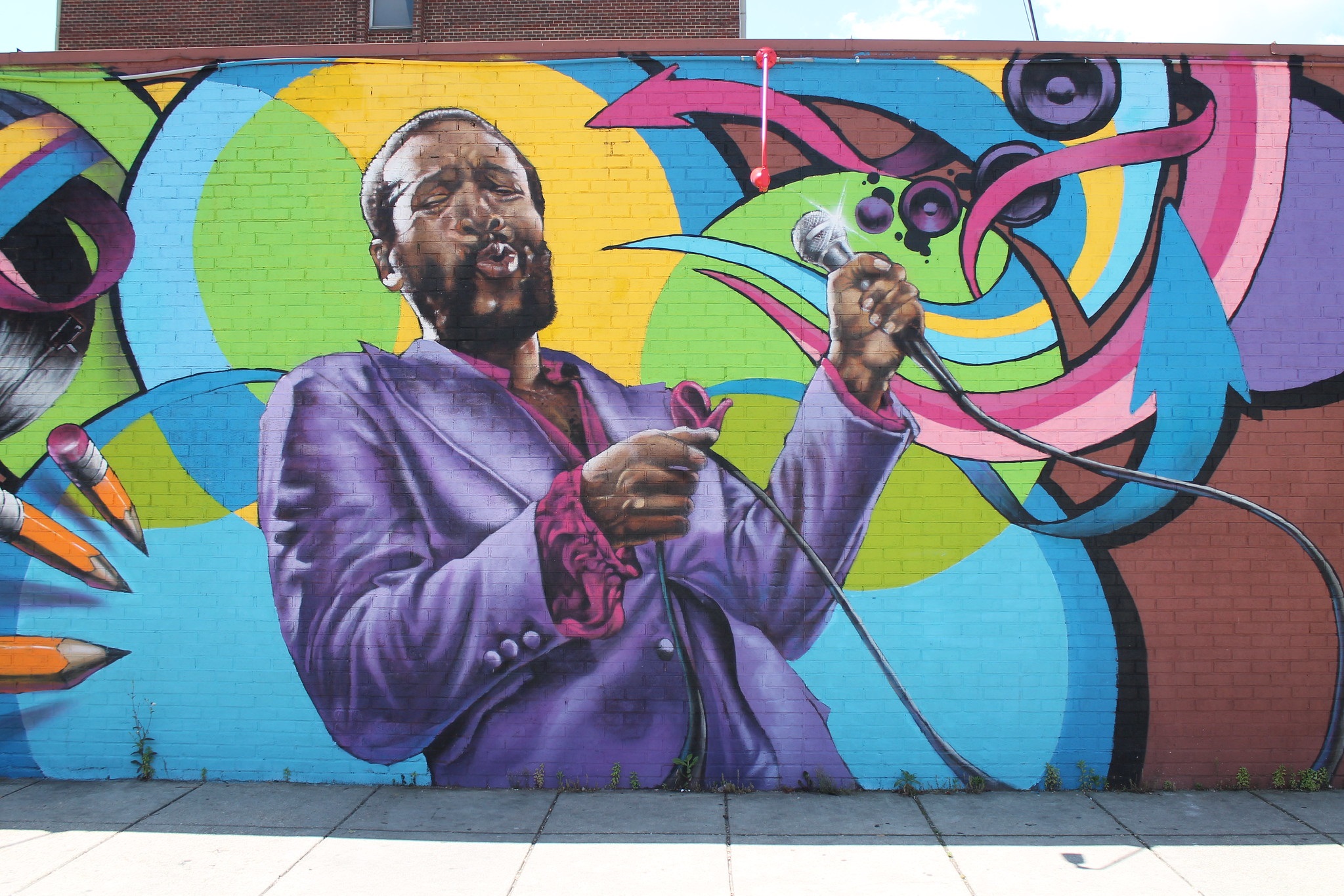
Marvin Gaye holds a special place in the heart and lore of Washington, D.C.
The legendary Motown and soul singer was born here on April 2, 1939 at Freedmen’s Hospital (now the site of Howard University’s radio station and communications school).
He grew up in the District, living at the Benning Terrace housing project in Southeast and then at East Capitol Dwellings in the Deanwood neighborhood in Northeast. He went to Randall Junior High School (since closed), and then Cardozo High School in Northwest, though he dropped out before graduating.
At Cardozo, he sang soprano in the choir.
“I remember him always wearing a golf sweater,” Rev. Sandra Butler-Truesdale said in a segment on Gaye on The Kojo Nnamdi Show on Wednesday. Butler-Truesdale went to Cardozo with Gaye, and sang in the choir with him. She’s also the founder and chair of D.C. Legendary Musicians, Inc. and the co-author of the book Washington, D.C. Jazz. “He was very tall and good-looking, so he had lots of ladies peeping and looking at him, including me,” she said. “He was a very calm person … and I always thought, he always knew what he wanted to do.”
Tuesday would have been Marvin’s 80th birthday. Just one day before, April 1, was the 35th anniversary of his death at the hands of his father, Marvin Gay Sr., who shot him after a fight at his parents’ home in Los Angeles in 1984. He died just one day before he would have turned 45.
“It really was devastating … the feeling that I had, because of the closeness. You never forget relationships and people who are positive in your life,” said Butler-Truesdale of her reaction to Gaye’s death. “When that happened, it was almost like my real brother passed away.”
In his late teens, Gaye (who added the “e” to his last name later in life) started singing with doo-wop groups in the city. He was a member of a group called the Rainbows, which later evolved into the Marquees, which performed all over the city, particularly in the many music venues on 14th Street NW, Butler-Truesdale said. It was through The Marquees that Gaye began recording in the home studio of Bo Diddley, the iconic singer, guitarist, and music producer who lived at 2614 Rhode Island Avenue NE.
The Marquees eventually also performed with Harvey Fuqua as the New Moonglows, and Fuqua and Gaye became friends and eventual recording partners at Motown in Detroit. And then—well, you probably have an idea what happened after that.
Detroit and Los Angeles, where the Motown label eventually moved, each have their own claims on Gaye. But D.C. is his hometown and his birthplace. It has its hold on him, too—even though Gaye reportedly hated the city and spent his youth trying to escape it.
“I hated Washington,” biographer David Ritz quotes Gaye as saying. “The place filled me with a feeling of hopelessness. Nothing happened in Washington. Nothing was made or produced or sold. It was all government, papers, bureaucrats, and bullshit. Here was a city blessed with musical talent and no place to record, no real labels or promoters or distributors.”
Gaye may have felt that way about D.C., but the city certainly does not feel that way about him. We’ve got murals, we’ve got Marvin Gaye Park, we’ve got Marvin Gaye Day. There are touted landmarks you can visit to commemorate his life here all over the city: the homes he lived in, the schools he attended, and the legendary music venues where he performed.
This year, there are also several other ways you can commemorate Gaye’s life: On what would have been his 80th birthday, the postal service released a Marvin Gaye stamp as a part of its music icon series. And on March 29, a posthumous album called You’re the Man, originally meant to be released in 1972 as a follow-up to the iconic What’s Going On, made its debut in the world. After releasing its title track, Gaye didn’t go through with releasing the album, partially because the track didn’t receive the same kind of acclaim as his other recent work, and allegedly also because the album’s political messages weren’t supported by Motown founder Berry Gordy.
Fifteen of the 17 songs on the album were never pressed to vinyl, though most of them have been included on CD compilations. They’ve never been assembled as the album Gaye created until now, according to NPR.
Take a listen, if you like:
This story has been updated to note that the Benning Terrace housing project where Gaye lived with his family was in Southeast.