 Eliza Tebo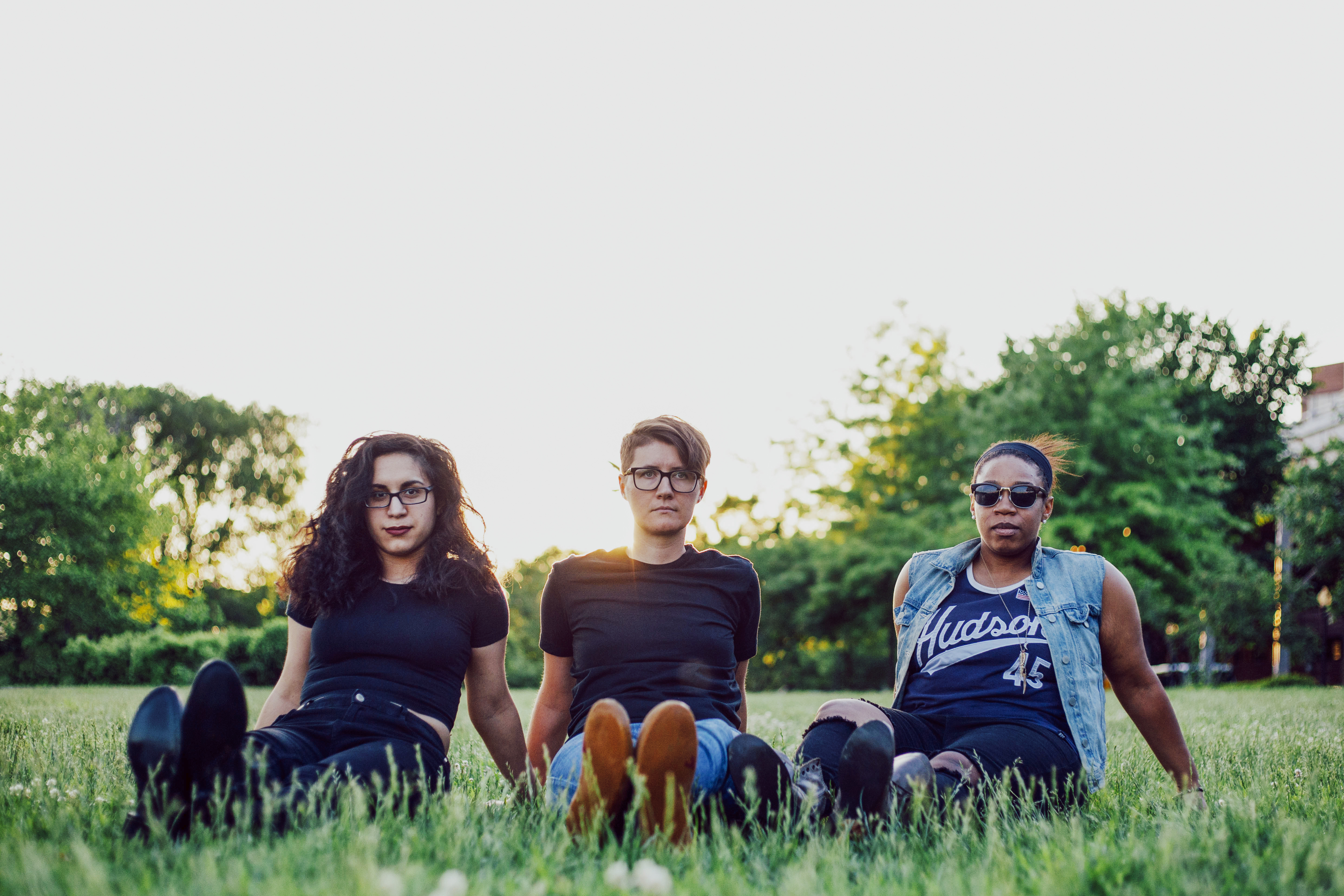
Hear the words “rock band” and your first mental image might be a gaggle of white men in their 20s sporting thrift-store T-shirts and a generous amount of facial scruff.
Enter the Womxn Fuck Shit Up Festival. Tagline: “Dismantling the patriarchy one festival at a time.”
The D.C. concert hits Union Stage on Saturday with a robust lineup of female and nonbinary-led groups. A sister event of the L.A. festival first held in 2015, the D.C. incarnation is returning for its second year and features more than 30 artists from the East Coast. Proceeds will benefit This Could Go Boom, a new D.C.-based label promoting underrepresented artists.
New to the bill this year is D.C. alt-rock outfit Honey. With members Saman Saffron (lead vocals and bass), Karen Foote (guitar) and Ebony Smith (drums), the group delivers unadulterated rock with tinges of punk and a wicked sense of humor. (Think The Waitresses or The Raincoats.) The trio formed in 2016 after meeting as volunteers with Girls Rock! DC, a nonprofit supporting girls and nonbinary or trans youth through experiential music education.
We caught up with Saffron, 26, (who uses a stage name to protect her privacy as a mental health professional) to chat about the festival and the band’s recent EP, I’m Your Best Friend Admit It. This conversation has been edited for length and clarity.
What drew the band to participate in WFSU?
We had a bunch of friends who played it last year. The mission is definitely aligned with the way that we were founded, with Girls Rock DC being our common denominator. So we definitely saw a natural values alignment. We have a song called “F*ckboys.” We’ve been saying to ourselves for ages that the best possible room we could do that song [in] would be at Womxn Fuck Shit Up.
Your Bandcamp page says Honey was “born out of a love for rock camp and interpretive dance.” Is that all in good fun or should we expect to see some inventive choreography at your shows?
We definitely do not do interpretive dance. We wrote that because all three of us were volunteers or organizers at Girls Rock DC. And at [an] afterparty, we were dancing on the dance floor together, gesticulating wildly, and all decided we wanted to play music together. So we formed a band right then.
So what went on at 86th and Columbus, one of the song titles off your EP?
I used to live in New York, and something particularly gay happened and 86th and Columbus. It has nothing to do with the actual rest of the song: There was a mailbox where I was standing near the Planetarium in New York. That’s when a girlfriend and I decided to be in a relationship.
It’s about that moment where you’re sitting across from a table with someone and you meet them for the first time, and you kind of get the sense that there’s something really building: “By the time it’s over, the corners of your mouth will hurt from smiling.” It’s like remembering those times where you accidentally meet a person, and you realize, “Oh, yeah. My face hurts. I’m having a great time.”
“The Side of the Tunnel with Lights” has a compelling arc—starts out soft and moody and then really develops intensity. You sing “Halfway through the tunnel / It’s been 15 miles since you said a word.” Is this about a relationship that’s in trouble?
Karen came up with the song, and then I came in one day and said, “This song is going to be called ‘The Side of the Tunnel with Lights.’” It’s taken from the WMATA posters in the Metro, the evacuation plan. If you have to get off the train, you’re supposed to exit on the side of the tunnel with lights.
You mentioned “F*ckboys.” On it, you sing: “You’re a waste of space … I don’t like you / No one likes you.” You’ve also got what you call a public-service announcement thrown in the middle for all the “fuckboys” out there. Give us the backstory on that one.
I used to play it in solo sets with just me and an electric guitar. It’s a funny thing I sing with my friends to complain. It’s nice because during the live shows, Karen and Ebony can sing along and yell, “No one likes you.” It’s pretty cathartic.
That song seems tongue-and-cheek, but some music and even some concerts take an antagonistic approach toward men. Do you think that could alienate significant numbers of listeners?
Usually when we do a live show, we like to say that “fuckboys” is a word that knows no bounds of gender because [it’s] a diatribe against poor behavior, particularly in relationships. So I think the way that someone responds to a song like “F*ckboys” tells me a lot about their character.
None of the people in my personal circle who are men think it’s a problem—they think it’s hilarious. My brother is constantly sending people the song and being like, “Look what my little sister did!” But we have had, at least one time, a man come up to us after the show and say, “I was so offended by what you said that I had to leave and go to the bar.” We were pleased that it was eliciting a reaction, even though we never expected it to have people react that viscerally to it.
If you’re offended by the song “F*ckboys,” you’re probably a fuckboy.
What would you like to see less of and more of as a performer in D.C.?
More respect for the city’s roots and for the city’s native population. Less all-male, all-white bills. Ebony and I sometimes come into a show, and we’re so used to it that it doesn’t really bother us. I won’t speak for Ebony, but I always notice if me and Ebony are the two people of color playing that night. It’s not lost on us.
The Womxn Fuck Shit Up Festival takes place at Union Stage on Saturday, 4 p.m.-2 a.m. Tickets $15-$25.