 Jordan Pascale
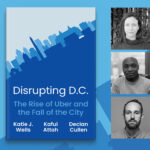
Uber drivers in D.C. don’t know the true cost of driving for the rideshare company, or how much they really make per hour, according to a new report from Georgetown University.
Researchers say the District needs to take a more aggressive role in learning about the industry and regulating pay, similar to cities like London.
They interviewed 40 Uber drivers in 2016, and found that all of them had a difficult time calculating their actual compensation. Some made as little as $5 an hour after taking expenses into account.
Katie Wells, a researcher for Georgetown’s Kalmanovitz Initiative for Labor and the Working Poor and DC Public Policy Initiative, says that many studies have examined the impact of ridesharing on transportation, but few have looked at the impact on drivers. She wanted to ask the question: “What kind of jobs are these?”
“Driving for Uber is like a mystery box,” Wells said. “While many drivers enjoy working for Uber, these individuals nonetheless deserve the opportunity for fair wages and better working conditions.”
The number one complaint she heard from drivers was that it was “difficult to play the game.” Drivers told her that the rules were always changing, including where surge pricing was in effect and different bonuses offered week to week.
According to Wells, one driver told researchers: “When the pope was visiting, Uber was like, ‘It’s going to be super busy, let us know if you’re going to drive, we want you out, it’s going to be super busy.’ They completely underestimated the business. There was absolutely no demand at all.”
“There’s no transparency with pay decision making,” Wells said. “Drivers felt powerless.”
In a statement, Uber said: “(We’ve) changed a lot since this research was started. Driver-partners are the heart of our service and Uber would not be what it is today without them.”
Uber also said the study represents a fraction of the firm’s thousands of drivers, and that researchers shouldn’t draw conclusions about the current conditions from comments made by 40 drivers three years ago. The company says it’s made the platform more friendly by introducing in-app tipping, instant pay, rewards programs, and more transparency in pay.
Other Hurdles
But Wells says many drivers don’t realize the expense associated with driving. She listed 20 factors to calculate a true hourly wage including, gas, car maintenance, depreciation, and hours on the road. And taxes were the biggest surprise for most drivers, she said.
“All of this shapes how much you can take home,” Wells said. One example from the report was particularly stark:
In the week before we met, Beatrice drove for Uber for 14 hours. After Uber took out its 25% commission and booking fees, she earned about $300. Then she took out her weekly expenses of $170 for the lease and $63 for the vehicle insurance.What these expenses meant was Beatrice had netted less than $5 per hour. Moreover, these rates meant that if Beatrice continued to drive for Uber, she would have $12,040 worth of annual expenses in addition to the costs of gas and vehicle maintenance, which could be significant as she put 3,000 miles on her car in the last month alone.
Wells said there is little available data on Uber as a workplace, so regulators have nearly no access to basic labor conditions.
Additionally, the study shows that nearly a third of drivers reported facing physical assaults by passengers or other safety concerns.
And a third of drivers took on debt to drive from the service. Wells said she heard from one driver who had to put a $1,200 car repair on a credit card and from another who took out a lease on a new car that may be hard to pay off.
One driver said that even after 16-hour workdays, he couldn’t make his car payments and had to file for bankruptcy.
Despite these challenges, half of Uber drivers told researchers that they’d recommend the job to a friend. About 45 percent say they plan to keep driving for at least six more months.
Need For A Comprehensive Study
The report calls on the District of Columbia to study the impact of ridesharing on workers as well as on congestion, public transit usage, transportation equity, and public safety.
Several other studies have found that ridesharing has contributed more to congestion in cities and is less effective at moving large numbers of people compared to public transit.
The study calls for the District to mandate a prevailing wage scale for drivers.
New York City now guarantees drivers minimum gross pay of $27.86 an hour, so that driver pay after expenses will be at least $17.22 an hour. In London, an employment tribunal ruled that drivers should be considered employees rather than independent contractors, giving them access to minimum wages and paid sick and vacation days.
It also calls for rideshare companies to turn over more data about their workers.
Unlike some major cities, D.C. does not have any driver organization or union.
Wells is presenting the report at a forum with Council Chair Phil Mendelson and officials from the Department of For-Hire Vehicles on Thursday.
“I hope this raises a big question mark above their head to get curious about what we don’t know and get motivated to answer these questions,” Wells said. “Right now, we’re just not sure.”
Not Just Uber
Wells’s research focused on Uber for simplicity sake, but she said that many drivers worked for multiple platforms like Lyft and Via, which have similar problems.
Lyft has recently launched a driver advisory council in D.C. to gather feedback. Wells said while that’s a good step, she questions whether it will change the dynamic.
“It almost sounds like a focus group,” Wells said. “Does it change the power and balance (to help drivers) or is it just a question mark.”
This story originally appeared on WAMU.