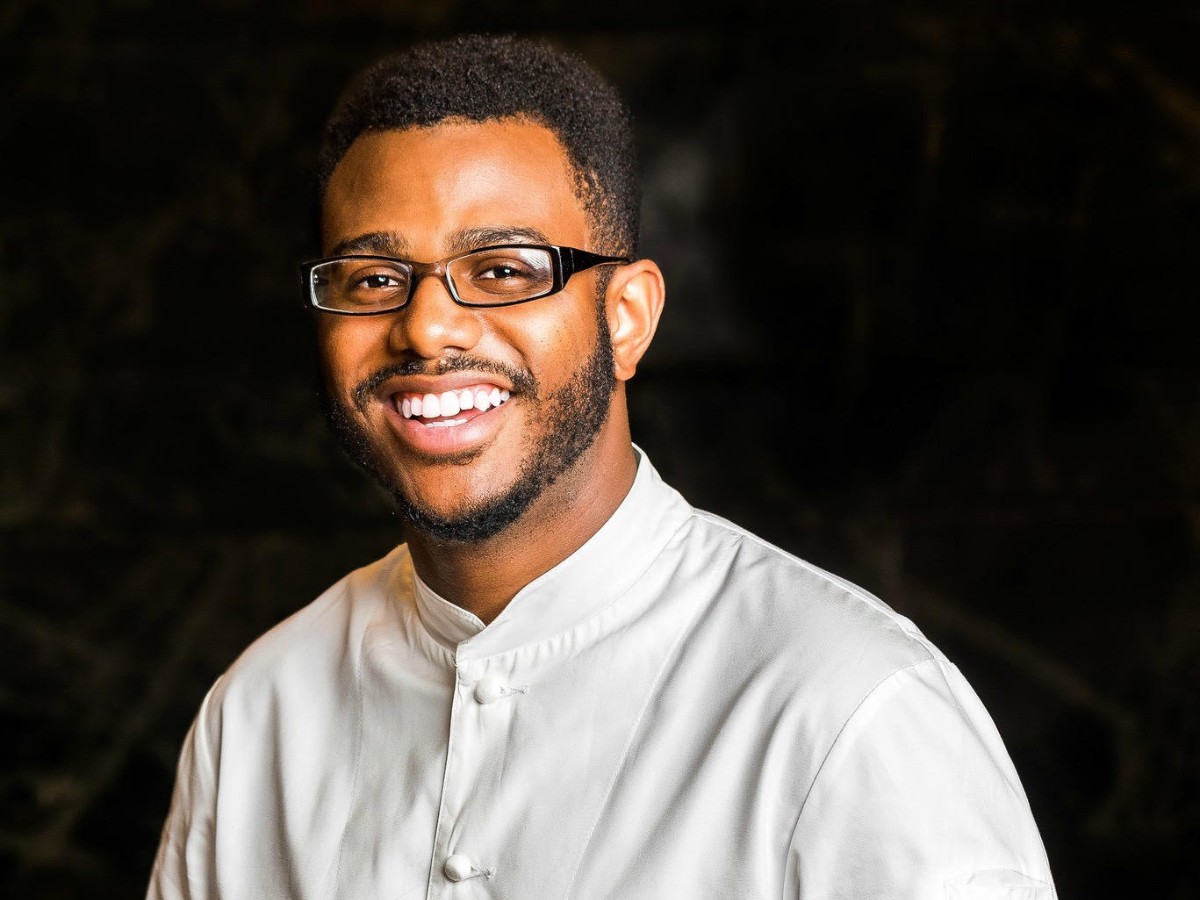
Chef Kwame Onwuachi may have experienced a very high profile defeat in this city, but he still has faith in D.C.’s restaurant scene.
“I see a huge trajectory for the food scene in D.C.,” the chef said on WAMU’s 1A this week. “I just see it getting bigger and bigger.”
The Kith and Kin executive chef joined the program to discuss his new memoir, Notes From a Young Black Chef. He talked about the successful Waterfront restaurant, what it felt like when his first restaurant went under, and the District’s vibrant food scene.
For Onwuachi, familiarity brought him to the city for his first restaurant, following a stint on Top Chef and time spent working in lauded New York restaurant Per Se. “My grandfather taught at Howard University—not many people know that,” he said. “I spent my summers here and I always had a connection to D.C. So when I was looking to open a restaurant, I came here, looked around, and it had this familiar vibe that I really connected with. So I thought, ‘Why not give it shot?’”
He’s not the only one asking that question. According to the National Restaurant Association, D.C. was home to close to 2,500 eating establishments in 2018, and the industry made around $4.4 billion in sales.
“If you look at our track record, the Michelin Guide is here,” Onwuachi said. “This last James Beard shortlist and longlist we had a lot of people from D.C. representing on there.” When James Beard Award semifinalists were announced earlier this year, 20 D.C. chefs and restaurants made the cut—that’s six more than New York City. The District’s numbers include Onwuachi, who made it to the finals for rising star chef of the year.
He wasn’t always given such praise though. Two years ago, his debut restaurant the Shaw Bijou received criticism from many sides. The restaurant, situated in a rowhouse in Shaw, included more than a dozen courses served at various locations around the property. “It was a very interactive experience,” Onwuachi said on 1A.
But at the time, diners questioned the $185 per person tasting menu price, and critics panned it (though DCist’s reviewer called it one of the best dining experiences in the city). The Washington Post gave it a notoriously scathing review:
The beautiful, custom-made plates from Cloud Terre don’t ferry more than a bite or two per course to the table. Dinner at the Shaw Bijou feels more like extended hors d’oeuvres.
Mulling the meal, a companion asks the rest of us, ‘How would you rather spend $2,000?’ That’s the sum for four, once tip, tax and wine are factored in.”
… As my party stands outside one of the most highly anticipated restaurants of the season, currently all but obscured by construction fencing, I take a vote to see how many would return on their own dime. Head shakes all around confirm my hunch.
Onwuachi and his business partners adjusted the offerings, debuting an a la carte menu and slashing the prices on the full dining experience, but the restaurant still closed a little over two months after opening.
In the interview, Onwuachi defended the vision he and his partners had for the Shaw Bijou. “I was expecting a success,” he said. “I wouldn’t call it overnight, because it was two years in the making—we built that restaurant with our bare hands. … I expected an amazing restaurant—which it was.”
Shaw Bijou, he said, was designed to offer specific, curated experiences. When one diner joked that they would like to wear slippers during their meal, for example, Onwuachi said his fiancee went to Marshalls to purchase some fuzzy shoes, which a server presented to the diner under a cloche. “Those were the moments I lived for at that restaurant,” Onwuachi said. “We were making people feel special and curating this experience that they wouldn’t get everywhere.”
He also pushed back against the idea that the restaurant and its high-end menu contributed to the rapid gentrification in D.C. “I think those criticisms are bogus,” Onwuachi said. “If you ever came to the Shaw Bijou, you’re talking about a dining room full of affluent African Americans. … Here’s a restaurant by a young black chef that’s just adding to the neighborhood. I don’t think that it was adding to any sort of gentrification. I think the people that grew up there were actually coming back to Shaw to dine for the first time in a while.”
The reception for his second restaurant Kith & Kin, a 200-seat Afro-Caribbean spot at The Wharf that opened in fall 2017, has been much warmer. Onwuachi says the menu was inspired by his own dinner table. “I actually just started writing things that I grew up eating,” he said of the menu creation. “I joke a lot with my guests that Kith and Kin is pretty much my family’s Thanksgiving on a menu. Because I have Jamaican, Nigerian, Trinidadian, and Creole roots, you’ll see anything from jollof rice, to suya, to curried goat, to oxtails, to gumbo.”
Despite the variety of influences, he doesn’t call Kith & Kin’s cuisine fusion. “As we evolve, our food evolves,” he said, adding that diners are hungry for that fare. “If you go to Kith & Kin, I would say it’s one of the most diverse restaurants—dining room and staff-wise—in the District. It’s because of discovery. It’s people discovering a brand new food … or they’re able to appreciate their culture.”