 Lori McCue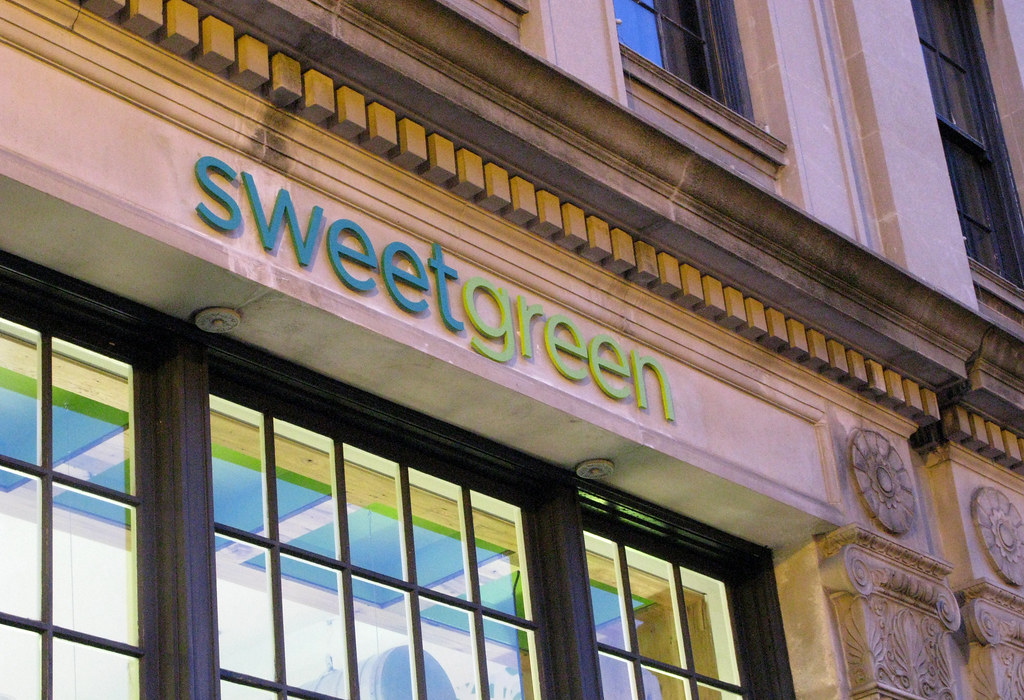
Sweetgreen, the D.C.-born fast-casual salad chain, is doing away with its two-year-old ban on cash transactions. The company announced Thursday that all of its 94 locations—expected to grow to 110 by year’s end—will begin accepting cash again by the end of 2019.
“Ultimately, we have realized that while being cashless has advantages, today it is not the right solution to fulfill our mission,” the company wrote in a Medium post. “To accomplish our mission, everyone in the community needs to have access to real food.”
Cashless policies and the eateries that have enacted them, including the D.C. sandwich spot Jetties and barbecue restaurant Hill Country, have faced criticism for shutting out customers who don’t or can’t use credit or debit cards. Last summer, At-large Councilmember David Grosso introduced legislation that would bar food establishments in D.C. from refusing to accept cash payments.
“By denying patrons the ability to use cash as a form of payment, businesses are effectively telling lower-income and young patrons that they are not welcome,” Grosso said in a release at the time. “Practices like this further stratify our diverse city when we should be working to foster greater inclusion.” Grosso reintroduced the legislation to the Council in February.
Philadelphia approved similar legislation in February, and Massachusetts has a law on the books barring cashless retail. As a result, Sweetgreen locations in the state never stopped accepting cash.
When Sweetgreen announced the cashless policy in 2016, it claimed lines would be shorter (the company reported that going cashless means 5-15 percent more transactions per hour), employees would be safer (“with no cash on-hand, they’re less of a target for theft”), and the planet would be greener (no armored cars to pick up and drop off cash).
The safety concerns were particularly important to another local spot that went cashless, the Penn Quarter restaurant Hill Country, which was burgled four times in 2018. An employee was later charged with the incidents. But Marc Glosserman, founder and CEO of Hill Country Hospitality, said cash was still too much of a hassle. “Managing cash and handling cash is time-consuming and it’s cumbersome,” Glosserman told WAMU last year. “We would rather see [our staff] focusing on serving our guests.”
But it also leaves a fair amount of Washingtonians unable to partake in Sweetgreen’s salads and Hill Country’s brisket. As of 2017, eight percent of D.C. residents are unbanked, according to the FDIC, meaning they don’t have bank accounts. (That figure is down nearly three percentage points from 2015). Another 21 percent are underbanked, meaning they have bank accounts, but also rely on outside financial services.
And as Linnea Lassiter, an analyst at the D.C. Fiscal Policy Institute, told Washington City Paper in 2017, a cashless policy excludes lower-income customers. None of Sweetgreen’s 12 D.C. locations are in Wards 7 or 8, a predominantly black area with few sit-down restaurants and even fewer grocery stores. “They’ll say, ‘We’re not in Ward 7 or 8, and our clientele is not low-income or African-American,’” Lassiter said. “People of color commute and or live in areas where there are Sweetgreens.”
A spokesperson for the company said the founders were unavailable to comment about the return to accepting cash. But Sweetgreen co-founder and chief concept officer Nicolas Jammet told Bloomberg that they’ve heard the criticism, and that the company had been discussing doing away with the cashless policy for about six months. It will start with six locations in Philadelphia, which are slated to implement the change by July. “As a business, we are in a very different place than we were three years ago, and that requires evolution,” he said.
This story has been updated to reflect that the rate of unbanked D.C. residents is down three percentage points from 2015.