 Jenny Gathright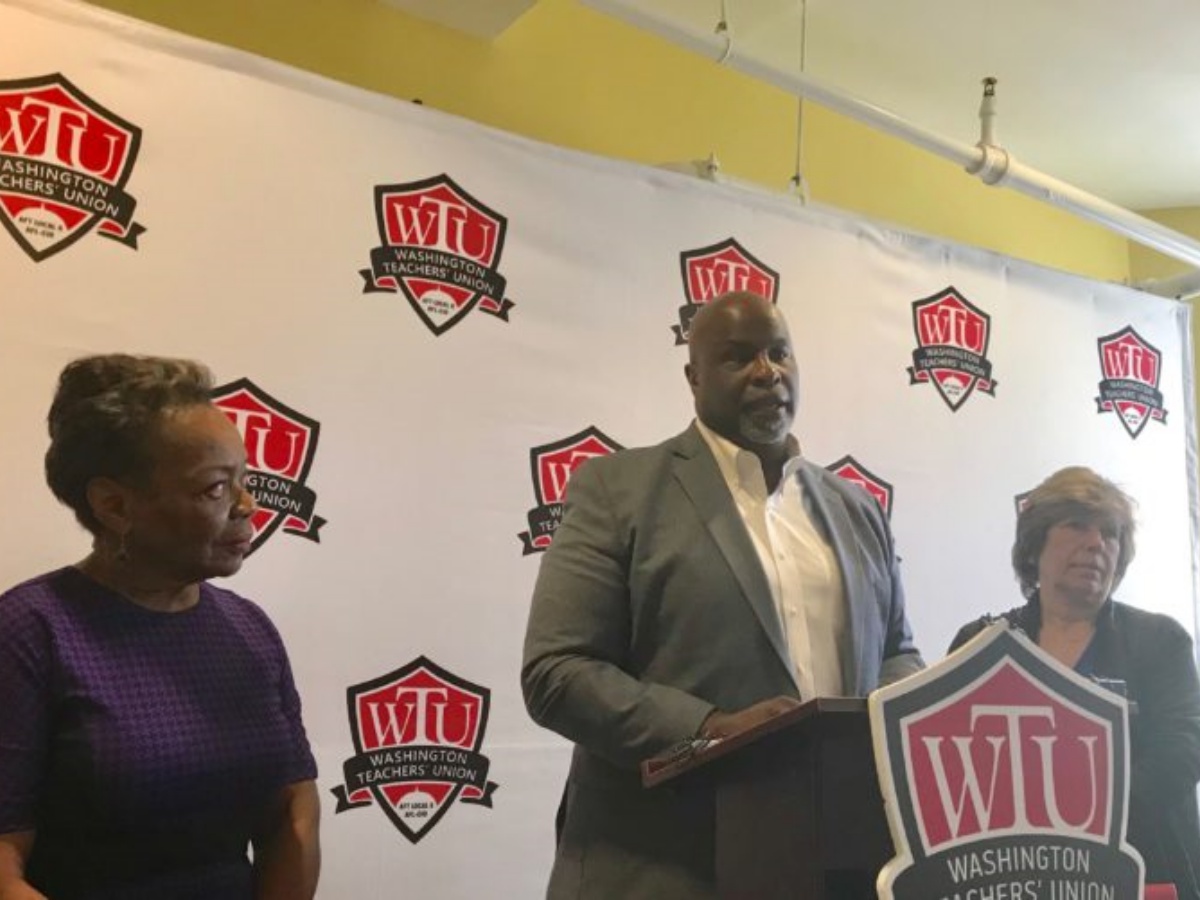
Last year, an arbitrator ruled that former D.C. teacher Jeff Canady was wrongfully terminated by District of Columbia Public Schools. But a decade after his firing, and nine months after the arbitrator’s ruling, Canady has not received his back pay.
At the time of his firing, DCPS claimed Canady was being terminated because he received a low score on a teacher evaluation index; Canady and the American Federation of Teachers have claimed Canady was fired because he was outspoken and active in the union.
In an emailed statement, DCPS spokesperson Shayne Wells said the District is taking steps towards compliance with the arbitrator’s decision and “actively working to determine the appropriate amount of backpay due.”
In a press conference Monday morning, Canady was joined by Washington Teachers’ Union President Elizabeth Davis and American Federation of Teachers president Randi Weingarten.
Weingarten said that her role as AFT President means she would not normally attend local press conferences about the payment of arbitrations, but she said she did attend this time, because “this is a complete injustice that revives what happened during the Rhee era.”
Michelle Rhee, who served as DCPS chancellor from 2007 to 2010, was a highly polarizing figure in local education. Nearly 1,000 teachers were fired during her term.
“She came in and just tried to sweep out people, a disproportionate number of whom were African American teachers in this city,” Weingarten said.
In 2011, DCPS lost its appeal of a different arbitration case involving teachers who were fired while Rhee was chancellor: It was decided that 75 teachers who weren’t given reasons for their firings were owed over $7 million in back pay.
Davis told reporters that the Washington Teachers’ Union recently submitted to D.C. Attorney General Karl Racine a list of cases in which teachers who had been entitled to back pay by arbitration had not received payment from DCPS. Davis said the number of teachers is in the hundreds, and the cases are a mix of individual cases and class action cases.
“It’s on the radar of the mayor, city administrator, the attorney general, the chancellor — they’re all aware,” Davis said.
Canady was earning $80,000 at the time of his termination, which means it is likely the District owes him over $800,000 in back pay and legal fees, according to the terms of the arbitrator’s ruling. He was recently reinstated by the District as an employee on administrative leave with pay, so he was sent his first paycheck in years on Friday. But he said he has not accessed the money yet.
“They put it into a closed account that I had 10 years ago,” Canady said.
Canady said he has had trouble finding other teaching jobs since he was fired in 2009.
“When I went to Prince George’s County, who I had previously worked for, they sat down with me … and they said, ‘How in the world did this not get resolved?’” Canady said. “And they could not hire me because the case was not resolved.”
As a result, Canady said, he has struggled financially and had to live in the Central Union Mission homeless shelter for a time.
Davis said that most of the cases WTU has filed over the past five years have been related to IMPACT, the system DCPS currently uses to evaluate teacher performance. Davis said this summer the Washington Teachers’ Union is hoping to do impact bargaining with DCPS to instate a new evaluation system that is more fair to teachers.
“Teacher evaluation need to be a process which number one improves the quality of teaching, but also one that teachers trust,” Davis said.
Davis said IMPACT “has morphed into more of a weapon against teachers.”
Stephen Bigelow, Jr., the chairman of D.C.’s police union, also spoke at the Monday press conference in solidarity with the Washington Teachers’ Union. Bigelow said the police union is dealing with a backlog of over 400 arbitration cases.
This story originally appeared on WAMU.