For the last twenty years, decisions to grant or revoke parole for D.C. prisoners has rested with federal board members of the United States Parole Commission.
“There’s this federal agency with no connection to D.C. which is denying people parole right and left,” says Phil Fornaci, senior counsel at the Washington Lawyers’ Committee and director of the D.C. Prisoners’ Project. The two commissioners currently serving on the U.S. Parole Commission are from Maryland and Kentucky.
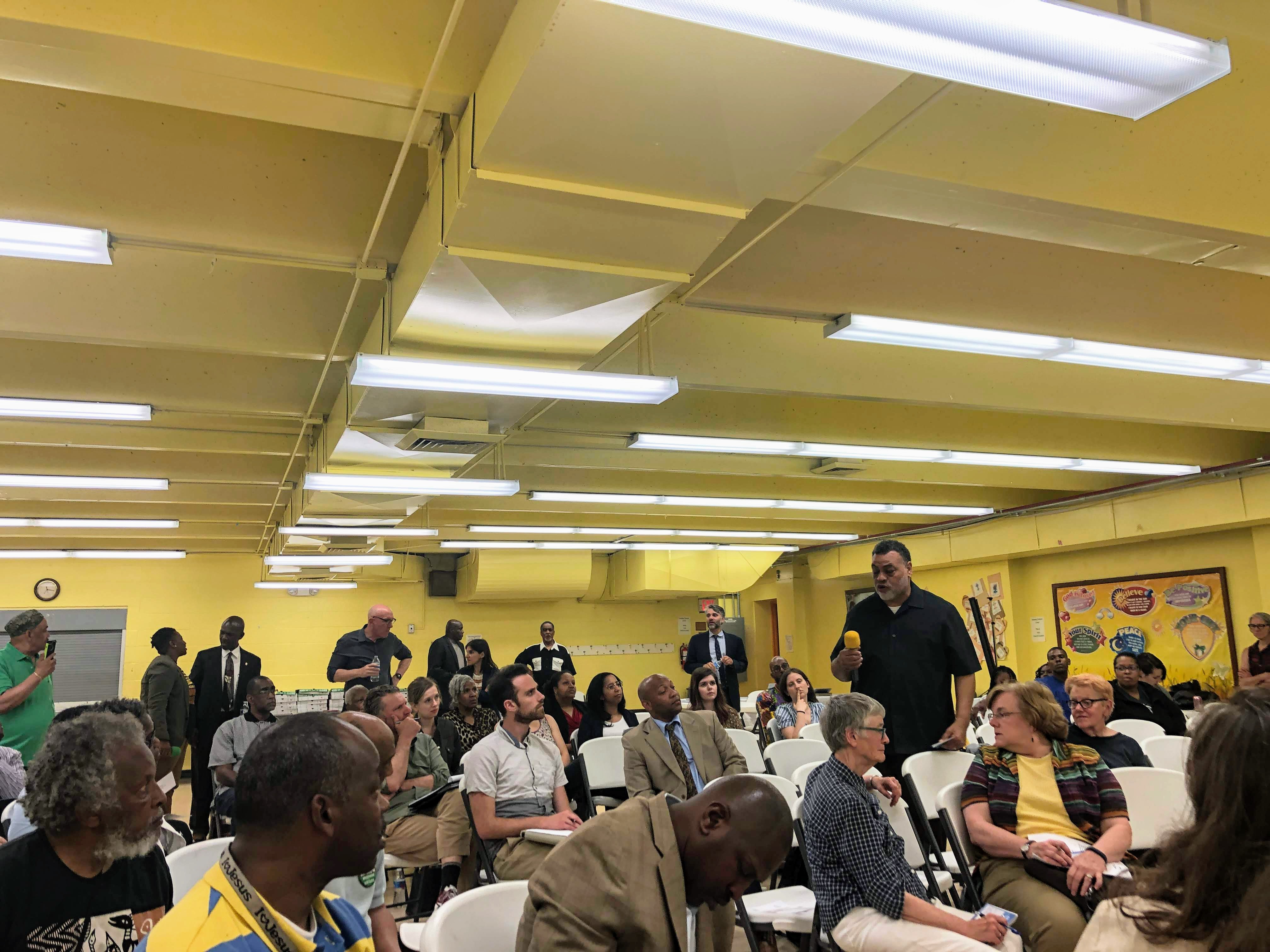
Criminal justice advocates gathered Tuesday with former prisoners and families of incarcerated residents to rally for change at a “speakout” organized by the D.C. Reentry Task Force. Community members passed microphones around the crowded church basement and signed postcards to Mayor Muriel Bowser.
“Dear Mayor Bowser,” the cards read. “Time is running out. We must act NOW to restore local control of DC parole.”
One woman named Latrice described her husband’s lengthy and uncertain parole process. “In the last ten years, he’s been up for parole four times,” she said, but he’s still in a federal prison in Massachusetts.
The District once had its own parole board. That changed with the National Capital Revitalization and Self-Government Improvement Act of 1997, in which the city traded an annual payment in exchange for the federal government taking over city debts, employee pensions, management of the courts and prisons, and other responsibilities.
Margaret Quick served as the last chair of the D.C. Board of Parole before the agency was abolished. During her tenure, board members often heard cases firsthand. “So when they made a decision, they made a decision based on looking the person in the eye and seeing who they were, and understanding, or trying to understand, whether they’d changed,” she said.
Under the current system, the U.S. Parole Commission decides whether to grant prisoners parole based on the recommendations of hearing examiners. Quick said “It’s a sad situation when you tell a person ‘I would recommend that you are released,’ and then the commission gives them a set off”—postponing the prisoner’s parole hearing for a set number of years.
The mayor has already begun investigating the process of reestablishing local control over the parole system. Earlier this year, she allocated a $75,000 grant to study the necessary “legal and structural frameworks.” The report is due at the end of September.
It would first require an act of Congress to amend the current duties of the U.S. Parole Commission and grant the District authority over adjudicating parole. The mayor would then need to allocate funds in the budget to create a new D.C. Board of Parole (advocates say they want to see at least two returning citizens on any future D.C. board.)
It’s unclear how long that process could take or what it would cost either to establish a new parole board or to fund on an annual basis.
“Findings from the study, slated for completion at the end of this fiscal year, will guide our next steps, however, any recommendations put forward will require congressional action,” Deputy Mayor for Public Safety and Justice Kevin Donahue said in an emailed statement. “As we work to complete the study and determine these next steps, we will engage the community, advocates, and experts to ensure we are putting forward the best recommendations for our residents.”
On Tuesday, spouses and relatives of D.C. prisoners shared their frustrations with navigating the federal criminal justice system.
One woman described how her husband has been up for parole three times. And three times, the U.S. Parole Commission has overturned the hearing examiner’s recommendation for parole. “We got the paperwork back, they said no, ‘We’re gonna see you in another three years,’” she said. “I thought the system was supposed to be a system to show, to provide rehabilitation. So if they’re showing that they’re being rehabilitated, then why can’t they come home?”
Advocates say that the U.S. Parole Commission issues parole decisions that are “far harsher” than those of the former D.C. Board of Parole.
Quick doesn’t recall ever holding three or four parole hearings for the same prisoner.“I can’t imagine that we set somebody off four times after telling them that they were going to be released,” she said. “That’s just not something we did.”
Lengthy parole sentences is hardly a new complaint. More than a dozen judges, prosecutors, defense attorneys, and advocates signed an open letter in 2016 raising the issue. They identified limited access to rehabilitative programming, which the Parole Commission often listed as a requirement for granting parole, as one of the major factors.
The lack of local control over criminal law enforcement can leave D.C. prisoners and their loved ones adrift between two different systems. Returning citizens caught with marijuana, for example, would not be violating D.C. law, but could still be charged with violating parole because the drug is federally illegal. And since the closure of the Lorton prison (also following the National Capital Revitalization Act), felons from D.C. are held in prisons across the country—as near as Cumberland, Maryland and as far as Victorville, California.
More than a third of the 4,700 D.C. prisoners in the federal Bureau of Prisons are being held for violations of parole or supervised release, according to the Washington Lawyers’ Committee. Fornaci calls it “just unfair and out-of-hand and outrageous.”
“The Bureau of Prisons doesn’t even tell any [D.C.] government agency when someone’s coming home from prison,” Fornaci says. “So we can’t even plan and help them. They just get off the bus.”