Natalie Delgadillo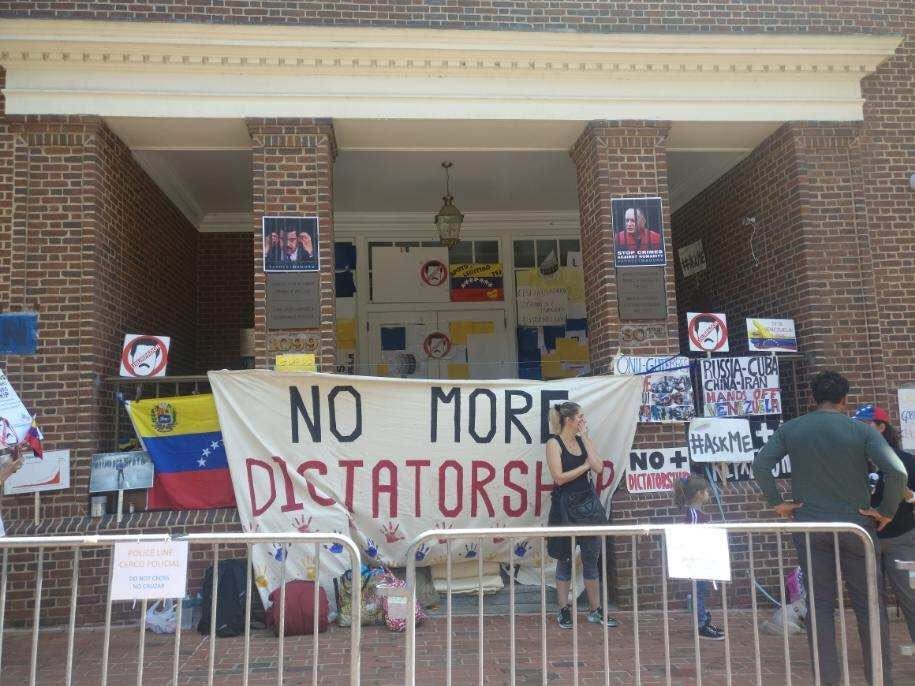
Update 5:10 p.m.:
Three people were arrested Thursday afternoon. Activists living inside the Venezuelan Embassy came out to hold a press conference and try to collect food and other supplies for the people inside.
According to the activists, Venezuelan opposition protesters had been blocking all the entrances to the embassy, preventing people from bringing in food. Videos taken Wednesday show protesters yelling “no food, no water!” at organizers trying to reach the embassy.
During the press conference, the two groups continued to clash. Secret Service eventually moved everyone away from the entrances of the embassy, and would not allow anyone (including the activists who had been living there) back inside. Two of the people throwing food ended up getting arrested, as did a Venezuelan opposition protester, who was arrested as he confronted the activists.
Original:
The group of activists that have barricaded themselves inside the Venezuelan Embassy in Georgetown for the last several weeks say they haven’t been able to receive any new food deliveries since Wednesday evening. The protesters outside are blocking all the doors.
“It’s a really dangerous situation, and these are D.C. residents in here,” says Ariel Gold, the national co-director of the antiwar organization Code Pink and one of the activists who’s been living in the Venezuelan Embassy since early April. “And the police are doing absolutely nothing.”
Since April 10, a group of organizers has been staying 24 hours a day inside the Venezuelan Embassy to stop diplomats for the country’s opposition government from taking up residence here. As the weeks have worn on, the number of people inside the embassy has only grown—there are now between 30 and 50 people living there at any one time, Gold says.
Meanwhile, just outside, a group of mostly Venezuelan nationals has been staking out the embassy for two days, booing and jeering the activists inside. Decked out in the blue, yellow, and red colors of the Venezuelan flag, they’ve mocked the (mostly American) activists for not speaking Spanish, called them thieves and trespassers, and sometimes nearly gotten into violent clashes as they’ve tried to get the group to leave the embassy. On Thursday morning, a group had pitched a tent behind the embassy, as though to signal that they, too, plan to stay as long as it takes.
They want @codepink and other activists, who’ve been living here to keep it in Maduro’s hands, evicted.
“You are supporting a criminal and dictator,” this woman said. “You don’t stand for human rights, you stand for starvation.” #Venezuela pic.twitter.com/TUiIdnbWW5
— Alejandro Alvarez 🫡 (@aletweetsnews) April 30, 2019
“You are supporting a dictator, a criminal, shame on you Code Pink!” one protester can be seen shouting through a megaphone in a video of the scene. “You don’t stand for human rights, you stand for starvation, you stand for oppression! You stand for terrorism! Shame on you, thieves and trespassers!”
Venezuela is the middle of an urgent political and economic crisis. Two men are staking claim to the presidency, and their supporters have been clashing in the country’s streets for the last two days. On the left, there is Nicolás Maduro, who had the support of socialist president Hugo Chávez and whom many blame for the country’s economic collapse. Maduro won reelection last year in an election that has been criticized as illegitimate. On the opposition’s side, there is Juan Guaidó, who declared himself president of the country earlier this year (and whom the U.S. recognizes as the legitimate president of Venezuela, though many other countries and the United Nations continue to recognize Maduro).
The activists taking up residence in the embassy say they’re against U.S. intervention in Venezuela, and want to prevent Guaidó’s diplomats from taking over the building. They were given key card access to the embassy by Maduro’s diplomats before they were required to leave the country on April 24.
“I’m 67 years old, and I’ve seen too much already of my government screwing things up in other countries,” Medea Benjamin, the co-founder of Code Pink, told DCist earlier this month. “And I’ve seen personally decades of war in Latin America and how utterly devastating it is … and I just can’t abide by sitting and watching as my government helps engineer another coup in Latin America that will lead to decades of violence.”
The Venezuelans outside the embassy see things differently. Many of them believe that the Americans in the embassy have no real idea what life is like in Venezuela, and no right to be inside the embassy.
“I’m out here because we are defending our territory as Venezuelans right now,” says Daniela, a protester outside the embassy who declined to give her last name. “[The embassy] has been hijacked by … a group of Americans, and as Venezuelans we have a right to our property.”
During their vigil outside the embassy for the last two days, the protesters have held up their Venezuelan IDs and passports, as though to prove their right to the building. They’ve made signs that say “Hands Off My Embassy” and “Keep Your Ignorance Off My Country.”
“This organization has been appropriating the situation, the suffering of many Venezuelans, to push their own agenda here in the U.S.,” Daniela says. “And what people have to know is that this is not a right or left movement. This is about suffering, visible Venezuelans right now.”
Inside the embassy, this sentiment does not resonate.
“Guaidó is the one who represents American interests,” says Kei Pritsker, a member of the ANSWER coalition, another activist group that has had members living in the embassy. “[The group outside] is a select sample size of Venezuelans, mostly right wing, and living in the United States, the country backing the coup. It’s totally self-selecting.”
The groups have been clashing around the embassy since Tuesday. Pritsker says he was yanked down a couple of stairs and had his shirtsleeve ripped off and arm scratched as he tried to block Guaidó supporters outside the embassy from accessing a door. In the wee hours of the morning on Tuesday, a protester from outside somehow jimmied a window and got into the embassy, barricading himself in one of the upstairs rooms. Federal police eventually came to escort him out.
On Wednesday afternoon, the Guaidó-appointed diplomat to the United States, Carlos Vecchio, made a speech in front of the embassy to massive cheers from the crowd outside, praising their protest and calling on them to “continue in our struggle, brothers.”
Eventually, though, he was drowned out by chanting from inside, as the activists leaned out of upstairs windows with megaphones.
Mayowa Aina contributed reporting.