The Washington area hosts two of the most prestigious arts programs dedicated to celebrating Jewish culture. And this year they’re combining forces.
Presented by Edlavitch DCJCC, the JxJ festival brings together the efforts of the Washington Jewish Film Festival, now in its 29th year, and the Washington Jewish Music Festival, now in its 20th. “For us it’s a little less tied to the medium itself, but to the message and the conversation that can happen,” festival director Ilya Tovbis says.
How does JXJ accomplish this? By putting on something like a multi-disciplinary mixtape.
“The way I like to think about it is the musical concept of beat frequencies,” Tovbis says. “You play two notes and you hear a note that’s sort of oscillating between the two.” Since the festival’s film and music programs frequently deal with similar themes, the combination of the two resonates in a way that can be more than the sum of their parts.
There are a number of such cross-media intersections in the festival.
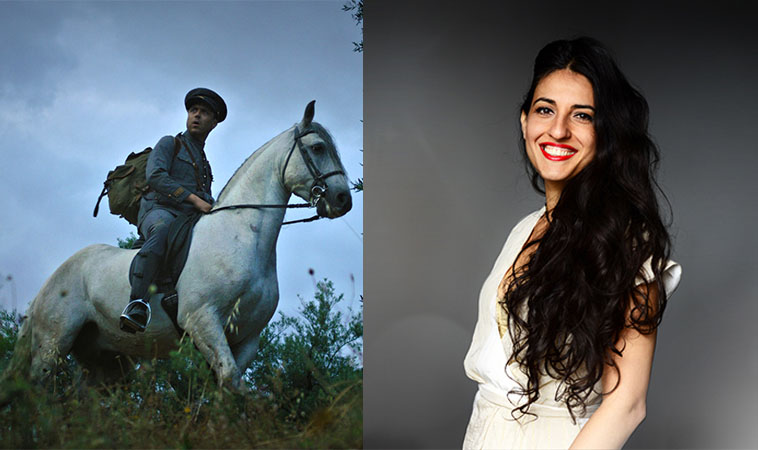
For instance, the 2018 film Sefarad (May 12 at 5:45 p.m. at the AFI Silver and May 20 at 8:15 p.m. at Landmark Bethesda Row) deals with Crypto Jews–those who practiced the faith in secret–in 15th century Portugal, who worshiped at a time when King Manuel I prohibited the open practice of Judaism.
A musical double bill featuring Yemen Blues and the Dutch singer Nani (May 16 at 8 p.m. at Union Stage) approaches Portuguese Judaism from a different angle. Nani’s songs, Tovbis says, take “an Andalusian mix from both Spain and Portugal and speak to the soul and history of this music. Two very different takes that complement each other well.”
Another cross-disciplinary and cross-cultural meeting occurs between Ethiopia and Israel with the music of Gili Yalo (May 12 at 8 p.m. at Pearl Street Warehouse). Yalo was only four years old in 1984 when, as part of a rescue effort known as Operation Moses, he was airlifted along out of famine-stricken Sudan to Israel.
On the film side, the documentary The Passengers (May 11 at 6:15 p.m. at Landmark E Street Cinema and May 14 at 6:30 p.m. at the AFI Silver) gives, according to Tovbis, “a pretty gritty account” of Ethiopian Jews that immigrated to Israel.
In addition to film and music, the JxJ Studio series within the festival offers “hybrid cultural events” that touch on theater and comedy. Zalmen Mlotek, artistic director of National Yiddish Theatre, and music director of the off-Broadway revival Fiddler on the Roof in Yiddish, directed by Joel Grey, hosts an artist’s talk (May 13 at 8:30 p.m. at Arena Stage). Mlotek will be joined by Jennifer Babiak (Golde) and Bruce Sabath (Leyzer-Volf), who will perform a couple of songs from the production and discuss, as Tovbis says, “why this revival, why now, why in Yiddish?”
The Studio program even includes a Eurovision Song Contest party (May 18 at 2:30 p.m. at the AFi), since the winning country from the previous year gets to host this year’s festivities. This year, Israel will host.
Even just within the film slate, Jewish culture resonates in some unlikely places. The coming-of-age movie Abe (May 18 at 1:45 p.m. at Landmark Bethesda Row and May 26 at 3 p.m. at the AFI) tells the story of a precocious Brooklyn tween who’s the son of a Palestinian Muslim and an Israeli Jew, but has been brought up without any religious training. Looking for meaning, he turns to cooking, and is tutored by a Brazilian chef who convincing argues for cultural appropriation, saying, “mixing flavors can bring people together.”
Similarly, who knew that New York Jews helped popularize the Cuban rhythms of the mambo? That’s what you learn in The Mamboniks (May 18 at 6 p.m. at Landmark Bethesda Row and May 22 at 8:30 p.m. at the AFI), from local director Lex Gillespie. The documentary takes an entertaining dip into the history not only of the Latin bands that played Catskills resorts and New York’s famed Palladium nightclub, but enterprising Jewish musicians who donned frilly shirts and became mambo kings themselves.
Finally, the concert event Music in Yiddish Cinema (May 23 at 7:30 p.m. at the AFI), with Isle of Klezbos and Metropolitan Klezmer, brings film and music together. Isle of Klezbos leader Eve Sicular has curated shows at the Museum of Modern Art and comes to film from the archiving world. This program features music inspired by Yiddish film clips that include notable works such as the Dybbuk and Uncle Moses to rare newsreel footage from the Moscow State Yiddish Theatre.
“The mission for us as a Jewish community organization,” Tovbis says, “is to explore the full breadth and diversity of the Jewish experience through the arts.” JxJ’s fascinating schedule accomplishes this mission.
JxJ takes place from May 8-26 at venues around town.