Martin Austermuhle
Co-working spaces—where a self-employed entrepreneur or small company can rent office space by the hour, day or month—are becoming more and more popular. There’s a co-working space for just about everyone: women and gender minorities, racial minorities, low-income entrepreneurs, artists and creatives, and so on.
But a new D.C. co-working space is offering something more than the typical desk, phone line and free coffee: a licensed child care center on site.
Two Birds, which opened in April in Tenleytown, is the product not just of opportunity, but also of need, says founder Kelsey Lents. She and co-founder JP Coakley came up with the idea while both were at Georgetown Business School, and had both recently become first-time parents. Lents she felt out of place with the traditional options of being a stay-at-home mom or returning to an office after maternity leave.
“There just wasn’t anything out there that really existed in this space where you got all of the benefits of licensed child care and early childhood development but could be working next door to them,” she says. “That was the genesis of this.”
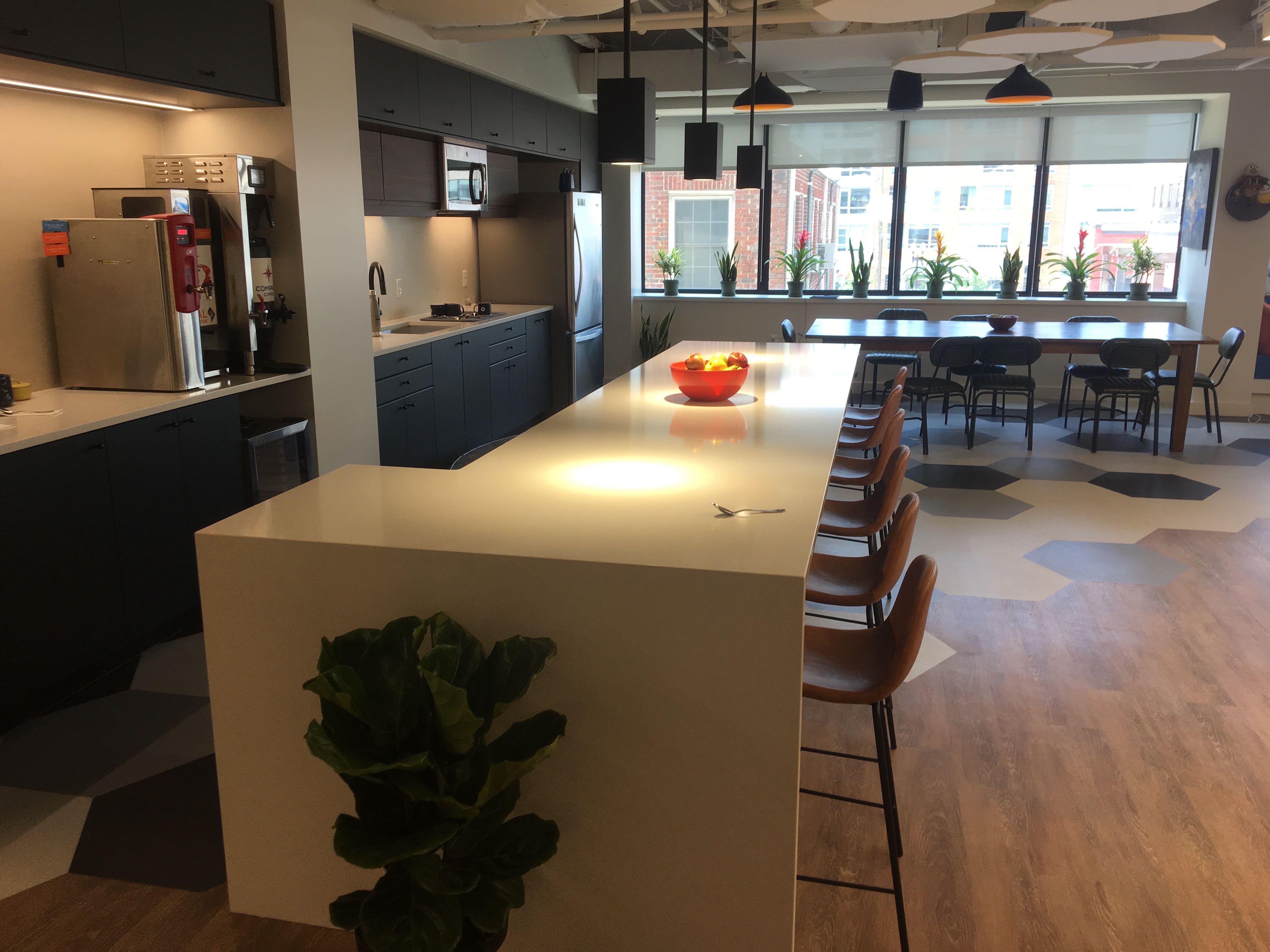
The co-working space at Two Birds includes a kitchen with free coffee and tea, a conference room, shared desks and private pods.
Lents and Coakley spent the better part of two years researching and refining the concept, using their own experiences and those gleaned from other parents they surveyed. The resulting space is a marriage of co-working and child care—but one that allows both to operate independently. Co-working and child care can be paid for as a package, or used separately.
Additionally, parents can get to the child care center through a separate entrance from the co-working area, allowing them to create space during the day for both their children and their professional endeavors.
“For people who want that to feel professional, it’s really nice to not have to tell someone ‘You have to navigate through some child care before your meeting,’” says Lents.
Beyond the usual challenges of starting a business and building space, Lents and Coakley had to navigate the not-so-insignificant regulatory hurdles that go into opening a child care center in D.C. On that front, their timing couldn’t have been better.
Since 2017, Mayor Muriel Bowser has launched a number of initiatives to help bring down the high cost of child care in the District, including increasing the supply of seats available. That helped Lents and Coakley land a $330,000 grant from the city to build Two Birds, which will be able to serve 94 children from infancy through age 5. According to city officials, the grant program has added 558 new child care seats over the last two years; Bowser has set a goal of 1,000 seats by September 2020.
A 2018 report from the Bainum Family Foundation found a significant shortage of child care seats in D.C. Of a maximum potential demand of more than 36,000 kids, the foundation found only 8,000 seats in regulated centers or home-based settings. That, some experts say, can leave parents struggling with long wait-lists and high costs. It’s an experience Lents says she came across with her own son, who is now almost two.
“There just isn’t enough for the number of kids who exist in D.C.,” she says. “Figuring out what type of child care you are most interested in having and then finding access is probably the most difficult.”
Child care advocates also say that simply adding seats alone won’t bring down the overall price of care, largely because staffing ratios and regulatory requirements remain a significant cost-driver. At Two Birds, monthly full-time care costs $2,300, or just over $27,000 a year. (It offers a Reggio Emilia curriculum.) That’s slightly above the annual average cost of center-based care in D.C.—$23,666 per year.
Those advocates say more public investment in child care is needed to truly make it more affordable and accessible across the board. Last year, the D.C. Council passed a broad early education bill that seeks to cap child care costs at 10 percent of a family’s income, in part by offering more families access to subsidies. (Over the last two years, Bowser has increased subsidy rates for low-income families.) The bill is expected to cost $500 million over a decade to implement.
Lents says there are currently 13 kids enrolled in the Two Birds child care center, and she’s going to start opening more classrooms—especially those for older children—on a rolling basis. While other such examples of co-working and child care exist across the country, she says hers is among the first in the Washington region. (A similar concept in Northern Virginia that opened in 2017 offered care for up to three hours a day, but it closed late last year.)
“There are some models that have tested out more babysitting or co-op-based models. There’s a need for all of those. The babysitting model gives you child care for maybe an hour or two a day. The co-op model tends to be more parent-interactive or parent-based. Our model tends to be good for people who need 20+ hours a week,” she says.
Two Birds also has a nursing lounge, and plans on offering evening events that focus on working parenthood. Lents says that Two Birds was an unexpected idea, but one that she can also see growing.
“This came out of personal experience and me feeling there was this massive population of people who were really interested in the idea and it started to feel like it was something I needed to do,” she says. “Our hope is to have this flagship location and expand to other locations.”
This story originally appeared at WAMU.