Rachel Kurzius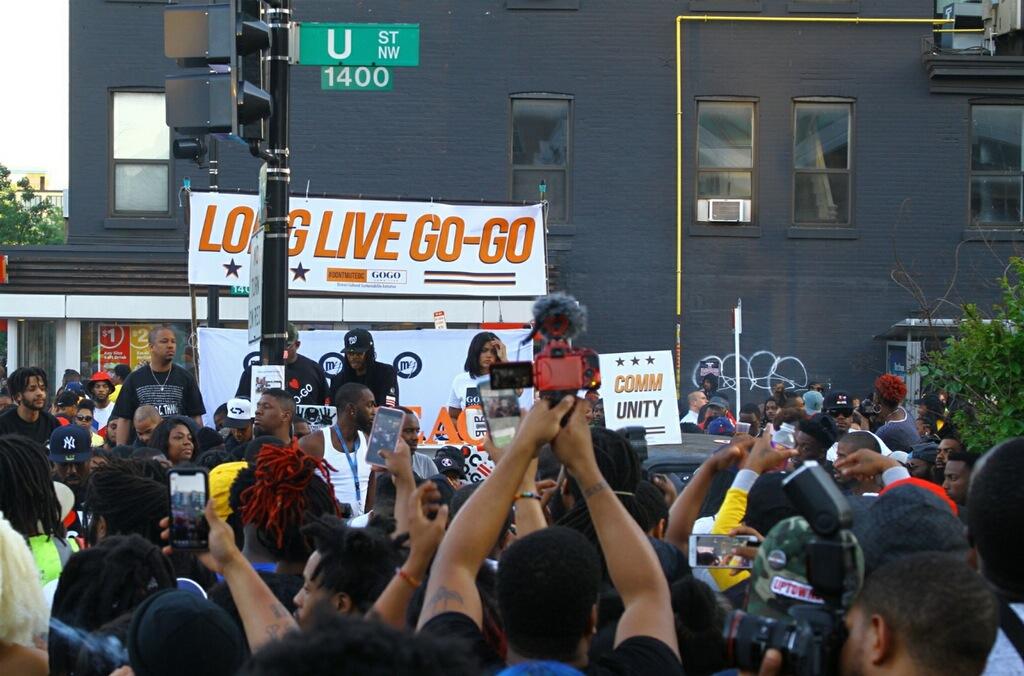
If the massive Backyard Band concert and protest that shut down the corner of 14th and U streets for hours on Tuesday is any indication, go-go isn’t going anywhere, and neither are its fans—the longtime Washingtonians who cultivated the funky genre.
“What you see now is a new age of rebellion,” says Kymone Freeman, co-founder of We Act Radio and one of the organizers of what’s become known as #DontMuteDC. “We’re rebelling against the status quo that gentrification is natural and we have to get prepared for it. We’re here to say to the powers that be that gentrification is cultural genocide, and the result of public policy without public input.”
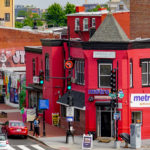
The #DontMuteDC movement began in early April, when the iconic Metro PCS store in Shaw was forced to turn off the go-go beats it had cranked since 1995. The news prompted a flurry of protests, including a huge go-go concert on the corner of 14th and U streets, and spurred larger conversations about the impact of gentrification on rapidly changing neighborhoods like Shaw. Mere days later, the homegrown D.C. music returned.
But organizers made it clear that, even though speakers are once again blasting Chuck Brown at that Shaw corner, the story couldn’t be wrapped up in a neat bow. Complaints against black business owners, concerns over school budgets, rising living costs, how noise will be regulated in the city: all of these topics have become just as much a part of the #DontMuteDC conversation as the temporary silencing of the Metro PCS store.
On Tuesday night, thousands of people flocked to the corner of 14th and U for the latest iteration of Moechella, a portmanteau of D.C. slang “moe” and music festival Coachella. The first one happened last summer in response to a D.C. Council bill to regulate amplified noise in the city, and there have been three since the conflagration at Metro PCS. Organized by Dominique Wells, who was the event’s DJ, and Justin “Yaddiya” Johnson, these demonstrations “are using go-go as an attraction … and as a way to explain D.C. culture peacefully,” Johnson told NBC Washington.
#MOECHELLA was classic. Three thousand people singing Pretty Girls 🔥🔥 #DontMuteDC ( via @BackyardBand) pic.twitter.com/lNljH31ifI
— DC Maryland Virginia (@DMVFollowers) May 8, 2019
Hold it Sauce…I Love DC #BYB #GoGo #Moechella #Hello pic.twitter.com/tPpzyA3zOf
— #Crankculture (@RecipeMusic) May 8, 2019
Metropolitan Police Department officers blocked off the surrounding streets from vehicular traffic during Tuesday’s Moechella. Despite the appearance of some people riding ATVs (which are illegal on city streets) during the protest, there were no arrests.
Freeman says, to his surprise, he wanted to thank D.C. police for the way officers dealt with Moechella: “They have practiced restraint and a rare instance of extending respect and courtesy to the have-nots of this city.” He adds that these large-scale concerts “are challenging the stereotype that go-go music causes violence.” Indeed, MPD has previously compiled lists of go-go concerts and otherwise made the case that the music and nightclub scene was filled with crime.
It’s unclear when the next Moechella will occur. “It’s not on a regular schedule,” says Freeman. Artists like Backyard Band have donated their time and many more have donated resources.
But the next step for #DontMuteDC is one that Freeman finds both thrilling and nerve wracking—this Saturday, there will be a movement conference as part of the Funk Parade. “All these events have been our unification, we’re all against something,” says Freeman. “Saturday is, ‘Okay people, what do you want to see happen?’ It’s the true test. That is going to determine where we go from here.”
There are conversations scheduled about social justice, culture, housing, and population, which will include activists, artists, and city officials.
“I’m inspired, but I’m very nervous, because I know movements get killed in these types of spaces,” says Freeman. “If we can survive Saturday, then we’re going to be stronger because of it.”