Martin Austermuhle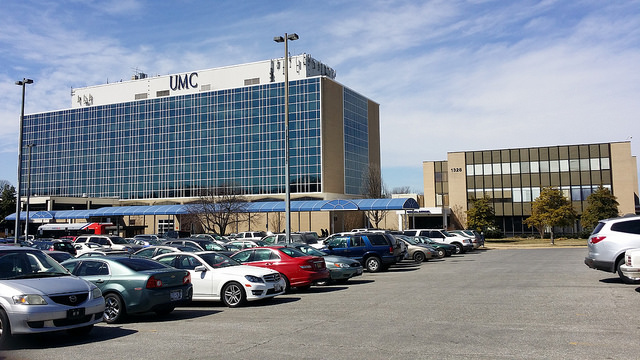
The operations of D.C.’s only hospital east of North Capitol Street and the future of the new hospital that will replace it have again become a political flashpoint in the Wilson Building, with Mayor Muriel Bowser and Ward 7 Councilmember Vincent Gray again feuding over both the public subsidy for the United Medical Center and the timeline for a new hospital planned for the St. Elizabeths campus.
As part of her 2020 budget, Bowser has proposed a $40 million public subsidy for the long-troubled hospital—and the only one east of the Anacostia River—which the city took over in 2010 after its former operator went bankrupt. That’s up from the $16.9 million the hospital is currently receiving.
But Gray, who dealt with United Medical Center when he served as mayor and remains involved in as the chair of the Council’s health committee, says he’ll go no higher than $15 million.
“I’m personally not willing to just continue to provide a blank check to the hospital operators and the board with it unchecked,” he said during a budget discussion with his Council colleagues on Wednesday. “I think that’s irresponsible, and I think we need to do better.”
Gray also wants to give the hospital’s board until July to come up with a budget that could be balanced using the lower public subsidy. If it fails to do so, a five-person control board would be appointed to take over.
The proposed cut to the United Medical Center’s subsidy has drawn opposition from Bowser and her top aides, who say the hospital cannot operate with so little money from the city. In a letter to the Council, Bowser called Gray’s proposal “disappointing and impetuous.”
“What it very likely will mean is a reduction in services for residents who use United Medical Center, because the only way to get a $15 million subsidy is to cut services at the hospital and lay people off,” said City Administrator Rashad Young earlier this week.
Gray told his Council colleagues that the firm the city hired last year to operate the hospital, Mazars USA, hasn’t done enough to trim services and increase patient visits. (It replaced the well-connected but oft-criticized firm Veritas, which had its contract canceled by the Council in late 2017.) He said the most recent daily census that was made available to him showed 78 patients and 850 staff at the hospital.
“That is roughly a 1 to 10 ratio,” he said. “Most hospitals will tell you it’s 1 to 7 when they’re operating well.”
But Gray’s proposal is also facing opposition from the union representing the nurses at United Medical Center, who say any more cost-cutting at the hospital is likely to come at their expense.
“Our nurses have been offering services. Some of them have been there up to 40 years. It feel like there is a movement to exclude them,” said Wala Blegay, an attorney with the D.C. Nurses Association.
Blegay also took issue with Gray’s claim that United Medical Center has a low patient count, countering that the emergency room alone handles between 200 and 300 patients a day.
Gray is also pushing to speed up construction of the new 200-bed, $326 million hospital D.C. plans to build on the grounds of the St. Elizabeths Campus to replace the United Medical Center. Bowser says current plans have that hospital being done in 2023—finding a private operator for it has been a complicated process—but Gray says he thinks it can be finished by the end of 2021.
He told his colleagues Wednesday that building a new hospital must be an imperative for the city—even more so after the closure of Providence Hospital last month.
“There is an unbelievable inequity in this city around health care. When you go west in the District, you have some of the finest health care service imaginable. But when you go east, it is an embarrassment what we have at this stage. A lot of people don’t realize that a women’s unable to deliver a baby in a hospital setting east of North and South Capitol Street,” he said.
But Gray’s insistence that a new hospital be completed by 2021—a goal he has expressed repeatedly over recent years—has not only drawn opposition from Bowser, but also some of his own colleagues.
“Moving up the schedule I think is unrealistic,” said Council Chairman Phil Mendelson, noting that the planned hospital will go on the site of a current men’s homeless shelter that has to be demolished. “The hospital will go where shelter is now. If the land was vacant, then they could start construction in fiscal year 2020. But the shelter is there, and it’s going to remain there until new one is built. That will be finished March 2021.”
Gray did not relent, saying advances in construction technology could have the hospital finished within 18 to 24 months. “Where there’s a will, there’s a way,” he said.
But some of Gray’s colleagues say that, even if a hospital could be built that quickly, the city should spend more time mapping out how it could survive independently and whether it would best provide all the health services needed in Wards 7 and 8, which are predominantly African American and include some of the poorest neighborhoods in the city.
“You know I agree that we should close the health equity gap. But what I am seeing here… is we are not looking at our health system holistically,” said At-large Councilmember Elissa Silverman. “And I do think we are going to do the same thing over and over again.”
Blegay, from the nurses union, agrees. “They need to go slowly and determine what they need in the community. We do not understand what the rush is,” she said.
In March, the city announced that it has green-lit the opening of the first urgent care clinic east of the Anacostia River. There’s also a new network of primary clinics serving communities in wards 7 and 8.
Gray told his Council colleagues he still believes there should be more effort put into building the new hospital sooner.
“To maintain the faith of people who live on east end… I think we need to show some progress,” he said.
“It appears to me you’re trying to build a house of cards in a hurricane,” said At-large Councilmember David Grosso to Gray.
This story originally appeared on WAMU.