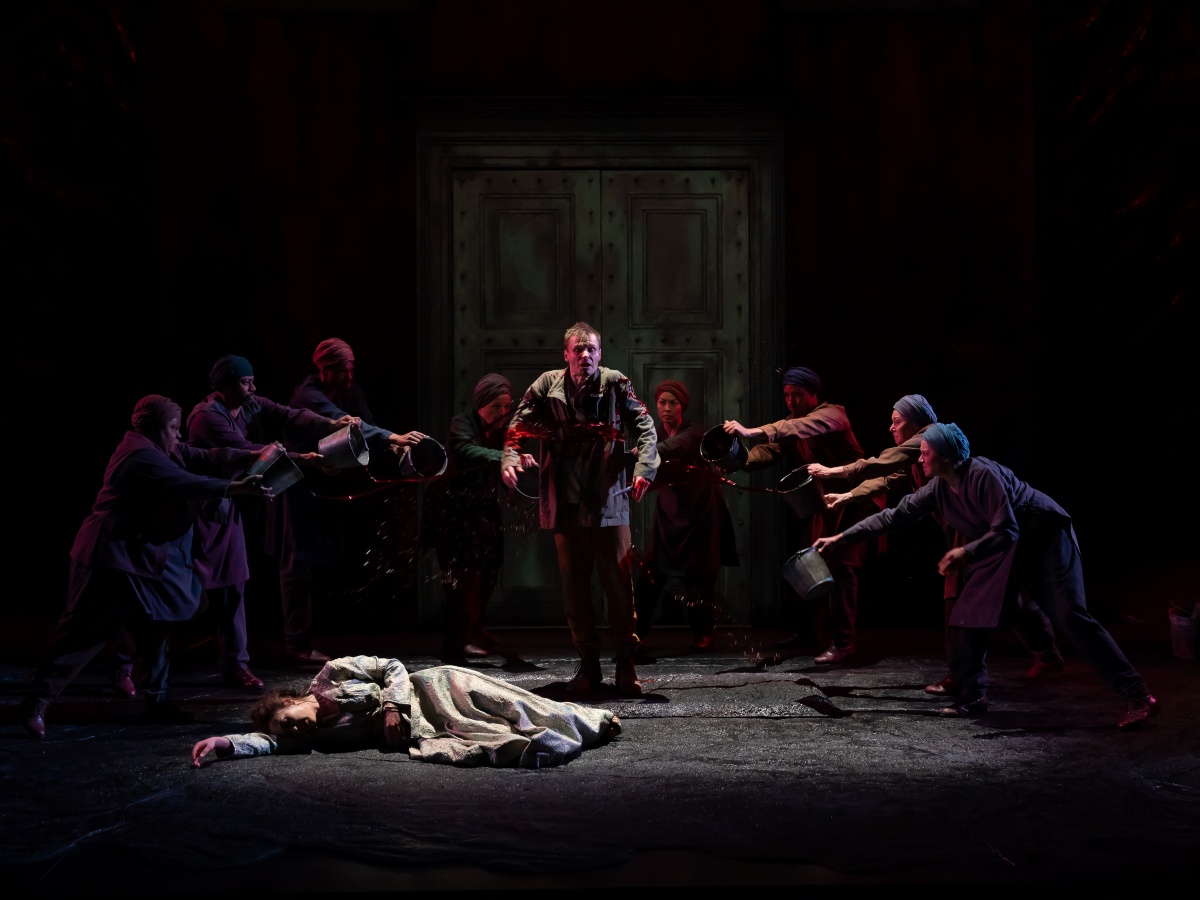
It’s hard to pass through the Gallery Place Metro station without sensing something noteworthy is happening nearby. Ads for The Oresteia—plastered throughout the station’s turnstiles, walls, and columns—herald the Shakespeare Theatre Company show as if it were the latest Marvel blockbuster. In a way, this production mirrors Avengers: Endgame. The Oresteia marks the capstone of artistic director Michael Kahn’s monumental, 33-year-long tenure: He’s directing the production as his swan song at Shakespeare (Simon Godwin, currently of the National Theatre in London, will take the helm of the company starting next season). Apollo himself couldn’t have prophesied a world where Endgame, a mass-market tale of redemption following death, would feel more satisfying than this toothless revamp of a classical work. And yet, here we are.
This bloody trilogy from the Greek playwright Aeschylus comprises three works: Agamemnon, The Libation Bearers, and The Eumenides. Kahn’s production roars during its brilliant first half, which covers the entirety of Agamemnon. It’s no coincidence that this is where playwright Ellen McLaughlin, who liberally adapted the trilogy, hews closest to the source material.
At the show’s opening, Clytemnestra (the fabulous Kelley Curran) awaits the return of her husband, who’s off fighting in Troy. Though sick with melancholy and stricken with night terrors, she cares little about Agamemnon (Kelcey Watson) and his “heroic” adventures. Clytemnestra, instead, boils with rage over their daughter Iphigenia (Simone Warren), who was sacrificed by Agamemnon to earn hospitable sailing conditions almost a decade earlier. When Agamemnon returns home with his clairvoyant lover Cassandra (Zoë Sophia Garcia), it’s not long before Clytemnestra kicks them both, lifeless, into an open grave. Sure, Clytemnestra becomes a double murderer. But apart from Iphigenia, she’s the most sympathetic and relatable character in this tragic cycle.
The Oresteia’s second half, which roughly follows the narrative beats of The Libation Bearers and The Eumenides, quickly unspools into a mess of yarn. Once Clytemnestra’s two surviving children, Electra (Rad Pereira) and Orestes (Josiah Bania), conspire to kill her, McLaughlin’s adaptation veers from Aeschylus’ text and suffers accordingly. This production excises a crucial intervention from the gods, most notably the Furies who terrorize Orestes in part three, all for the sake of naturalism, I suppose. And so, this version of the Oresteia is defanged shortly after its best character is eliminated and just before the original plot, thrillingly, goes bonkers.
The true heroine here is Susan Hilferty, who designed the show’s incredible set (and costumes, too). The cursed House of Atreus, a stone structure with two windows and a door, stands in front of a rocky ridge, looming with portent in the background, and a twinkling sky. A black chasm yawns behind the doomed residence, ready to swallow the entire stage with a single gulp.
The Oresteia never fully lives up to this sense of dread. But Kahn and McLaughlin also avoid the sheer optimism of Aeschylus’ finale. Their collaboration, which eschews hot and cold extremes, ends up being tepid through and through.
The Oresteia runs at Shakespeare Theatre Company’s Sidney Harman Hall through June 2. Tickets $44-$118. Runtime 2 hours and 20 minutes with one 15-minute intermission.