Martin Austermuhle
On a mild afternoon three days after Christmas last year, Daryl and his teenage son sat in their car on a residential street in Northeast D.C. waiting to pick up a friend. As he used his phone to buy tickets for a wrestling match they were going to attend that evening in Baltimore, Daryl didn’t notice three men in a nearby silver car.
“Then all of a sudden, bullets started flying through our SUV,” says Daryl, who asked that we only use his first name due to safety concerns.
The three men unloaded 26 bullets into the car, hitting Daryl, 34, three times and his 14-year-old son Darell, who goes by Rell, nine times.
The shots were actually intended for someone else. According to police, the shooters mistook the SUV for a similar one that had been involved in another deadly shooting a few days before. But the bullets didn’t know the distinction, and so the damage was done: Rell was hit in the head. When first responders arrived, Daryl and Darell were alive. Had they died, they would have been yet another pair of fatalities in a year that saw homicides in D.C. spike by 40 percent—many caused by gunshots.
Daryl—who had been hit in the hand, back and leg—initially refused medical care, knowing that his son was in far worse shape.
“The only moment I was awake was when they wanted me to move right or left to take my clothes off but I couldn’t because I was about to close my eyes and relax,” Rell says.
Father and son were rushed to a hospital in Prince George’s County. At the same time, Kassa, Rell’s mother, was spending a quiet evening at their Maryland home with their other kids, 6-year-old son Kaiden and daughter Zeniah, who was only a few months old at the time.
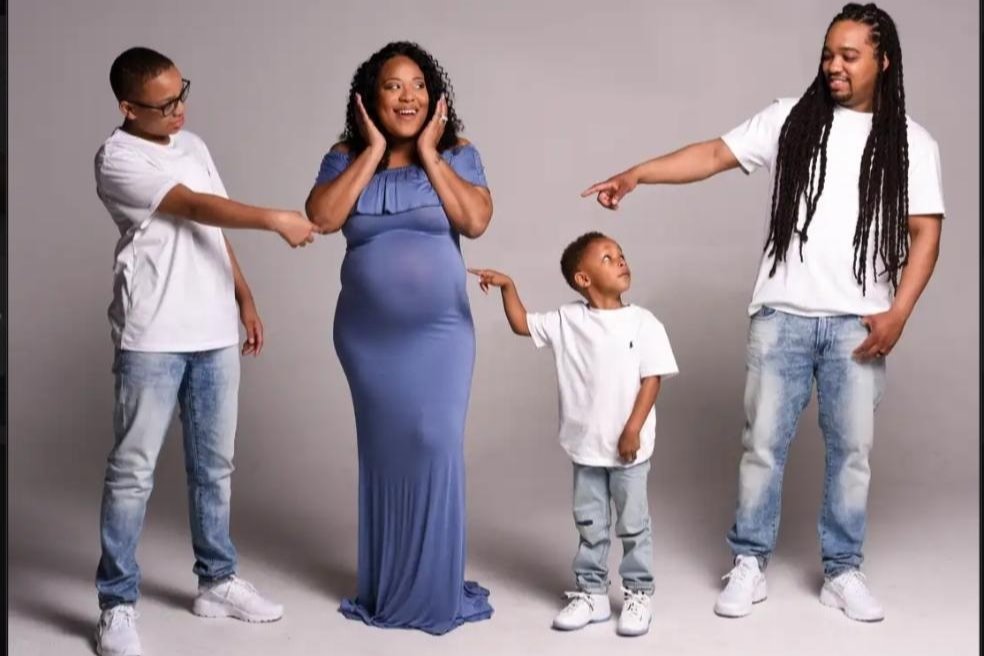
Rell, at left, stands with his mother Kassa, then pregnant with daughter Zaniah, who is now 10 months old. Kaiden, 6, stands next to Daryl.
“And get a phone call from the hospital. ‘Do you have anyone to watch your younger kids?’” she recalls. “That’s not a normal to question to get. ‘Well, there’s been an accident, can you come to the hospital?’”
Daryl was driving the family’s only car, so Kassa, 36, called a friend for a ride to the hospital. When she got there, her father-in-law gave her the news: Rell was in surgery to relieve pressure on his brain from the bullet wound. Kassa was faced with an unthinkable possibility: that her husband, whom she met in elementary school in Northeast D.C. and married in 2011, and her first son, whose name she has tattooed on her right arm, would not make it.
“And I prayed. That’s all I know. That I prayed. I grew up in church, so that’s the first you do, you pray. I prayed, I dispatched all angels for my family,” she says.
Rell was eventually rushed to Children’s National Hospital in the District, because of the severity of his wounds.
“‘Save my baby.’ Those were my words to the doctors,” says Kassa. “‘Yes, I hear everything you’re saying, the breakdown of it, save my baby.’ And they were looking at me like, ‘You realize he got shot in the head?’ Save my baby.”
Carlos Sanchez was the attending neurosurgeon on call at Children’s National that night. He examined Rell in the hospital’s trauma bay as soon as he arrived. After a few tests, Sanchez determined he had to operate right away. He says what looked like a small wound by Rell’s left ear was actually something much more serious.
“On that initial scan there was blood, there was brain shift, there were shards of bullet fragments everywhere,” he says. “I thought that his mid-brain, a very important part of his brain, was dark, and I was afraid he had already stroked out several parts of his brain.”
Before the surgery, the most Rell could do was lift his left arm when asked to do so. Sanchez says after Rell came out of surgery, he didn’t know if he would be able to do much more.
“But when he uttered a word less than two weeks after the surgery and this event, that was extraordinary,” Sanchez says.
“The first full sentence he put together for his parents was, ‘When can I go back to school?’” says Susan French, a nurse navigator at Children’s who helped Daryl and Kassa make their way through the first difficult days after Rell was shot.
Help also came from the hospital’s social workers, who are trained to work with families facing traumatic involving their children. Gayle Gilmore, the manager of social work at the hospital, said they try to keep parents focused on the immediate circumstances and how to best advocate for their children. They also try to steer them away from worrying too much about what they can’t control.
“What they really want to know is what is going to happen a week from now, a month from now, a year from now. Am I going to have the same kid? Those are answers that are unknown, and that contributes to a great deal of stress,” she says.
French says Daryl and Kassa were both consistently engaged with Rell’s recovery, both at the hospital and when he was transferred to a rehab center a month later.
“They never left his bedside the whole time he was here, and continued at his bedside at his rehab,” she says. “I attribute so much of his success not only to our team, but also the family.”
The Long Recovery Ahead
Rell came home in mid-February after what his family calls a “miracle” survival. But the recovery road is long, with obstacles for the whole family. Rell still needs three more surgeries, so it’ll be a while before he can go back to school. He’s being home-schooled until then so he can keep up.
As for Daryl, he had to undergo his own surgery for a wound to his hand and is currently collecting short-term disability from his job at FedEx.
“That’s what we’re surviving off right now,” he says. “And it’s truly surviving. We’re barely above water at this point, financially.”
He’s had to pay for a rental car, since their SUV is still in police custody. Since the incident, Daryl says he’s spent close to $4,000. There are therapy sessions for both father and son, and more medical costs to come. And last month they got their first eviction notice for unpaid rent, before getting some last-minute assistance. The family has set up a GoFundMe page to ask for help, estimating they need $30,000 to handle all the expenses they are facing.
But through it all, they say this experience has made them stronger as a family. Kassa says it also made them realize how lucky they are to have a network of family and relatives nearby.
“My village is what stepped up,” she says. “And if I didn’t have them or the family, I don’t know where we would be right now. He’s a miracle. He’s a normal teenager.”
Three men were arrested in March for the shooting. Daryl says he’s not thinking about them. For him, everything is about the recovery ahead. And as he awaits his next surgeries, Rell says he’s anxious to get back to the things any teenager would do.
“I just really want to get these surgeries so I can go back to my normal things like bowling, hanging out with friends, going to swimming pools,” he says. “I just want everything back.”
This story originally appeared at WAMU.