Rachel Kurzius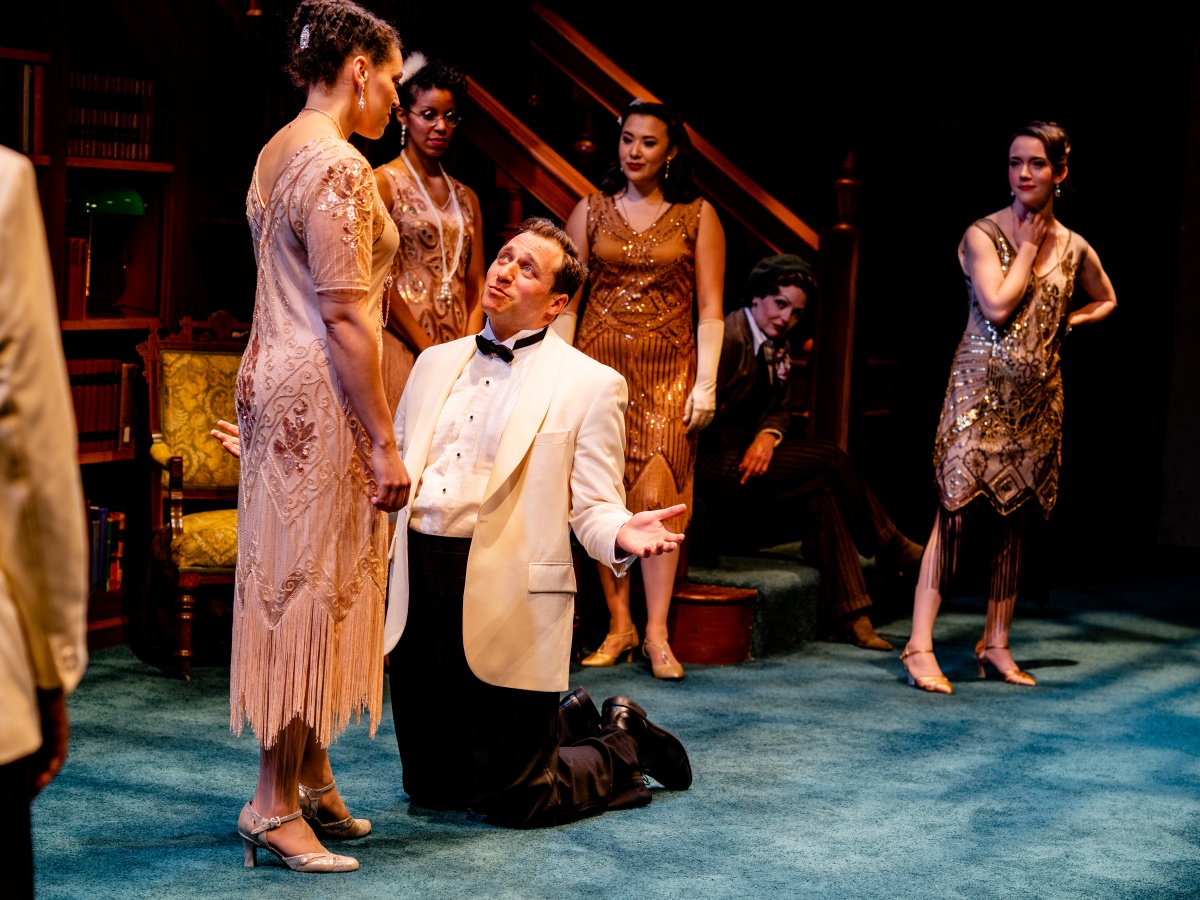
After a years-long dearth, the romantic comedy has returned to prominence with a major assist from Netflix. Once more, audiences can soak in implausible meet-cutes between attractive folks with oodles of chemistry and some high-concept reason why they can’t be together until, in front of some stunning vista or crowded transportation hub, they declare their undying love and lay a big smooch on each other. Though, to be honest, while people are giving streaming services kudos for breathing new life into the formula, credit must be given to the writer who walked so Nora Ephron could run: the one and only William Shakespeare.
And after a season filled with more serious Shakespearean works (like an asylum-based Macbeth and the rarely-staged King John), Folger Theatre breaks out the Bard at his most playful (and horny) with Love’s Labor’s Lost. The setup is classic rom-com fare: Four men declare they’re swearing off sex for three years, right as four very alluring women show up and test their commitment to that pledge. Folger’s version sets the scene at … well, Folger itself when it opened in 1932, a choice that mainly allows costume designer Tracy Christensen to dress the actors in stunning beaded dresses and other well-tailored attire of the era.
Love’s Labor’s Lost has some of the Bard’s most tongue-twisting, impressive language. It’s a feat that the actors don’t trip over their tongues, but they do us one better by imbuing their lines with fizzy charisma. As Berowne, the cleverest and monologue-filled of the men, Zachary Fine had me wondering why I ever thought Much Ado About Nothing’s Benedick was Shakespeare’s most charming leading gent. And the interplay between the besotted Don Armado (Eric Hissom), described by Shakespeare as “a fantastical Spaniard,” and his beleaguered page (Megan Graves) is side-splitting.
But surprisingly for a show with such sterling lines, the real delight comes from the wordless acting—the gaggle of men giggling after realizing they’re all head over heels, or dudes amorously licking envelopes. Director Vivienne Benesch makes the most of these group dynamics, and aptly stages the push and pull between the male and female groups on major setpieces like the staircase in the middle of the stage. Scenic design from Lee Savage leaves the characters all sorts of hidey-holes to discover one another’s secrets while well within the audience’s view to see their reactions.
There are moments where the play lags, but it largely zips along so quickly that intermission comes as a surprise. But that’s not the only shock in the show. For a rom-com aficionado like myself, well-accustomed to the cadences of the genre, Love’s Labor’s Lost reminds us that the man who wrote the formula knows best how to toss it aside.
Love’s Labor’s Lost runs at Folger Theatre through June 16. Tickets $42-$79. Runtime approximately two hours and 30 minutes with one 15-minute intermission.