Rachel Kurzius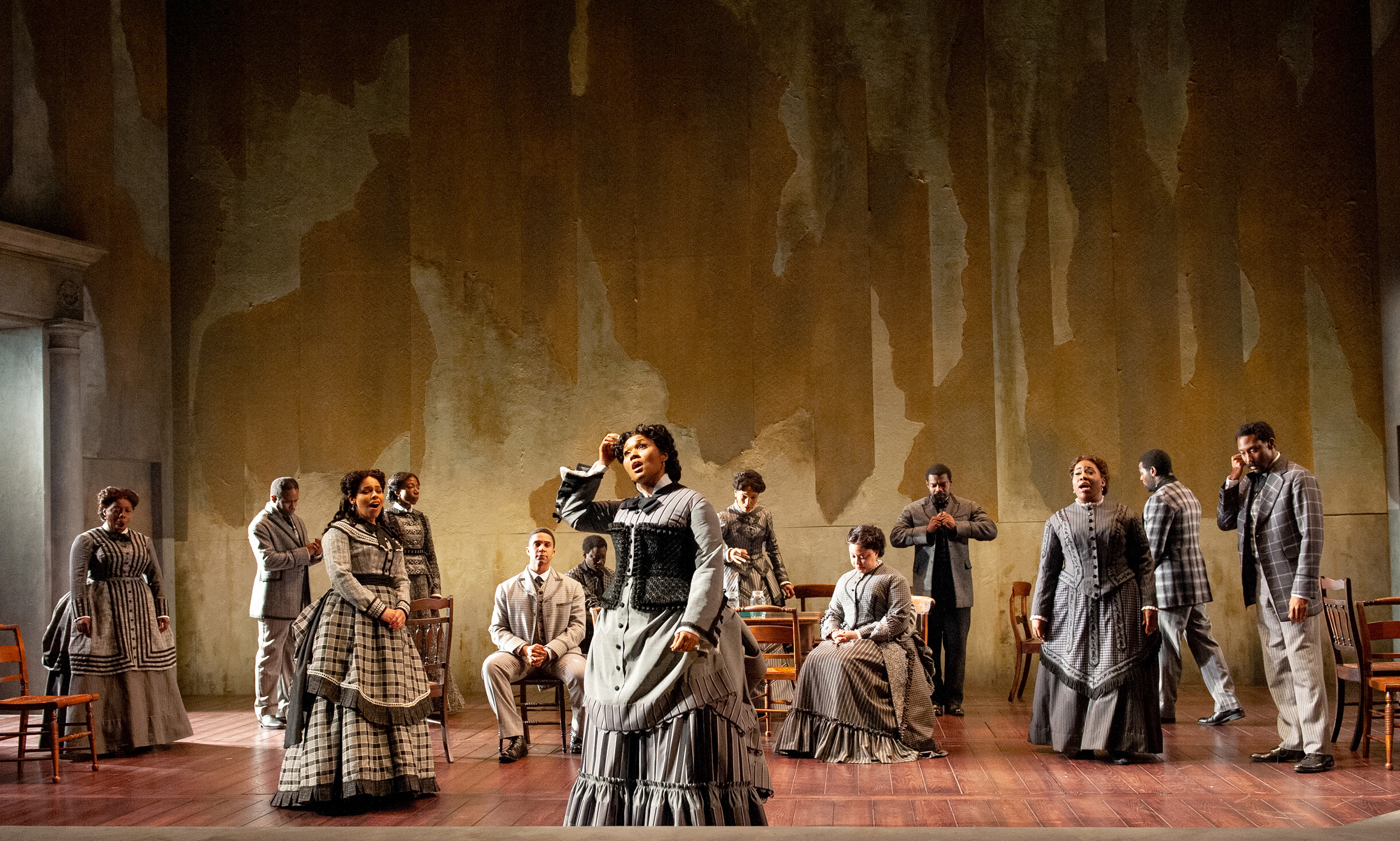
The history of the Fisk Jubilee Singers takes center stage in Arena Stage’s Jubilee, a tale told largely through a capella renditions of the spirituals the original African American troupe sang.
Still active today, the Fisk Jubilee Singers were established in 1871 to raise funds for Fisk University, and the group has since been the subject of a PBS documentary and won national awards.
The first act of the show largely embodies the stated ethos of the a capella group itself: a “group constellation” in which all of the voices rise together to create a whole more compelling than any one person. The show, both written and directed by Tazewell Thompson, intersperses the classic Negro spirituals with spoken declarations from the cast. But even when speaking rather than singing, the actors finish one another’s sentences, giving the impression of harmonization even without music.
But let’s talk for a second about the music because wow, this cast can sing. With incredible vocal arrangements and music direction from Dianne Adams McDowell, the pipes on these performers are consistently moving, somehow nostalgic and surprising at the same time. The minimalist set—a handful of chairs—allows for dynamic staging of these songs, complemented by transporting projections from designer Shawn Duan.
While the broad strokes of the singers’ experiences come across in the first half of the play, the only performer from the group who is named before intermission is Maggie (Aundi Marie Moore), who, fittingly, is a prima donna who declares to the choir director that “I’m not one of your workhorses. I’m a showhorse,” cueing eye rolling from the others. I hungered to learn more about who comprised the Fisk Jubilee Singers, and how they interacted with one another.
The audience learns more about the individuals during the second act. Characters face the audience and describe elements of their childhood, or how they feel while performing, or how singing helps them deal with their traumatic experiences of enslavement. Jubilee truly blossoms when it narrows its story to these moments. But because the show is so focused on having the troupe speak directly to the audience, the characters rarely share exchanges with one another.
The play is most fascinating, both as theater and as a retelling of history, during its epilogue, when the characters share what became of their now-dead counterparts. In front of projected photos of the original Fisk Jubilee Singers, the cast turns to silhouette as they sing, “When I am gone, Lord remember me.” Jubilee fulfills this most human of wishes.
Jubilee plays at Arena Stage through June 9. Tickets $66-$125. Runtime approximately 2 hours and 25 minutes with one 15-minute intermission.