 Jenny Gathright
 Martin Austermuhle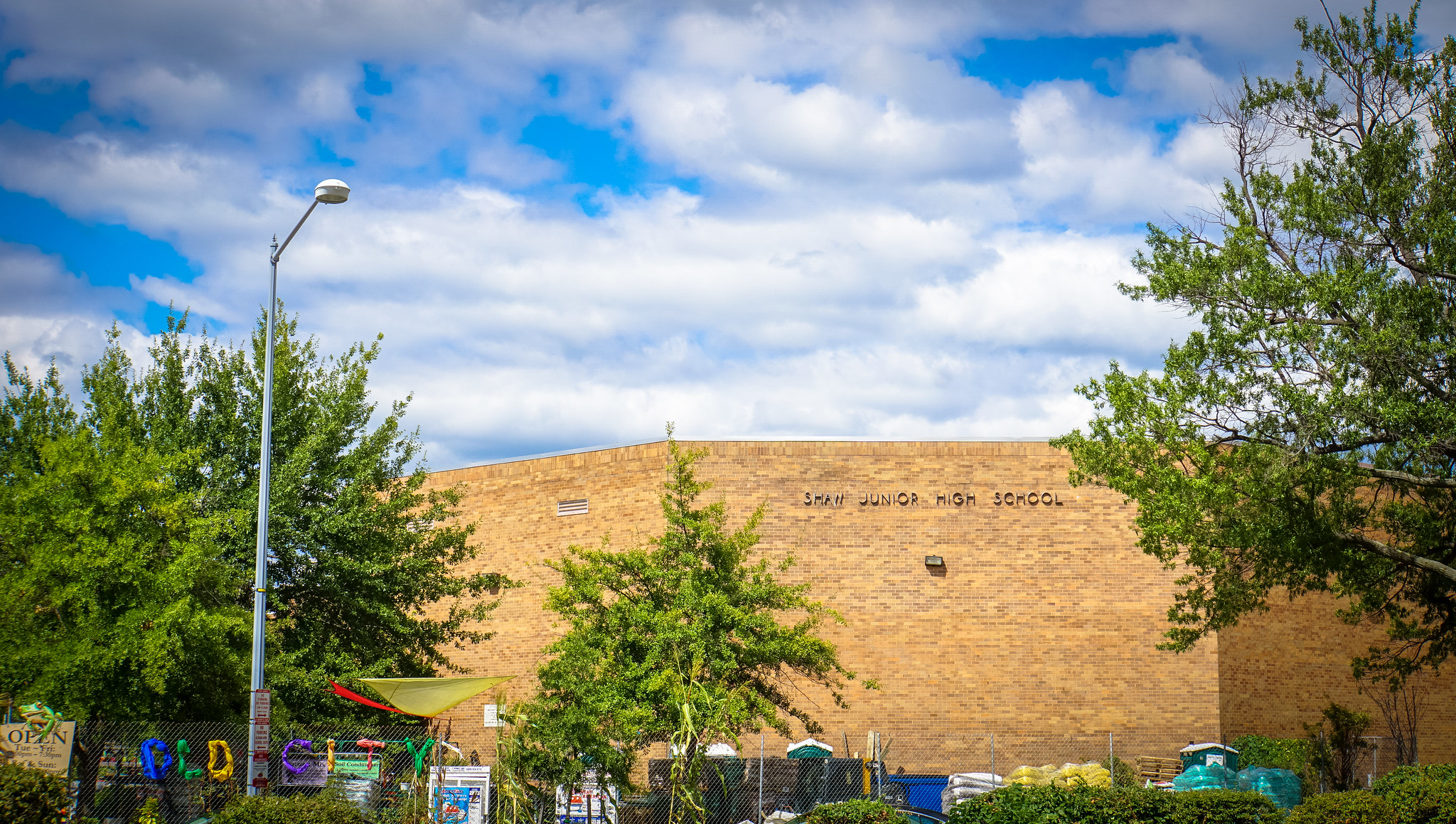
The D.C. Council spent nearly two hours on the day of its second budget vote once again in a fierce debate about two D.C. schools—Banneker Senior High School and a potential Shaw Middle School—that touches on some of the city’s most polarizing issues.
Earlier this month, the Council narrowly voted to oppose Mayor Muriel Bowser’s plan to move Banneker to a site off of Rhode Island Avenue NW in Shaw. Advocates for a Shaw middle school say that location was promised to them years ago, while advocates for a new Banneker campus have said relocating to Shaw would speed up a long-promised and much-needed revitalization of the high school.
After intensely heated debate on Tuesday, the Council essentially voted to swap the locations of the schools.
First, lawmakers narrowly passed an amendment introduced by At-large Councilmember David Grosso to move Banneker to the Rhode Island Avenue campus, while allowing for what some called the ultimate “win-win”: the possibility that a new Shaw middle school could be built on the same plot of land.
“This is not co-location, but two schools on the same block. We have a chance for a win-win, and if we don’t take it, shame on us,” said At-large Councilmember Robert White.
But in a subsequent vote, the Council approved another budget amendment that would locate a future Shaw middle school at Banneker’s current campus on Euclid Street NW, completing the school swap. Councilmembers said the move would ensure that the Shaw community would get a middle school, regardless of where it was built.
“The Council has put a stake in the ground that there will be a Shaw middle school,” said Chairman Phil Mendelson.
Despite the close votes on both amendments, lawmakers did seem to agree on one thing: That the struggle over Banneker and Shaw is about much more than two schools.
Mayor Muriel Bowser has highlighted Banneker as a “pathway to the middle class” for the city’s black residents—and has explicitly framed the debate as one about the city’s changing demographics.
“As we continue to combat displacement and gentrification, the decision to expand Banneker should be an easy one to make,” Bowser said in a tweet.
In a letter to the D.C. Council, Banneker parents—including D.C. cultural historian Natalie Hopkinson—said the debate was in part about whether the D.C. Council would be prioritizing new Shaw residents, who tend to be wealthy and white, over the existing Banneker families, who are mostly black and come from all eight wards of the city.
“Critics of the Banneker plan are asking you to bank on the notion that new Shaw families might come back to the neighborhood system, as opposed to investing in Banneker families who have proven their commitment and are enrolled now,” the letter said.
But others have rejected that framing. Washington Post columnist Colbert I. King noted in a weekend column that just 9 percent of children at feeder elementary schools to a potential Shaw middle school are white—44 percent are black and 37 percent are Hispanic.
At-large Councilmember Elissa Silverman said if the D.C. Council did not support a plan to build a new Shaw middle school, it would be abandoning parents who have long been asking for a focus on neighborhood schools. Banneker requires an application for entrance and the District rated it as the city’s highest performing school last year; the proposed middle school in Shaw would be available to all students within its boundary area.
“We’re at a pivotal point with our school system,” she said, pointing to the fact that about half of the city’s children attend D.C. public schools, while the other half attend charter schools that enroll students through a lottery system.
“If we don’t invest in neighborhood schools, we will invest in a system that’s all by chance in our city, in which there’s no guarantees and your education is up to luck of the draw,” Silverman said.
Other councilmembers also connected the debate to larger conversations about school funding. Mendelson urged the D.C. Council to broaden its view. He said that expanding Banneker at a new site, which the Council ultimately approved, would effectively direct more resources to an already high-performing school and distract from a broader push for equity in school funding.
Parents at schools in Wards 7 and 8 have said that the current budget, which uses a per-pupil funding formula, effectively cuts funding to schools east of the Anacostia River who are struggling with enrollment.
“If we want to improve Anacostia or Ballou, we have to put our resources there,” Mendelson said.
But Ward 8 Councilmember Trayon White, who supported building a new Banneker on the site of the old Shaw middle school, clearly objected to Mendelson’s invocation of his constituents. He went so far as to publicly call his comments “bullshit.”
“Politics is the distribution of resources. It’s time to put our money where our mouths are,” he said.
And for as much as the debate highlighted passionate—and sometimes petty—disagreements between councilmembers, it also evidenced some frustration with how Bowser handled the issue of Banneker’s future (Mendelson called her comments “polarizing”) and questions about what could come of the school’s current building if students move.
“What’s at the bottom of this? Some design somewhere in the future to make sure the Banneker site can be given to some developer,” speculated Ward 3 Councilmember Mary Cheh.
For her part, Silverman said she was disappointed with how the entire issue was handled, both in how the mayor framed it and how councilmembers moved to make last-minute changes during the budget vote.
“School planning shouldn’t be a game of chicken,” she said after the vote, “and that’s what we engaged in today.”
Previously:
The Battle Over Banneker High School And The Shaw Middle School, Explained