 Jordan Pascale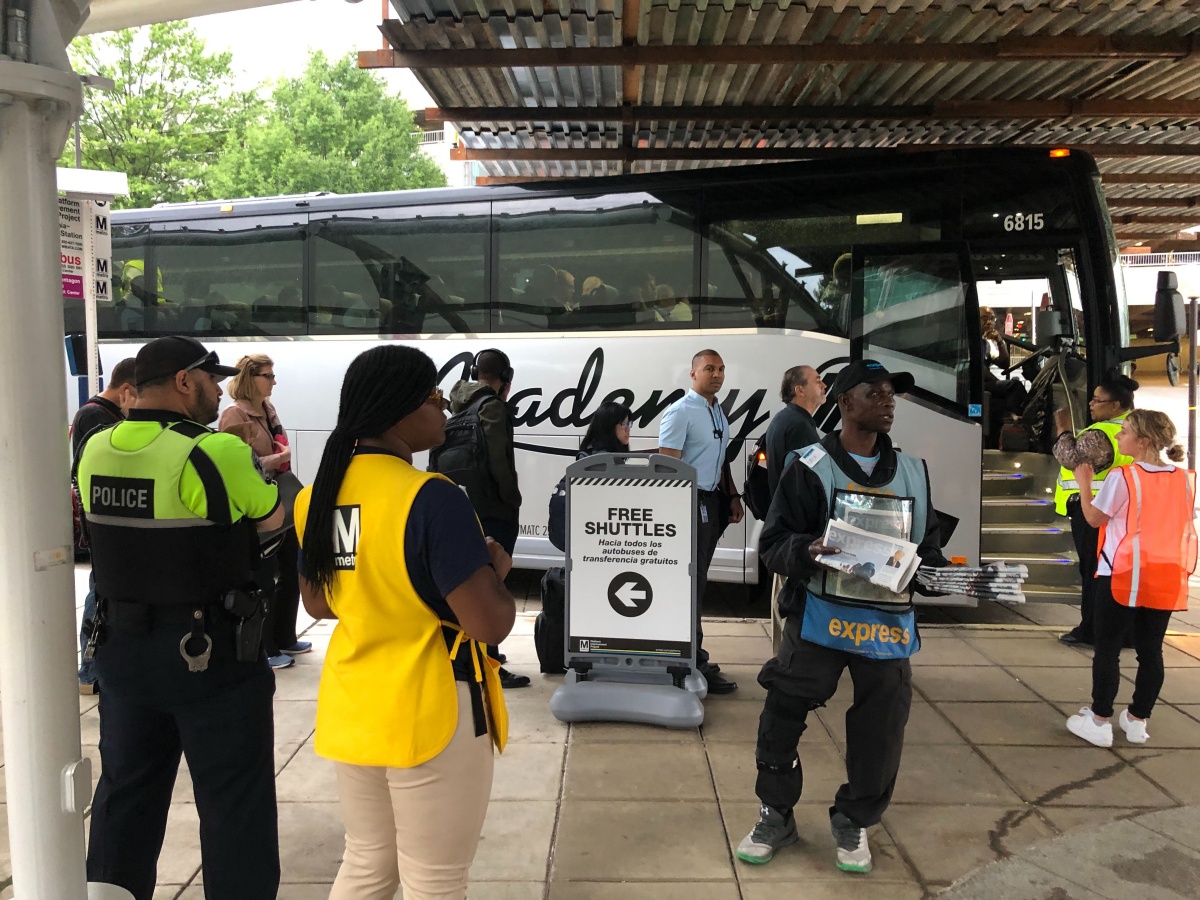
Virginia residents heading back to work Tuesday had mixed experiences coping with the shutdown of six Metro stations on the Blue and Yellow lines.
Solutions proposed by Metro saw varying degrees of success on the first major commuting day since the stations south of National Airport closed Saturday. Metro staff is meeting Tuesday afternoon to work out the kinks of the shutdown, which affects an estimated 17,000 riders in Alexandria and Arlington.
Riders reported that several shuttle drivers didn’t take the HOV lanes and got stuck in I-395 traffic. One driver got lost and ended up in Anacostia. Others reported confusion during the loading process at Huntington. Some station-to-station buses were so crowded that additional passengers couldn’t get on. Some regular bus routes, like the 10A from Huntington to Pentagon, were also running off schedule.
Meanwhile, there were delays on Metrorail as Blue and Yellow line trains ended at National Airport.
Metro encouraged commuters to build in at least an extra 30 minutes to cope with the changes, but some reported that the trip took an extra 45 minutes to even an hour-plus.
But others said they got to work just fine.
The first week is a key time to get things right, Alexandria Mayor Justin Wilson said last week. That’s when people start to form their habits for the next 100-plus days of the shutdown.
The stations are set to reopen Sept. 9, although platform reconstruction work may continue at times after that.
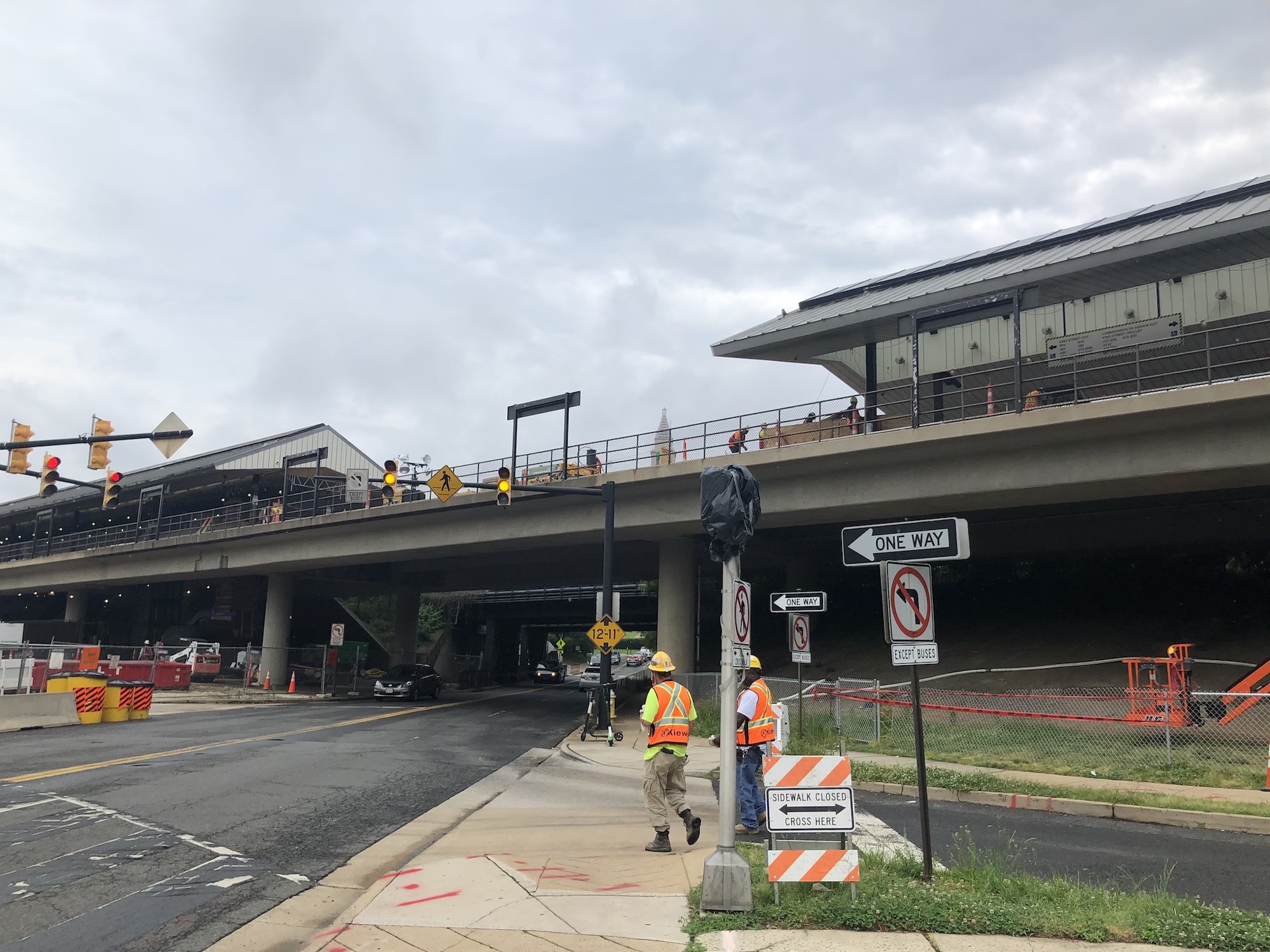
Platform reconstruction work began Saturday and continues on the six stations south of National Airport through Sept. 9. Jackhammers were going non-stop at the King St.-Old Town station Tuesday.
Jackhammers created the backdrop for bus riders taking shuttles outside the King St.-Old Town Station on Tuesday. Crews are demolishing and rebuilding the concrete platforms that have deteriorated over time. Metro decided to close the stations for the summer in an effort to make the work go faster.
Long, But Fast-Moving Lines
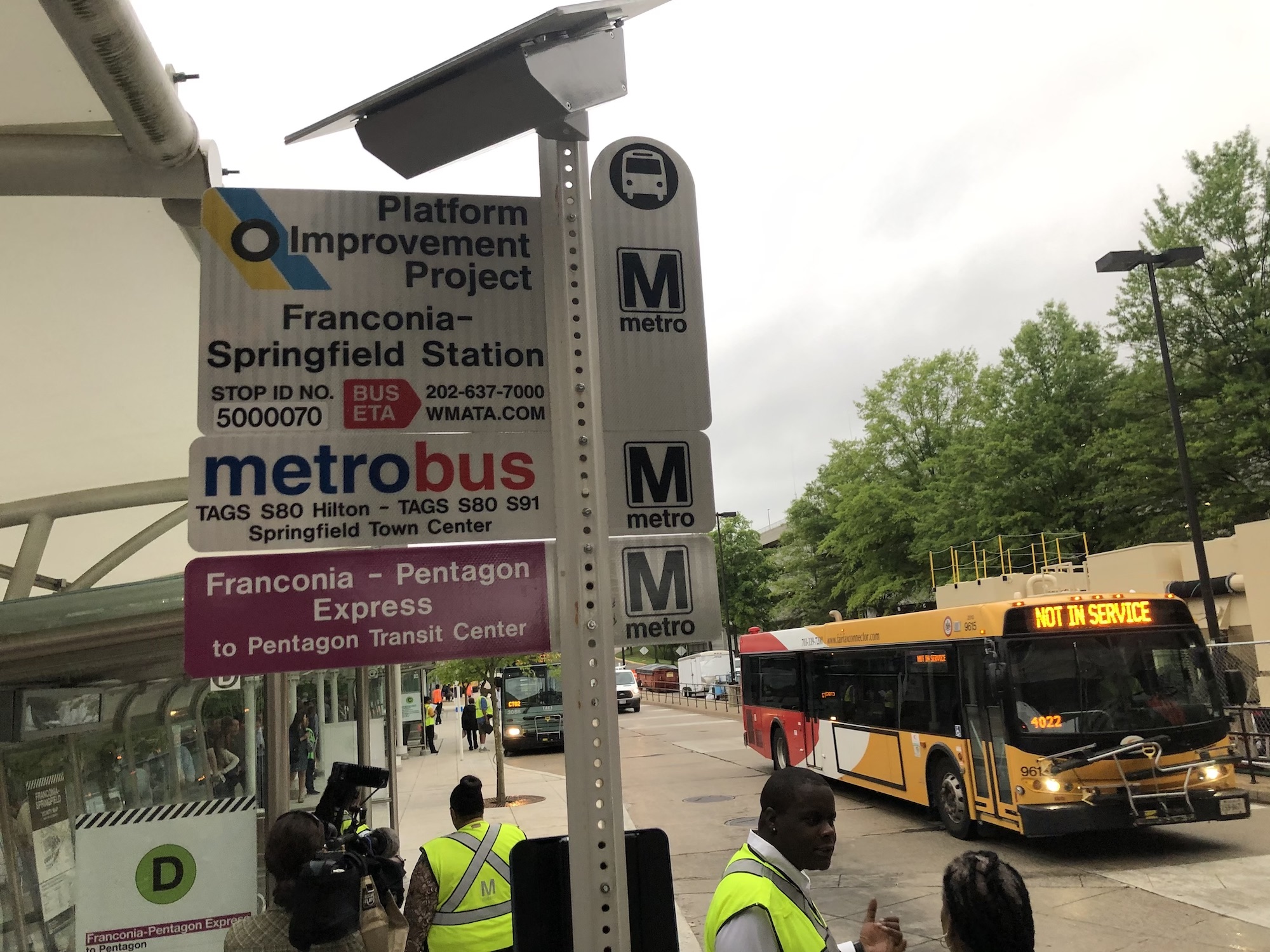
Plenty of signs dotted the Franconia-Springfield station to direct riders to shuttle buses.
Around the 7 a.m. hour Tuesday, the shuttle lines at the Franconia-Springfield station stretched to 100 people long at times. Sixty-seat shuttle buses showed up every four-to-five minutes, which helped the lines turn over fairly quickly.
Buses will run every five minutes during peak time and every 10 to 12 minutes during off-peak.
Metro General Manager Paul Wiedefeld got to Franconia-Springfield at 5:30 a.m. and stayed until about 8 a.m. to survey the situation. He said that every first day inevitably has issues. And, he noted that Metro serves more than just the 9-5 commuter.
“Obviously we have a big morning commute, but throughout the day it changes,” Wiedefeld said. “Reagan Airport has got a whole different schedule with people coming in at 7 p.m. and that’s going to be a totally different experience. So we will sort of see what we learned today and next few days, and we’ll keep adjusting along the way … maybe reallocate some resources. And we’ll be flexible.”
Wiedefeld said things usually get smoothed out in the first week or two. He was happy with the number of staff directing riders to where they needed to go. Signs pointing to shuttles, and other information, were plentiful.
The loading process went generally smoothly at Franconia-Springfield, and the express trip to Pentagon station took about 23 minutes.
Others reported the drivers didn’t know where they were going or didn’t take the HOV lanes. Many of the shuttle buses are coach buses with drivers contracted through different companies, like Academy Buses. Metro officials say they will re-emphasize that issue with drivers.
Randy Lilleston tweeted that his shuttle bus commute, which was supposed to go to the Pentagon, instead went into Maryland, then D.C. and ended up in Anacostia.
“In case you are wondering no this is not the intended route,” Lilleston wrote. “Almost everyone on the bus is remarkably chill which says something about expectations. Honestly not the worst thing in the world. And so the adventure ends.”
And while these are anecdotal cases, James Pizzuro of Rail Transit OPS, an independent organization that evaluates rail operations and performance, points out that Metro does not have real-time tracking on the shuttle buses, making it hard to judge the overall performance.
https://twitter.com/jamespizzurro/status/1133364165295394816
A Look At The Alternatives
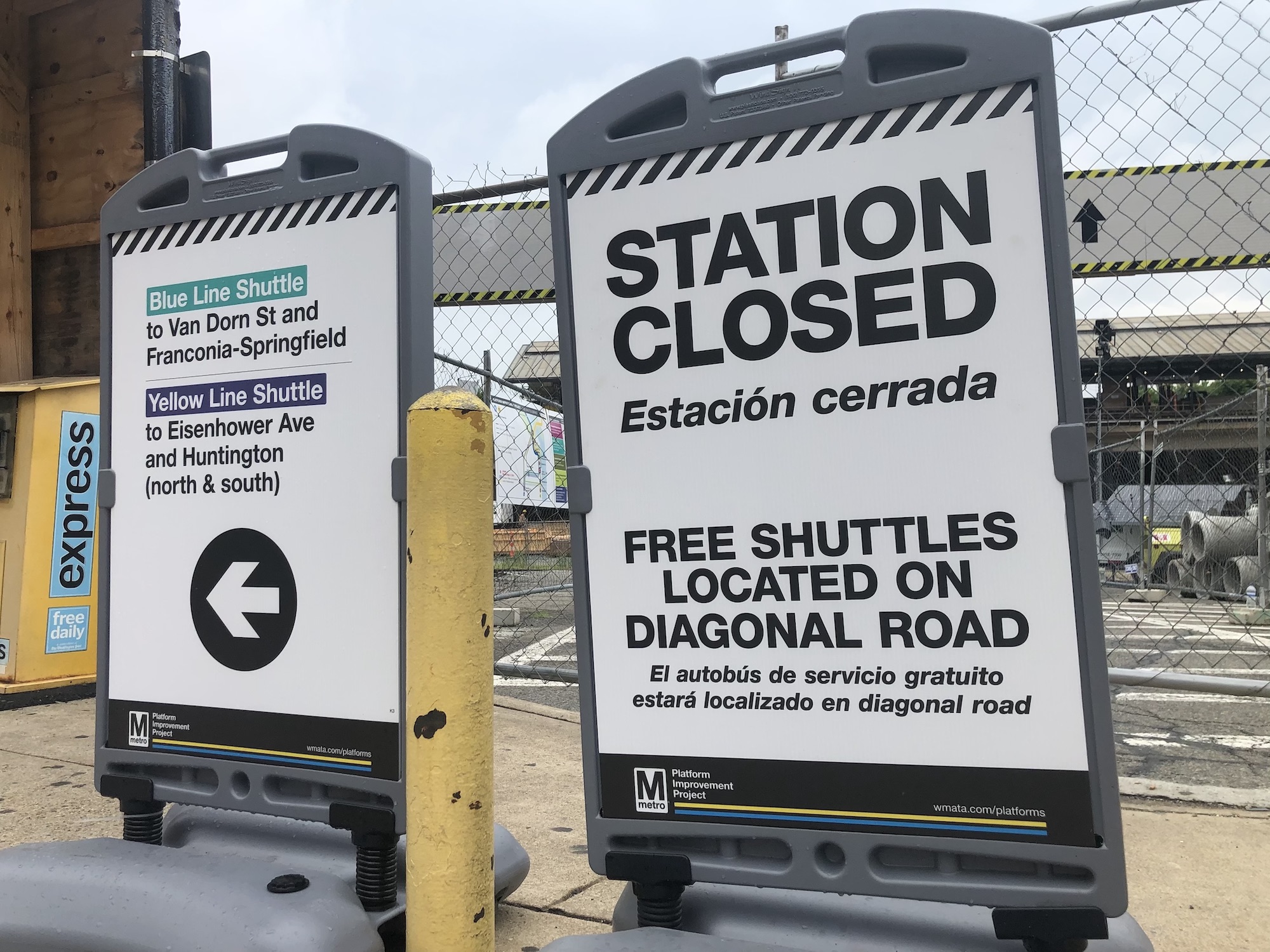
Signs at King St.-Old Town direct riders to other options.
Muggy weather and patchy rain didn’t stop several commuters from biking to their destinations. The bike community often touts how happy they are with their commute and weren’t afraid to rub it in.
Riders of the Alexandria-to-D.C. water taxis say there were about 10 people giving that option a try around 7:30 a.m. Slug lines were also a popular choice with some waits reported.
Some VRE Fredericksburg trains were delayed because of freight train congestion.

Metro is running multiple shuttles to help move the 17,000 riders.
This story originally appeared on WAMU.