 Eliza Tebo
It’s not officially summer for another 23 days, but you could easily argue it began today.
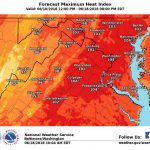
Mayor Muriel Bowser activated the city’s heat emergency plan for the first time this year, as temperatures reached the mid-90s with an expected heat index as high as 98 degrees. Those needing a place to cool off are advised to seek shelter in city libraries or recreation centers.
Hyperthemia is a risk for anyone in scorching temperatures but perhaps poses the greatest threat to D.C. residents without a home. As DCist reported last year:
“A person can become very confused. They can be sweating profusely. Their skin can go pale,” says Ger Skerrett, an outreach and engagement specialist at Miriam’s Kitchen. “In the later stage, when it becomes very dangerous, the sweating stops all together. If a person looks like they should be sweating and they’re not, that’s a very real sign that they’re experiencing a medical emergency.”
He says that a bystander shouldn’t hesitate to call for help.
“I would emphasize that hyperthermia is an emergency … it can kill. I would encourage people not to be afraid to call 911 if they see someone who is unconscious or if they appear to have heat stroke,” Skerrett advises.
For those without a cool place to go, cooling centers are available in a number of government buildings, and local residents can also gather more info about additional services by calling 311 or signing up for emergency alerts. Those in need of transportation can call the hyperthemia hotline at 202-399-7093.
Residents are also advised to reduce the risk of heat exposure by drinking lots of liquids, wearing light-colored clothing, and using sunscreen.
But, it seems, we’ll need to get used to this state of affairs. The number of days with temperatures above 95 degrees roughly doubled between 1970 and 2016 (to around 15), and it looks like it will keep going.
“By the year 2030, we could have 20 days out of the year in which temperatures exceed 95 degrees. By the year 2050, that number is projected to be around 40 days out of the year. And then by the end of the century about 80 days of the year,” said David Herring, with the climate program office of the National Oceanic and Atmospheric Administration, told WAMU last year. Researchers have set out to map D.C.’s (literal) hottest neighborhoods.
More resources about staying safe in the heat are available from the Homeland Security and Emergency Management Agency. And here’s a map of all the city’s cooling centers: