 Lori McCue
Mid-way through the opening number of the Cappies, I found myself wishing I had followed one event organizer’s advice and worn earplugs.
More than 2,400 high school students, parents, and supporters—all decked out in sparkling gowns and freshly-ironed suits (even a couple of tuxedos out there)—took turns shrieking as they saw friends parade out as nominees. The noise was deafening.
Now in its 20th year, the Cappies are basically the Tonys of local high school theater. There are trophies for lead and supporting actors and actresses, stage managers, ensembles, set designers, makeup artists, and other theater types. The winners are determined by student critics, who write reviews of the regional productions throughout the year.
Several parents had told me the Cappies were “theater kid prom.” To me, it felt like the Oscars meets a pep rally.
Like at the Tonys, the top-nominated productions perform snippets of their plays or musicals at the show. That meant the hallway outside the dress rehearsal space the day before looked like a flamboyant convention: Around every corner near the stage door, there were Mamma Mia! dancers clomping around in impossibly tall silver boots and sequined jumpsuits, Rock of Ages rockers adjusting their miniskirts or mullets, and what felt like hundreds of Mary Poppins chimney sweeps covered in soot and wielding prop brooms made from PVC pipe and pipe cleaners.
“These are kids who have reached a level of commitment and expertise, so they are very focused on the goal,” says Chip Rome, the gala’s director of 15 years, before the five(!)-hour rehearsal. Nearby, the student orchestra warms up for the opening number: “Come On, Get Cappies.” (You can probably guess the tune.) “It’s really fun to see all the pieces come together.”

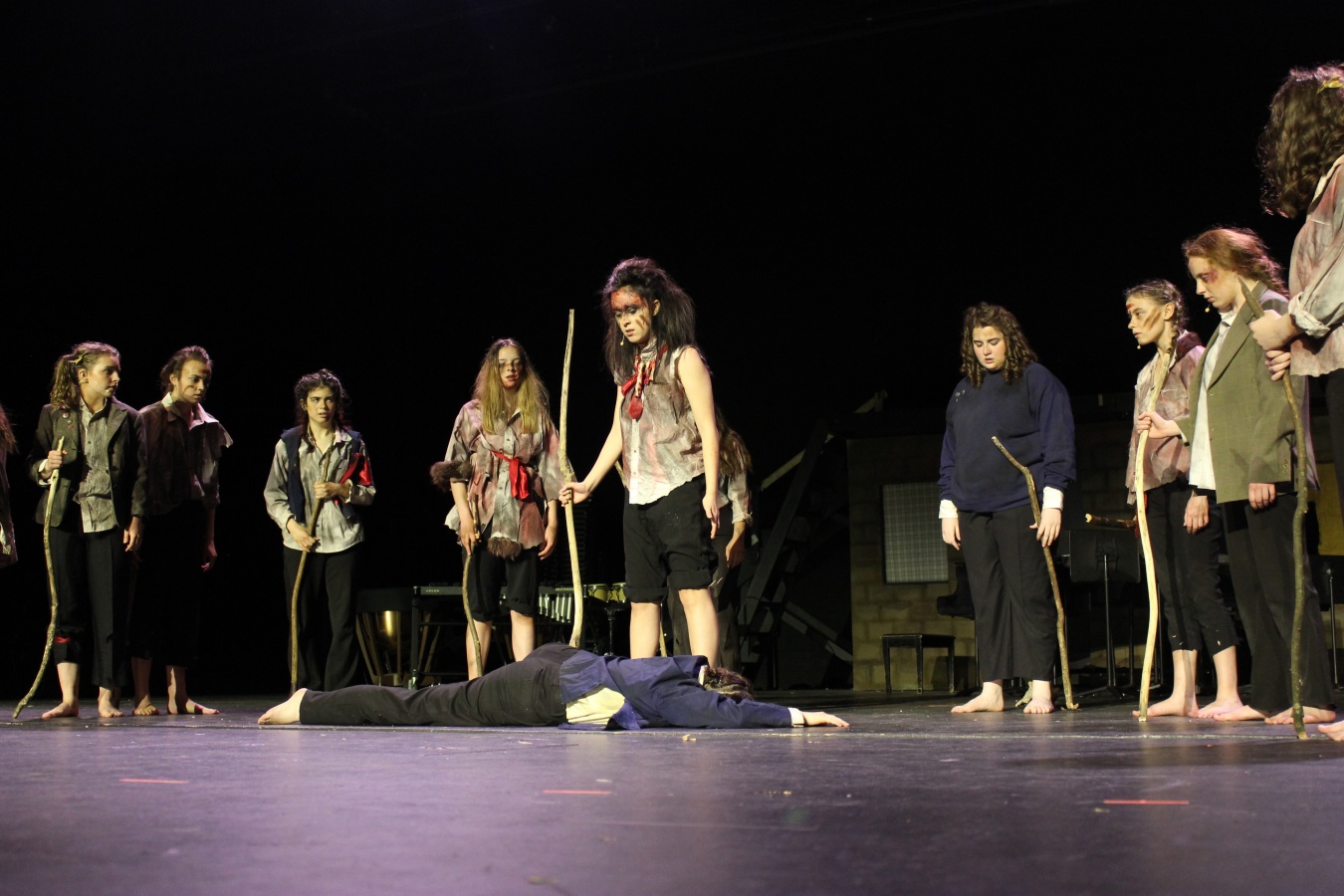
Among the students tasked with making sense of all those pieces is Phoebe Kirk, a senior at McLean High School. She’s one of the six stage managers meant to shepherd performers to their exits and entrances throughout the night (Her sharp whisper commanding the actors to “goupstageupstageNOTDOWNSTAGEupstage” as they scurry to the wings is very effective.) She’s also part of the team that makes sure the myriad props—like the (fake!) pig carcass filled with (fake!) blood used by the actresses in Lord of the Flies—doesn’t leave a mess.
The Cappies—and stage managing in general—have helped her find her voice. “There can be a lot of error in live theater, and sometimes people don’t speak up,” she tells me during a break in rehearsal. “I definitely can’t just sit there and not speak my mind anymore.”
Lizzy Lawrence, a senior at Robinson Secondary School in Fairfax, remembers her first time performing at the Cappies two years ago. “The audience is so large from what I’m used to,” she says after her group’s rehearsal (she’s one of the chimney sweeps). “It was so breathtaking. After, I was like, ‘This is what makes it worth it.’” (For the record, it’s not just theater kid nerdery that makes the Kennedy Center experience so exciting: I’ve seen Alan Cumming, Gillian Welch, and Solange gush over getting to perform on that same stage.)
When the Cappies began in 1999, primarily as a project of Fairfax County Public Schools, it was held at Hayfield, and 18 schools participated. Still, “it was magical,” says Judy Bowns, who co-founded the Cappies alongside Bill Strauss (one of the co-founders of the Capitol Steps).
The next year, at the suggestion of FCPS’ then-superintendent, the ceremony moved to the Kennedy Center, where it’s grown ever since. (The venue is provided free of charge through the Kennedy Center’s education programming.) The program is funded mostly by the ticket sales from previous Cappies and membership fees paid by each school (it’s $450 for each theater department and $15 for each student critic), as well as by local arts grants.
Since launching 20 years ago—that’s 10 years before the glitzy, nationally recognized National High School Musical Theatre Awards—the Cappies has produced graduates that have gone on to pursue the arts professionally. Kevin Clay, an actor in the Broadway and touring companies of The Book of Mormon, is a former Cappies winner and graduate of Westfield High School in Chantilly, and is held up often as an example. The Cappies program has also expanded beyond the D.C. area: There are now nine chapters in the United States and an additional three in Canada.
Of the 60 schools on the nominees list, Virginia teams were the clear frontrunners. Rock of Ages, from Westfield High School in Chantilly, picked up eight awards (including best musical) the most of any production.
While the Duke Ellington School of the Arts didn’t perform its nominated play The Laramie Project, the school did pick up three trophies, whose winners made the most politically charged statements of the night: Jada E. Gainer, who picked up best featured actress, mentioned “the martyrs of the movement,” including Matthew Shepard (the subject of Laramie Project), Trayvon Martin, and Marsha P. Johnson. Evelyn Jane Wohlbier, winner for best supporting actress, ended her speech by demanding that the country’s citizens “own their mistakes and go out and vote in 2020,” then proudly declared she was bisexual, to thunderous applause.
Others made jokes: Kristen Waagner from McLean High School, accepting her first of three trophies, this time for criticism, noted the fact that she was in costume ahead of her excerpt from Lord of the Flies, shirt and pants torn, her forehead painted with fake blood, and hair teased and studded with twigs. “As you can see, I dress to impress,” she said. (It killed.)
After this gala, the students who are graduating are all scattering: Waagner is entering Northwestern University’s theater program, where she hopes to focus on directing. Lawrence, of Robinson Secondary, is headed to Randolph-Macon College in Ashland to pursue ministry. “So I’ll still be on a stage, just a little different,” she says.
Kirk, the stage manager, meanwhile, will start at Virginia Commonwealth University in the fall to study physical therapy. She still wants to continue participating in theater on the side. “I like the high-pressure stakes” of being a stage manager, she says.
Rome, the director, isn’t particularly concerned about how many of his students become stars. “I think it doesn’t matter because some of them will play in their community theater shows,” he says. “Yes, some will go professional. Many will stay active, even though they might have to get a day job to pay the rent. Many or most of them will become an active audience participants for the rest of their lives.”
After the house lights come back up and the curtain rises, the students take a while to disperse. For many of these students, it’s their last time seeing each other before heading off to college. But eventually the Kennedy Center’s halls clear out, and the newly-minted winners head home. It is a school night, after all.