Is it time to rebrand “East of the River”?
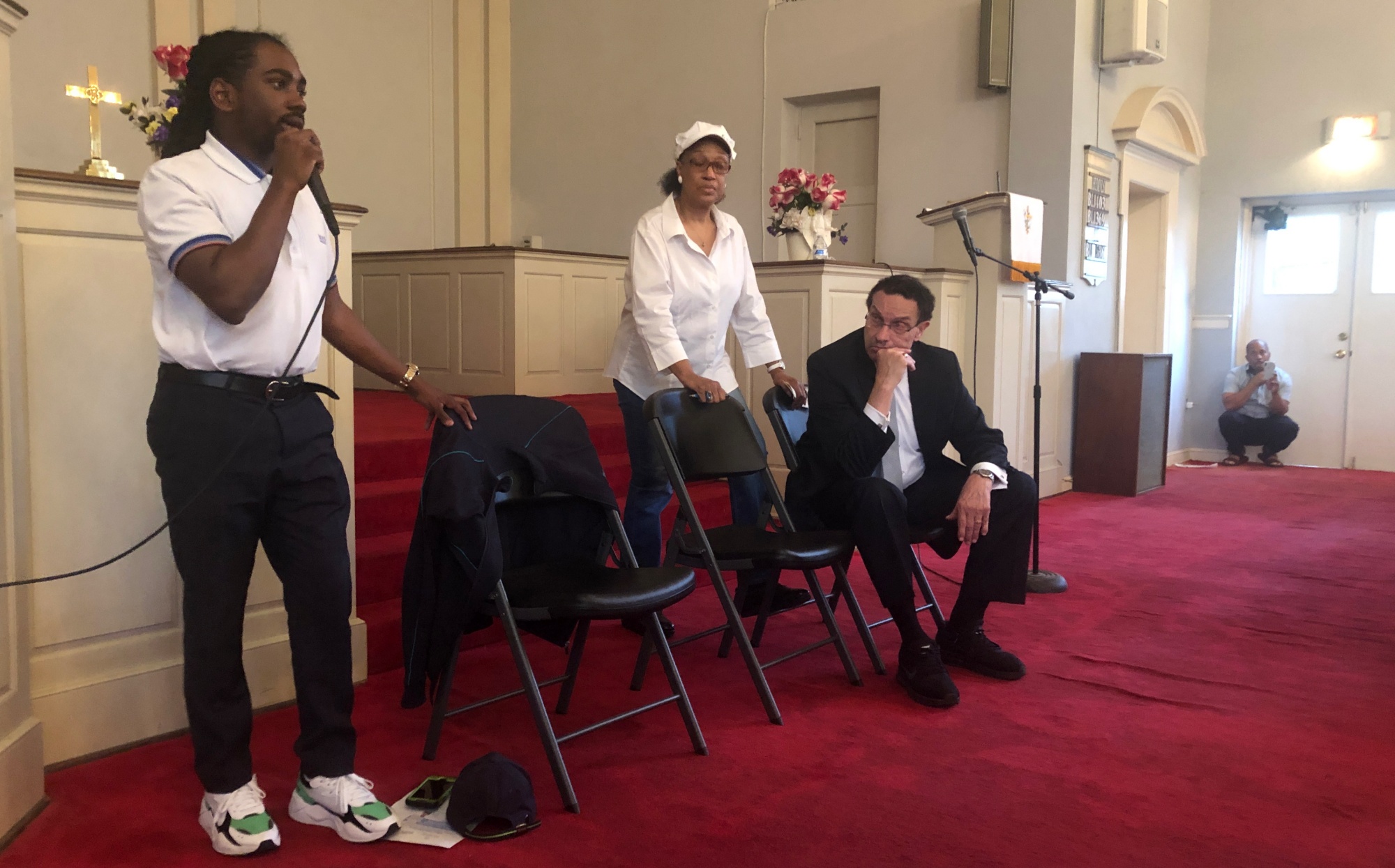
That was the central question of a community meeting in Fairlawn on Wednesday evening, where D.C. Councilmembers Vincent Gray and Trayon White, who represent Wards 7 and 8 respectively, and roughly three dozen residents took up the simmering issue of whether the moniker—an unofficial name for neighborhoods nestled just east of the Anacostia—needs a rethink.
Councilmember Gray broached the subject in 2017, when he said he’d stopped using the term “East of the River” because it had been tainted by connotations of poverty, crime, and economic stagnancy. The ex-mayor, who lives in Hillcrest, said he favored the name “East End.”
But several residents who spoke during the forum at Garden Memorial Presbyterian Church went beyond a debate over branding, instead raising larger questions of why “East of the River” has come to signify what it does, and whether a name change—official or not—would do anything to address real challenges facing residents of Wards 7 and 8.
Nearly 27 percent of Ward 7’s population lives below the poverty line, according to Census data. In Ward 8, it’s almost 36 percent. Neighborhoods east of the Anacostia also bear the brunt of gun violence in the District, with the area rocked by shootings over Memorial Day weekend.
“I don’t necessarily think renaming our communities brings about the progressive change that we actually need,” said Mysiki Valentine, who lives in River Terrace. “I think when people start seeing East of the River growing, developing, and changing in the way that the people who live there want it to be, then the connotations will go away on its own.”
The subject of development came up multiple times, as some attendees insinuated that Gray’s promotion of “East End” is a thinly veiled attempt to market Wards 7 and 8 to the private sector.
“I don’t see that there is a negative connotation with my neighbors about the neighborhoods that we live in,” said Jo Knight, who moved to historic Anacostia from Arlington two years ago. “Who are we trying to change that connotation for? And my sense is, the developers.”
As neighborhoods across the District have been renamed to usher in new investment—think of booming Capitol Riverfront (formerly Navy Yard), North End Shaw (formerly Shaw) and NoMa (formerly… Swampoodle?)—it wasn’t lost on any speakers Wednesday night that rebranding efforts often accompany spikes in property values and uprooting of lower-income residents.
A recent study found that compared to other gentrifying cities across the U.S., the District has an unusually high rate of displacement.
“There are people who have stood [here] for the test of time, and they’re glad to see things turn around, but they don’t want to be erased out of history,” said Emil Smith, a Penn Branch resident. “Changing a name is a way of erasing these people out of history.”
Councilmember Gray has inserted “East End” into legislation and put it on his official Council website. But he softened his stance on the name Wednesday, largely agreeing with residents who urged him and Councilmember White to focus on quality-of-life issues in their wards instead of what to call them.
“Whether we change the name or not is irrelevant to me,” Gray said. “The real issue is what we do about the dynamics that we live with every day.”
Wednesday’s conversation was convened by Rev. Anthony Motley, a longtime faith leader and native of Southeast D.C. He says he plans to hold “a series of dialogues” loosely based on the debate over “East of the River,” but he wants to focus more on the region’s history. Future meetings, Motley says, will include appearances from D.C. historian Carroll “C.R.” Gibbs and Chocolate City co-author Derek Musgrove.
“We’re going to bring in some historians and some sociologists … [so] we can flesh out what is in the meaning of a word or a term or a name,” Motley said. “This is about identity, cultural pride, hope, and fairness.”
But for the record, Motley says, he prefers “East of the River” over “East End.”
This story originally appeared on WAMU.