Martin Austermuhle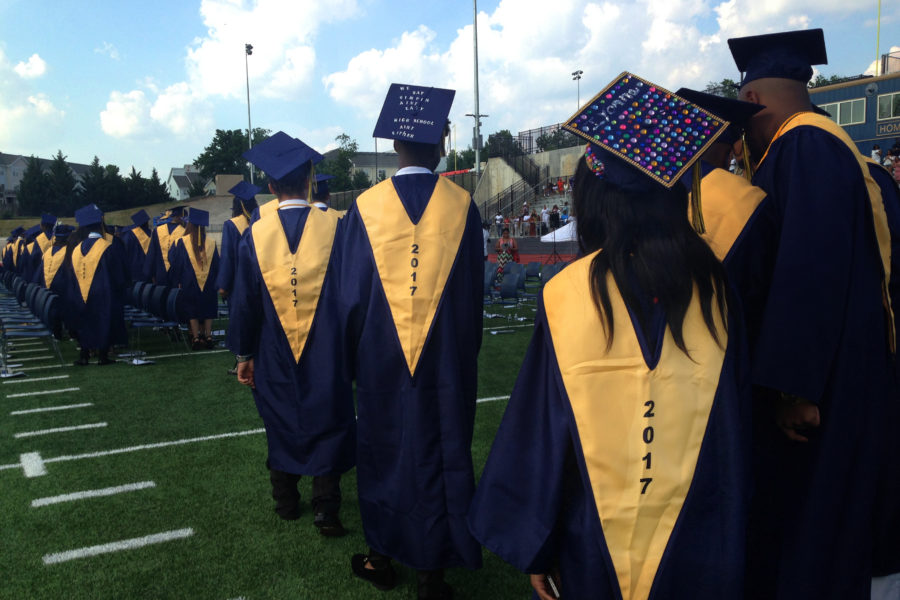
In late 2017, WAMU broke the story that dozens of students at Ballou High School had been allowed to graduate despite high rates of unexcused absences, violating the city’s graduation requirements.
Now, a report from D.C. Inspector General Daniel Lucas puts new numbers to the practice: more than half of the 178 students who graduated from Ballou that year were allowed to pass classes despite having logged more than 30 unexcused absences, the threshold set by the city for when a student should fail.
The report also says that dozens of students were improperly enrolled in credit-recovery classes, students who were absent more than five time did not always get the required support from teachers and administrators, and that school administrators failed to properly keep track of the 100 hours of community service each student in D.C. Public Schools is supposed to complete as a condition for graduation.
“Because DCPS and Ballou failed to adhere to grading, attendance, and community service requirements, some Ballou Class of 2017 graduates may be left unprepared for success in college, career, and life,” says the report. “We found that DCPS and Ballou administrators placed greater value on graduation rates than on meeting the minimum graduation requirements.”
The inspector general’s report—which was requested by Mayor Muriel Bowser—is the last in a long line of critical internal audits and analyses of how D.C. allowed students to graduate despite not having met the stated requirements for getting a diploma.
An audit commissioned by the Office of the State Superintendent for Education and published in early 2018 found that the problem extended beyond Ballou, and that in 2017, one-third of DCPS graduates got their diplomas despite not having met grading or attendance requirements. The city responded by tightening up graduation requirements—so much so that in 2018, the city’s graduation rates dropped by 4.6%.
The report finds that 158 of the 178 students who graduated from Ballou in 2017 got passing term grades despite having 10 unexcused absences, which according to city policy should have gotten them a grade of “FA”—failure due to absences. Ninety-six students were allowed to pass, despite having more than 30 absences.
School administrators did not properly use software to track attendance, and did not follow or enforce grading requirements.
“During interviews, Ballou teachers stated they felt school administrators required them to provide make-up work in an effort to boost student achievement,” says the report. “They also stated that students came to them at the direction of Ballou administrators to obtain make-up work, regardless of how many unexcused absences students had incurred or how much work students missed.”
The report makes 25 recommendations for changes—all of which DCPS officials say they are implementing or already implemented.
“DCPS took a hard look in the mirror when the problems at Ballou came to light,” wrote DCPS Chancellor Lewis Ferebee, who was not in the job in 2017, in a response to the inspector general’s report. “Graduation a key indicator for our students’ future successes … but we recognize graduation cannot be achieved through short-cuts.”
This story originally appeared on WAMU.