Jacob Fenston
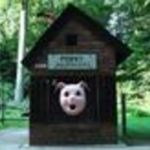
By a parking lot off of Beach Drive in Rock Creek Park, there is a small unassuming building. You might mistake it for a restroom from afar. On a map, you’ll see the name Miller Cabin, but there are no signs or interpretive displays nearby.
It’s a log cabin, built in 1883 by eccentric poet Joaquin Miller, known as “the Poet of the Sierras.” Now, the National Park Service has approved a plan to relocate the cabin, currently precariously situated in Rock Creek’s floodplain. Depending on future funding, the cabin may also be renovated so it could be open to the public.
This move would not be the first for the cabin. Miller originally built the structure on high ground across the street from what is now Meridian Hill Park. Back in the late 19th century, this was forested land, beyond the edge of the federal city (which ended just south of the hill, at Boundary Street, now Florida Avenue). Miller moved to Washington after making his name with the book of poems, “Songs of the Sierras.” But he had trouble finding affordable housing in the booming city.
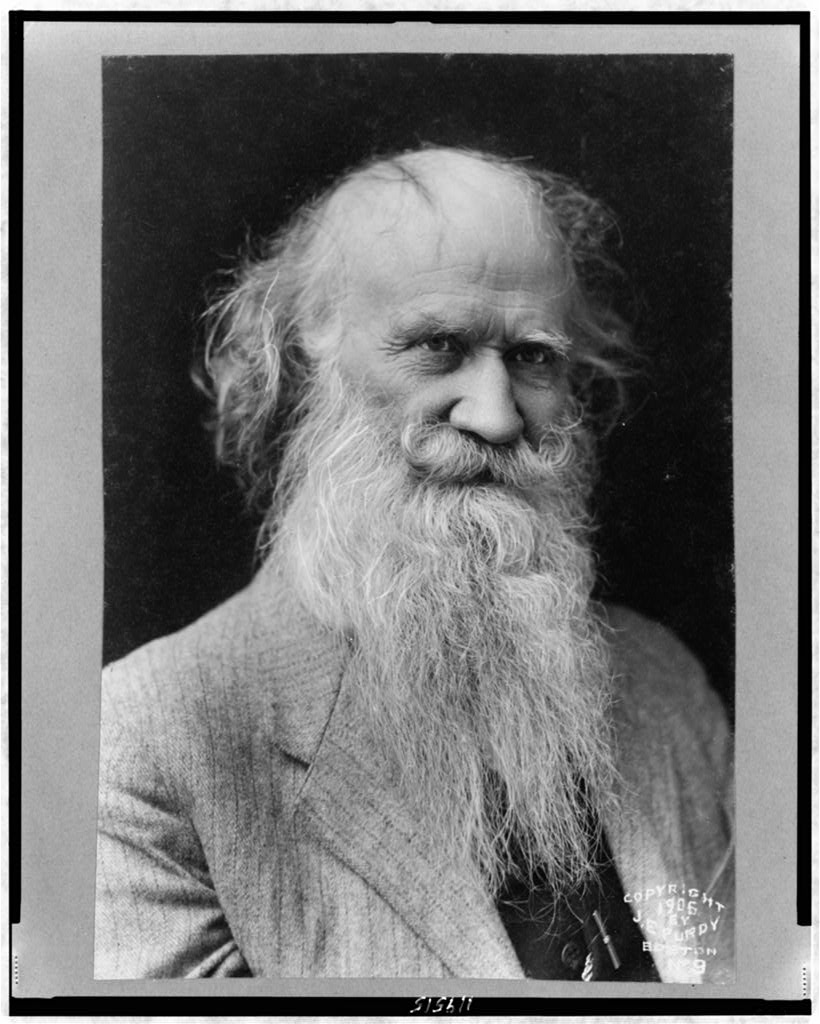
“The Poet of the Sierras,” Joaquin Miller, circa 1906, about a decade after leaving Washington.
Miller climbed the hill at what was then the end of 16th Street Northwest, and chose that spot to build his rustic retreat. He modeled the cabin off one he had lived in previously — in the mountains of Shasta County in Northern California.
When Miller left Washington and moved back to California, he built yet another cabin — this time in the hills above Oakland. The cabin in D.C. was rented out for a few years, but by 1910, it was standing in the way as development crept up the hill.
The cabin was saved by the intervention of powerful Californians and relocated. According the the National Park Service’s official history, the cabin was “an unwanted addition to the park.” The California State Association — a group of California expats in D.C. — wanted to donate the cabin to the park, but officials refused. Finally, one of the state’s senators pulled some strings, and park officials relented, offering an out-of-the-way spot next to the creek.
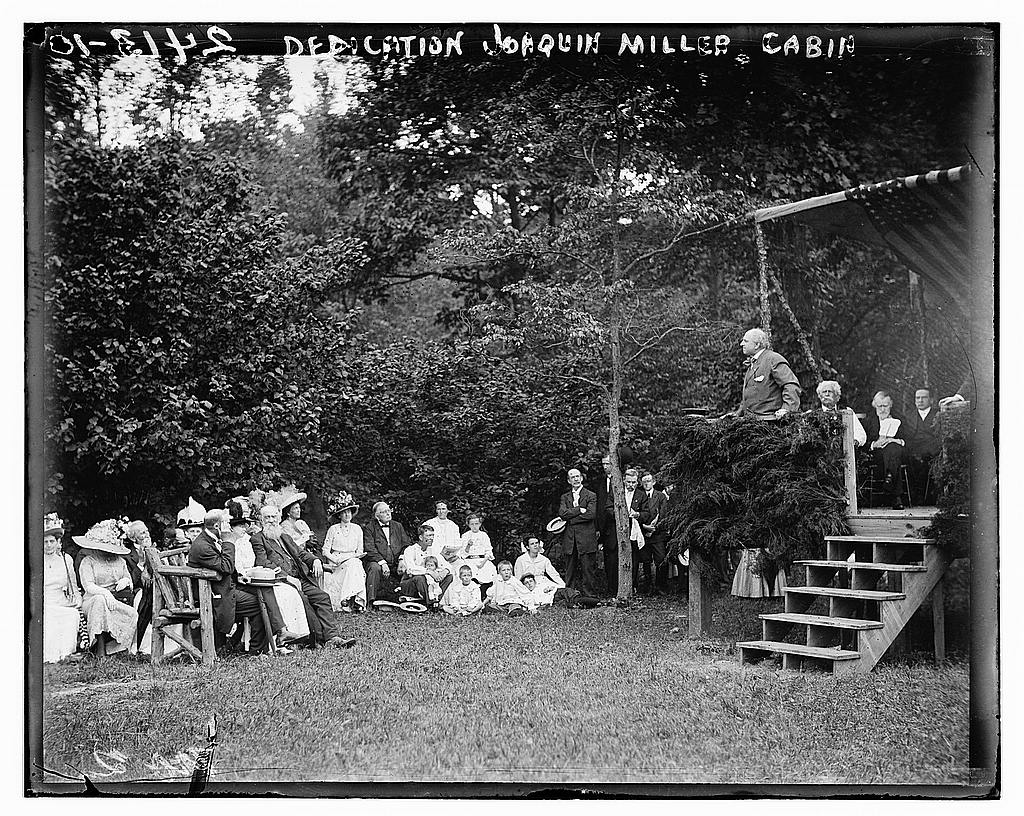
The dedication of the Miller Cabin after it was moved to Rock Creek Park, sometime between 1910 and 1915.
The cabin was carefully disassembled and rebuilt in its new location. Starting in 1931, it was leased to Miller’s niece, “who conducted art classes and sold candy and soft drinks there until the mid-1950s,” according to the official park history.
The cabin found a new use in 1976, when a group of local poets started holding candlelit poetry workshops in the cabin.
“Nobody had been using it for a lot of years,” says Karren Alenier, one of the poets in the group, called The Word Works. “They gave us a key to the place, and we went in and we tidied it up a little bit.”

One of the early poetry readings outside the Miller Cabin.
Two years later, in 1978, the workshops became a summer reading series, led by Alenier. It was called “The Joaquin Miller Cabin Poetry Series.” The readings quickly outgrew the small interior — which could only hold a dozen or so people — so they were held on the lawn outside the cabin. In 2011, the series moved to the nearby Rock Creek Park Nature Center. The series continues to this day, although the word “cabin” was dropped from the name (the reading series is happening this year on Sunday afternoons throughout June and July).
Alenier says the poets drew inspiration from Miller, but not necessarily from his words.
“I can’t say that we loved his work,” Alenier admits. “We loved the idea that there was a poet that built this cabin.”
The National Park Service now has a plan to update the 1960s-era Nature Center, and at the same time, relocate the Miller Cabin. The plan calls for placing the cabin at Picnic Grove 14, near the intersection of Military Road and Oregon Avenue.
“We would like to get the cabin out of the floodplain of Rock Creek, and put it in a place where a lot of people could access it,” says park ranger Dana Dierkes. She says planning is still at the initial stage, so there is still no timeline or funding.
Alenier looks forward to the possibly relocated and restored cabin.
“Since the cabin itself has a history of moving, I think it’s a cool idea,” she says.
As for the cabin’s current, derelict state: “I think that’s a crime, because it is a historic site,” says Alenier. “It would be a crying shame for it to fall down because termites are eating it.”